Department of Space: ISRO Missions and Space Achievements

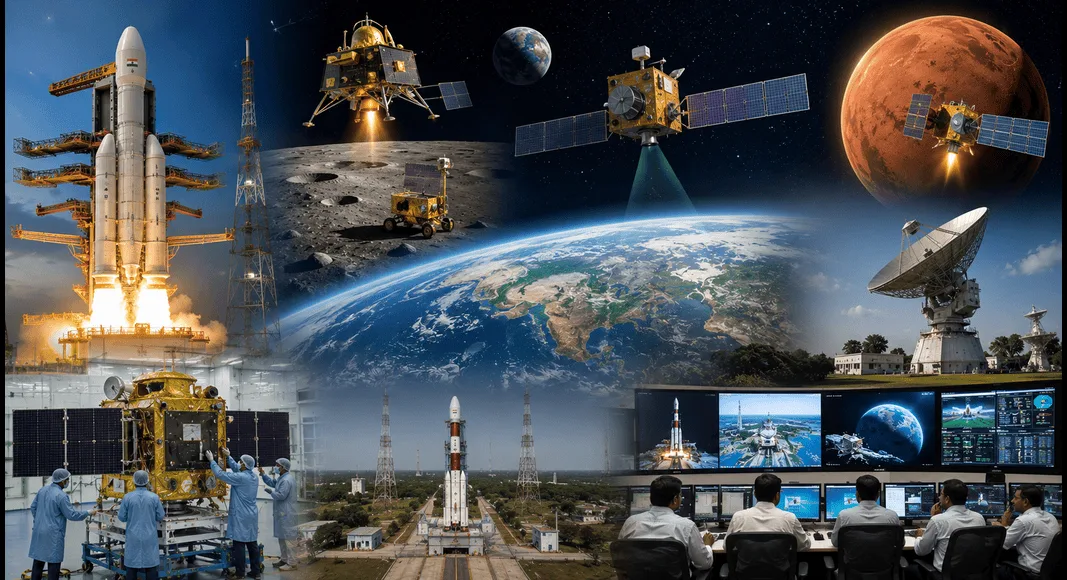
The Department of Space marked another remarkable year for India’s space programme. The Indian Space Research Organisation (ISRO) successfully launched several important satellites, celebrated milestones in planetary exploration, strengthened space education, and prepared for India’s first human spaceflight mission. From Chandrayaan-2 and Cartosat-3 to NavIC and Gaganyaan, 2019 demonstrated India’s growing strength in space technology.
Thank you for reading this post, don't forget to subscribe!The Department of Space is responsible for planning and implementing India’s space programmes. Through ISRO, it develops satellites, launch vehicles, communication systems, navigation services, and scientific missions that benefit millions of people. These technologies support weather forecasting, disaster management, agriculture, communication, defence, education, navigation, and scientific research.
What is the Department of Space?
The Department of Space (DoS) is a Government of India department that manages the country’s space programme. It works mainly through the Indian Space Research Organisation (ISRO).
Its major responsibilities include:
- Satellite development
- Rocket launches
- Space exploration
- Earth observation
- Communication satellites
- Navigation systems
- Scientific research
- International cooperation in space
India’s space programme has become one of the most cost-effective and successful programmes in the world.
UNNATI Programme
One of the important international initiatives of ISRO is the UNISPACE Nanosatellite Assembly and Training (UNNATI) programme.
UNNATI is designed to help engineers and scientists from developing countries learn how to build nanosatellites.
Objectives
The programme aims to:
- Build technical skills.
- Promote international cooperation.
- Share India’s space expertise.
- Encourage peaceful use of outer space.
Through this programme, India contributes to global capacity building in space technology.
YUVIKA Programme
The Yuva Vigyani Karyakram (YUVIKA) is a special programme for school students.

It introduces young students to:
- Space science
- Rocket technology
- Satellite applications
- Astronomy
- Scientific research
Students visit ISRO centres, interact with scientists, and perform simple experiments.
The programme encourages students to choose careers in science and engineering.
Microsat-R and Kalamsat-V2
In January 2019, ISRO successfully launched PSLV-C44 carrying two satellites.
Microsat-R
Microsat-R is a military imaging satellite.
Its applications include:
- Border surveillance
- Strategic observation
- National security
- Disaster monitoring
Kalamsat-V2
Kalamsat-V2 became one of the world’s lightest communication satellites.
Developed by students, it demonstrated how young innovators can contribute to India’s growing space sector.
EMISAT Mission
In April 2019, ISRO launched EMISAT aboard PSLV-C45.
EMISAT was developed for the Defence Research and Development Organisation (DRDO).
Purpose
The satellite measures electromagnetic signals.
Its data helps in:
- Electronic intelligence
- Defence planning
- Monitoring communication systems
- National security
RISAT-2B
RISAT-2B is a radar imaging Earth observation satellite.
Unlike ordinary cameras, radar imaging satellites can capture images:
- During day and night
- Through clouds
- During rainfall
- In bad weather
These capabilities make RISAT-2B extremely useful.
Applications
The satellite supports:
- Agriculture
- Disaster management
- Border surveillance
- Forest monitoring
- Flood assessment
GSLV Mk III M1
One of the biggest achievements of 2019 was the successful launch of GSLV Mk III M1, India’s most powerful rocket at the time.
The rocket consists of:
- Two solid boosters
- One liquid core stage
- One cryogenic upper stage
Its higher carrying capacity allows India to launch heavier satellites.
Most importantly, it carried Chandrayaan-2 towards the Moon.
Chandrayaan-2 Mission
Chandrayaan-2 became India’s second lunar mission.
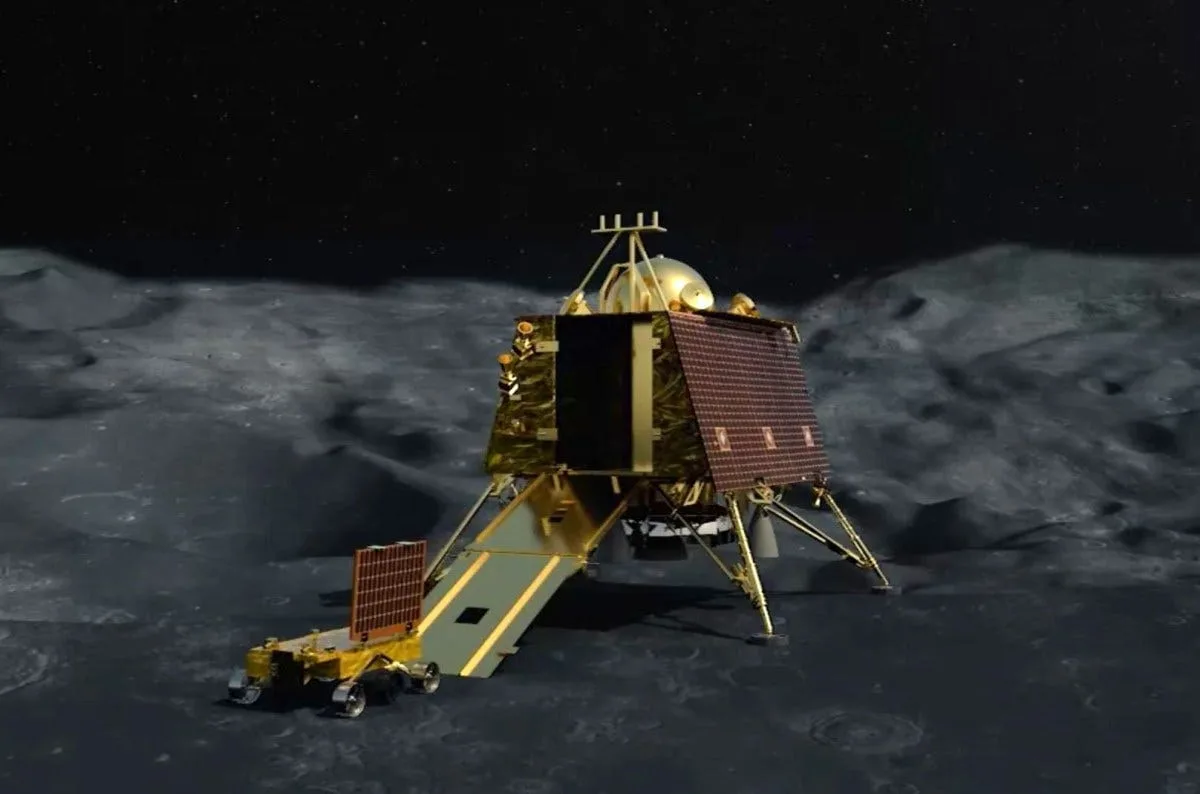
The mission consisted of:
- Orbiter
- Lander (Vikram)
- Rover (Pragyan)
Although the lander experienced a hard landing, the Orbiter continues to function successfully and has provided valuable scientific data on the Moon.
The mission greatly expanded India’s lunar research capabilities.
Cartosat-3
In November 2019, ISRO launched Cartosat-3.
It is one of India’s highest-resolution Earth observation satellites.
Uses
Cartosat-3 helps in:
- Urban planning
- Infrastructure development
- Smart city planning
- Disaster management
- Road and railway mapping
- Defence applications
Its advanced cameras can capture highly detailed images of Earth’s surface.
What is Remote Sensing?
Remote sensing means collecting information about Earth’s surface without physically touching it.
Satellites collect data using cameras and sensors.
Remote sensing helps in:
- Agriculture
- Forest management
- Water resources
- Mineral exploration
- Climate studies
- Disaster response
India is one of the world’s leading users of remote sensing satellites.
Mars Orbiter Mission (Mangalyaan)
India’s first Mars mission, Mars Orbiter Mission (MOM), completed five successful years in Mars orbit in 2019.
Also known as Mangalyaan, it was launched in 2013 and entered Mars orbit in 2014.
The mission became famous because:
- India reached Mars on its first attempt.
- It was one of the world’s most economical Mars missions.
- It demonstrated India’s advanced engineering capabilities.
Although communication with the spacecraft ended in 2022, the mission exceeded its planned life by many years.
AstroSat
India’s first dedicated space observatory, AstroSat, completed four years in orbit during 2019.
Unlike ordinary satellites, AstroSat studies:
- Stars
- Galaxies
- Black holes
- Neutron stars
- X-rays
- Ultraviolet radiation
Its ability to observe multiple wavelengths simultaneously makes it a valuable scientific mission.
AstroSat continues to support astronomical research worldwide.
NavIC Navigation System
One of the major achievements in 2019 was the approval of NavIC by the global mobile standards organization 3GPP.
NavIC stands for Navigation with Indian Constellation.
It is India’s own regional satellite navigation system.
Benefits
NavIC provides:
- Accurate navigation
- Vehicle tracking
- Marine navigation
- Disaster alerts
- Location-based services
Since 2019, NavIC support has gradually expanded into smartphones, vehicles, and other navigation devices.
Human Space Flight Centre
ISRO established the Human Space Flight Centre (HSFC) to lead the Gaganyaan Mission.
The centre is responsible for:
- Astronaut training
- Spacecraft development
- Crew safety
- Mission planning
Gaganyaan Mission
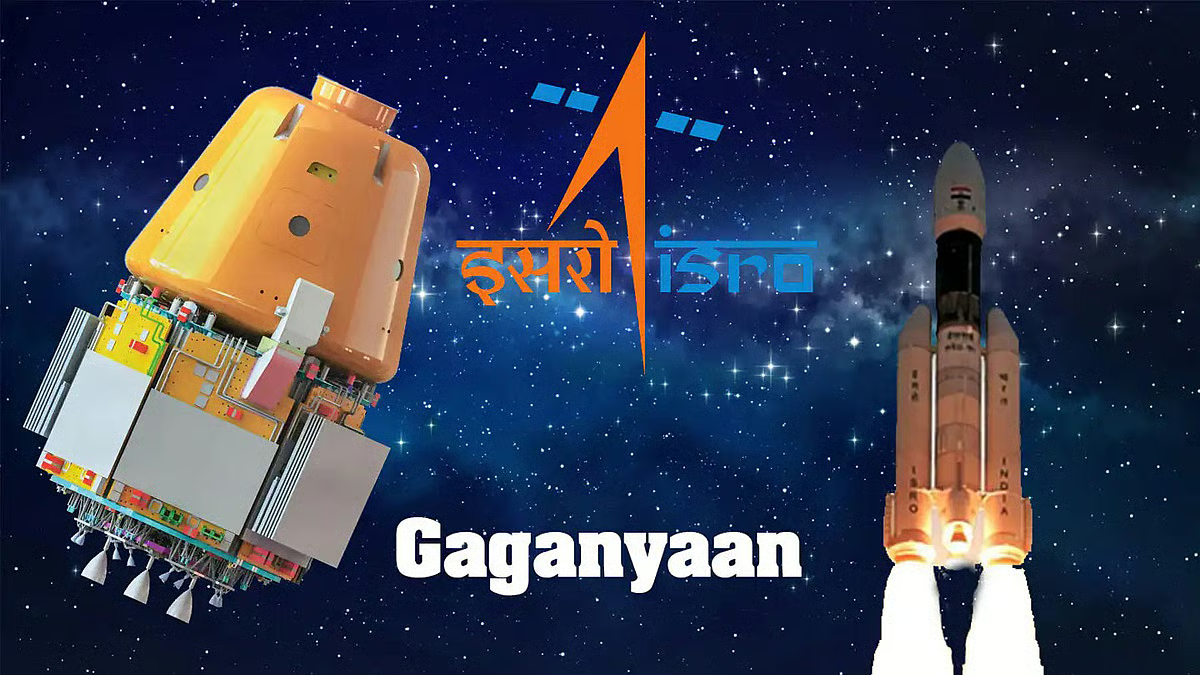
The Gaganyaan programme aims to send Indian astronauts into Low Earth Orbit for several days before safely bringing them back to Earth.
After several successful test missions and crew escape tests, India’s first crewed mission is now targeted for the coming years following extensive preparations through 2025.
The programme represents a major step in India’s space journey.
Lithium-Ion Battery Technology
ISRO transferred its Lithium-Ion battery technology to Indian industries in 2019.
Lithium-Ion batteries are widely used in:
- Electric vehicles
- Mobile phones
- Laptops
- Satellites
- Defence equipment
- Aerospace systems
This technology transfer supports the “Make in India” initiative by encouraging domestic manufacturing.
National Mission on Transformative Mobility
The Government launched the National Mission on Transformative Mobility and Battery Storage.
The mission promotes:
- Electric vehicles
- Battery manufacturing
- Clean transportation
- Sustainable mobility
- Local manufacturing
Its objective is to reduce pollution while strengthening India’s battery industry.
Wasteland Atlas 2019
The Department of Land Resources and ISRO jointly released the Wasteland Atlas 2019.
The atlas uses satellite images to identify unproductive land across India.
Importance
The atlas helps governments:
- Restore degraded land.
- Improve agriculture.
- Plan afforestation.
- Reduce desertification.
- Support sustainable development.
Satellite mapping has made land-use planning much more accurate.
Developments After 2019 (2020-2025)
India’s space programme continued to grow rapidly after 2019.
Chandrayaan-3 Success
In August 2023, Chandrayaan-3 successfully landed near the Moon’s south pole, making India the first country to achieve this feat and the fourth nation to perform a successful soft landing on the Moon.
Aditya-L1 Mission
In 2023, ISRO launched Aditya-L1, India’s first mission dedicated to studying the Sun. The spacecraft reached the L1 Lagrange point in 2024 and is now observing solar activity.
XPoSat
In 2024, ISRO launched XPoSat, India’s first X-ray Polarimeter Satellite, to study black holes, neutron stars, and other high-energy cosmic objects.
SpaDeX Mission
In 2024–25, ISRO advanced the SpaDeX (Space Docking Experiment) programme, demonstrating technologies required for future space stations and advanced missions.
Gaganyaan Progress
By 2025, ISRO successfully completed major test vehicle missions, crew escape demonstrations, and astronaut training, bringing India closer to its first human spaceflight.
Private Space Sector
Following the creation of IN-SPACe and policy reforms, private Indian companies have become increasingly involved in satellite manufacturing, launch services, and space innovation.
Why Space Technology Matters
Space technology improves everyday life in many ways.
It helps in:
- Weather forecasting
- GPS navigation
- Internet and communication
- Television broadcasting
- Disaster management
- Agriculture
- Fisheries
- National security
- Environmental monitoring
Many services people use daily depend on satellites.
Conclusion
The Department of Space showcased India’s remarkable achievements in satellite launches, space exploration, navigation technology, Earth observation, and scientific research. Missions such as Chandrayaan-2, Cartosat-3, EMISAT, RISAT-2B, and the continued success of Mangalyaan and AstroSat demonstrated ISRO’s growing technological capabilities.
Since then, India has achieved even greater milestones, including the historic success of Chandrayaan-3, the launch of Aditya-L1, advances in Gaganyaan, and the rapid growth of the private space sector. These achievements have strengthened India’s position as a leading space-faring nation.
With continued investment in research, innovation, and international cooperation, the Department of Space is playing a vital role in advancing science, supporting national development, improving everyday life, and inspiring the next generation of scientists and engineers.
FAQs
1. What were the major achievements of ISRO in 2019?
ISRO achieved several milestones in 2019, including the launch of Chandrayaan-2, Cartosat-3, EMISAT, RISAT-2B, Microsat-R, and Kalamsat-V2. It also celebrated the success of the Mars Orbiter Mission and AstroSat.
2. What is the UNNATI programme?
UNNATI (UNISPACE Nanosatellite Assembly and Training) is an ISRO capacity-building programme that trains participants from developing countries in nanosatellite development and space technology.
3. What is YUVIKA?
YUVIKA (Yuva Vigyani Karyakram) is an ISRO initiative that introduces school students to space science, satellite technology, and space applications through educational programmes.
4. What is Chandrayaan-2?
Chandrayaan-2 was India’s second Moon mission launched in 2019. It included an Orbiter, Vikram Lander, and Pragyan Rover to study the Moon’s surface and environment.
5. What is Cartosat-3 used for?
Cartosat-3 is a high-resolution Earth observation satellite used for mapping, urban planning, infrastructure development, disaster management, and national security.
6. What is NavIC?
NavIC (Navigation with Indian Constellation) is India’s regional satellite navigation system that provides accurate positioning and navigation services across India and nearby regions.
7. What is the Gaganyaan Mission?
Gaganyaan is India’s first human spaceflight programme that aims to send Indian astronauts into Low Earth Orbit and safely bring them back to Earth.
8. What is the Mars Orbiter Mission (Mangalyaan)?
The Mars Orbiter Mission, also known as Mangalyaan, is India’s first interplanetary mission that successfully entered Mars’ orbit in 2014 and completed several years of scientific observations.
9. What is AstroSat?
AstroSat is India’s first dedicated space observatory designed to study stars, galaxies, black holes, and other celestial objects across multiple wavelengths.
10. Why is ISRO important for India?
ISRO supports communication, weather forecasting, navigation, disaster management, agriculture, scientific research, national security, and space exploration while promoting technological innovation.