


Movement of the Working Class in India

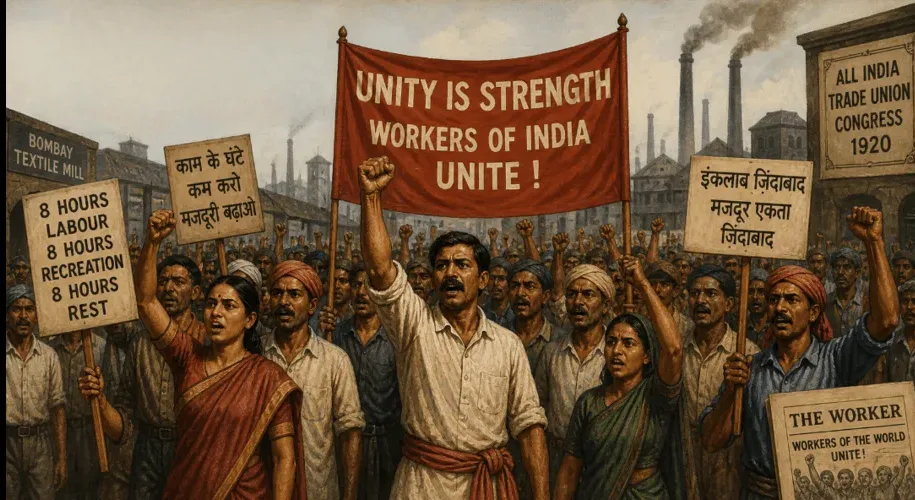
The Movement of the Working Class in India is an important part of modern Indian history. It explains how workers in factories, railways, plantations, and mines started raising their voices against exploitation and poor working conditions. This movement developed slowly over time and played a big role in shaping labour rights in India.
Thank you for reading this post, don't forget to subscribe!Introduction
The Movement of the Working Class in India began during the 19th century when the British introduced capitalism in India. Capitalism means an economic system where industries and businesses are owned by private individuals and run for profit.
Before this period, most Indians worked in agriculture or traditional crafts. But with the arrival of industries like factories, railways, and plantations, a new group of people emerged. These people worked for wages and were called the working class.
This new working class faced many problems such as low wages, long working hours, unsafe conditions, and no job security. Over time, they started organizing themselves to fight for their rights.
Rise of the Working Class in India
The rise of the working class in India is closely linked to industrial development under British rule.
Growth of Industries
During the 19th century, the British set up modern industries in India. Some of the important developments were:
- Establishment of factories
- Expansion of railways
- Construction of roads and buildings
- Growth of plantations (tea, coffee, etc.)
- Development of dockyards
These industries required a large number of workers. As a result, many people left villages and moved to cities in search of jobs.
Important Industrial Cities
Some cities became major industrial centers:
- Bombay (now Mumbai) – Cotton mills
- Calcutta (now Kolkata) – Jute mills
- Madras (now Chennai) – Various industries
- Ahmedabad, Kanpur, Nagpur, Solapur – Growing industrial towns
The first jute mill in India was set up in Calcutta in 1854 by a Scottish businessman. While Indians owned many cotton mills, the jute industry was mostly controlled by foreigners.
Early Condition of Workers
The condition of workers during the early period was very poor.
Major Problems Faced by Workers
- Very low wages
- Long working hours (10–16 hours a day)
- No safety measures in factories
- No holidays or rest
- No job security
- Exploitation by employers
Workers had no legal protection, and there were no proper laws to protect their rights.
Early Attempts to Improve Workers’ Conditions
Between 1870 and 1880, some efforts were made to improve the condition of workers.
However, these efforts were:
- Limited in scope
- Not well organized
- Focused only on local issues
Before 1900, there was no strong movement for workers’ rights. Most reforms were made by social workers and philanthropists who wanted to help workers.
Workers’ Movements Before Trade Unions
Before the formation of trade unions, workers tried to protest in their own ways.
Plantation and Mine Workers
Workers in plantations and mines were among the most exploited. They worked in remote areas, far from cities.
Because of this:
- Their problems were not widely known
- They did not get support from society
- Their protests were mostly ignored
Still, they sometimes protested against harsh treatment and poor wages.
Industrial Workers
Workers in cotton and jute mills were more visible because they worked in cities.
- Social reformers supported them
- Newspapers reported their problems
- Public awareness increased
This helped in building early worker organizations.
Formation of Early Worker Organizations
Some early organizations were formed to support workers.
Important Organizations
- Working Men’s Club (1870) by Sasipada Banerjee in Bengal
- Bharat Shramjibi (1874) – a journal for workers
- Working Men’s Mission (1878) by Brahmo Samaj
- Working Men’s Institution (1905)
- Bombay Millhands Association (1890) by N.M. Lokhandey
- Dinbandhu (1898) – a newspaper for workers
- Bombay Millhands Defence Association (1908) by Bal Gangadhar Tilak
These organizations mainly focused on welfare activities like education and awareness. They were not strong unions but laid the foundation for future movements.
Emergence of Trade Unions
The real Movement of the Working Class in India became strong after World War I. This period saw the organized beginning of trade unions, which played a key role in protecting workers’ rights.
Cause of Emergence
Trade unions emerged in India mainly after World War I due to several important reasons:
- Rising prices of essential commodities made daily life difficult for workers
- Decline in real wages reduced their purchasing power
- Increase in demand for industrial products led to expansion of industries
- Influence of national movements like Gandhi’s Non-Cooperation Movement
- Inspiration from the Russian Revolution encouraged workers to unite
Because of these reasons, workers understood that they needed strong and organized groups to fight for their rights and improve their conditions.
Formation of Trade Unions
With growing awareness, workers began forming trade unions across India.
Madras Labour Union (1918)
- Formed in April 1918
- Considered the first trade union in India
- Founded by B.P. Wadia, a nationalist leader and associate of Annie Besant
- Focused on improving workers’ rights and conditions in Madras
Textile Labour Association (1920)
- Established in Ahmedabad in 1920
- Also known as Majur Mahajan Sangh
- Formed after mill workers demanded bonus due to rising prices
- Supported by Mahatma Gandhi
- Followed Gandhian principles like non-violence and peaceful protest
- Became one of the strongest and most successful trade unions in India
Formation of AITUC
The formation of the All India Trade Union Congress (AITUC) was a major step in the Movement of the Working Class in India. It gave a new direction and strength to the labour movement in the country.
A New Edge to the Workers’ Movement
The creation of AITUC marked an important turning point. It was formed under the leadership of Bal Gangadhar Tilak and Lala Lajpat Rai. After its formation, the working class movement became more organized and powerful. From around 1930, the movement also started developing a strong ideological base, where workers began to think not only about wages but also about larger social and economic issues.
Cause of Formation
Before AITUC, there were many small trade unions working separately in different parts of India. Leaders and workers realized that there was a need for one central organization that could unite all workers and coordinate their efforts.
Another important reason was the formation of the International Labour Organization (ILO) in 1919. This international body focused on workers’ rights. India needed a national organization to represent its workers at this global level. AITUC fulfilled this need, and its members represented Indian labour at the ILO.
Key Features
- Formed to unite workers across India
- Provided a national platform for labour issues
- Strengthened and organized the workers’ movement
- Helped connect Indian labour with international organisations
Leaders Involved
Many important leaders were involved in the formation of AITUC:
- Bal Gangadhar Tilak
- Lala Lajpat Rai
- N.M. Joshi
- B.P. Wadia
- Diwan Chamanlal
- Joseph Baptista
Lala Lajpat Rai became the first president of AITUC, while Joseph Baptista became its vice president. Lajpat Rai also made an important observation by linking capitalism with imperialism. He said, “imperialism and militarism are the twin children of capitalism.”
Ideology of AITUC
In the beginning, AITUC was influenced by the ideas of the British Labour Party, especially social democracy. At the same time, the ideas of Mahatma Gandhi also had a strong influence.
These included:
- Non-violence
- Trusteeship (employers should act as trustees of workers’ welfare)
- Cooperation between workers and employers
This combination of ideas helped AITUC grow in a balanced and peaceful way.
Role of AITUC
AITUC played an important role in organizing workers across the country.
Contributions
- Coordinated trade unions across India
- Represented Indian workers at the international level
- Connected labour issues with the national freedom struggle
- Helped workers raise their voice in a united manner
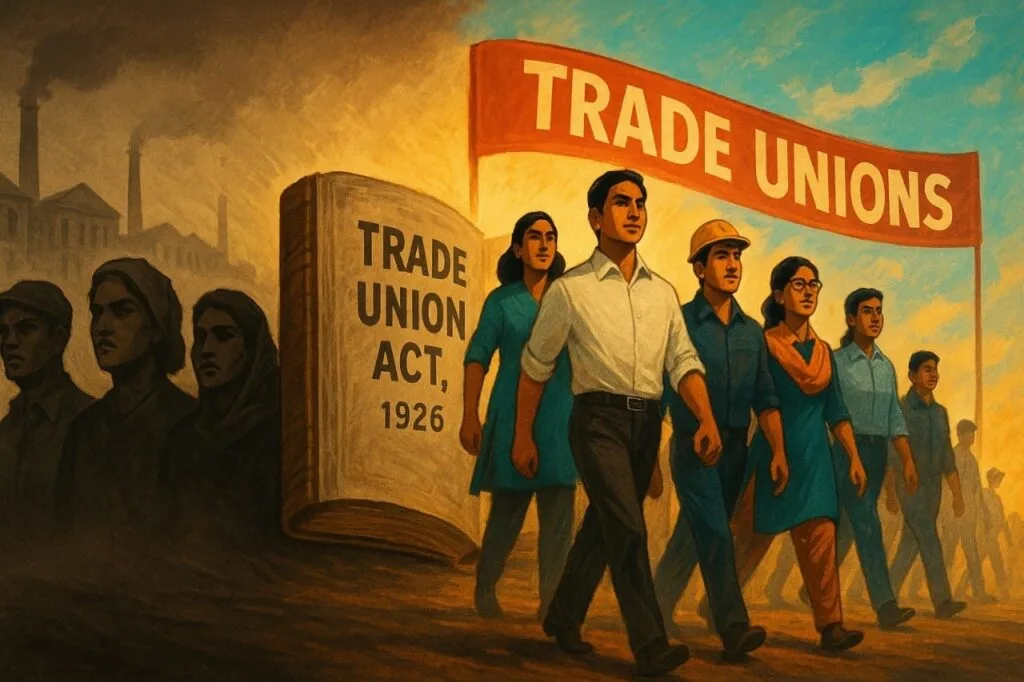
Trade Union Act, 1926
The Trade Union Act of 1926 was another important step for workers in India. It gave legal recognition to trade unions and made their activities more organized.
Main Features
- Recognized trade unions as legal associations
- Provided rules for registration and regulation
- Gave protection from civil and criminal cases for legal activities
- Allowed unions to function without fear
- Placed some limits on their political activities
This law gave strong legal support to workers and helped them organize and protest in a proper and lawful way.
Role of Communists in Labour Movement
The communist ideology had a strong influence on the Movement of the Working Class in India.
Key Ideas
Communism focuses on:
- Equality among people
- Rights of workers
- Ending exploitation
Communist Party of India (CPI)
- Formed in 1920
- Inspired by Karl Marx and Lenin
- Actively involved in labour movements
Contributions
- Organized workers in mills and factories
- Led strong protests and strikes
- Raised awareness about workers’ rights
Splits in Trade Unions
Over time, differences in ideas led to divisions among unions.
Major Splits
- Moderates vs Communists
- Nationalists vs Communists
New Organizations Formed
- Indian Federation of Trade Unions (IFTU)
- Red Trade Union Congress (RTUC)
By 1931, there were three major union groups in India.
Unity Among Trade Unions
Later, leaders realized that division was weakening the movement.
Steps Taken
- Formation of National Federation of Trade Unions (NFTU) in 1933
- Reunification of unions in 1935
This helped in strengthening the workers’ movement again.
Workers’ Movement After Independence
After India became independent in 1947, the Movement of the Working Class in India entered a new phase.
Formation of New Trade Unions
- Bharatiya Mazdoor Sangh (BMS)
- Centre of Indian Trade Unions (CITU)
These unions represented different political ideologies.
Labour Laws After Independence
The government introduced laws to protect workers.
Important Laws
- Industrial Disputes Act, 1947
- Labour Relations Bill, 1949
- Trade Union laws
These laws improved working conditions and reduced exploitation.
Decline in Strikes (1947–1960)
During this period:
- Workers’ conditions improved
- Fewer strikes occurred
- Industrial peace increased
Economic Challenges in the 1960s
In the late 1960s:
- Wages decreased
- Inflation increased
- Labour disputes increased
This led to a rise in strikes and protests.
Impact of Economic Reforms (1991)
The New Economic Policy of 1991 introduced:
- Liberalization
- Privatization
- Globalization
Effects on Workers
- Reduced job security
- Weak bargaining power
- Easier hiring and firing
- Lack of minimum wage protection in some sectors
These changes made it harder for workers to protect their rights.
Weaknesses of the Working Class Movement
Despite its achievements, the Movement of the Working Class in India has some weaknesses.
1. Limited Coverage
Many workers in the unorganized sector are not part of unions.
2. Too Many Trade Unions
- Multiple unions exist
- Workers are divided
- Weak collective power
3. Lack of Unity
- Conflicts between unions
- Political differences
4. Poor Response to Worker Issues
- Some unions do not address real problems
- Lack of strong leadership
5. Neglect of Women and Marginalized Workers
- Women workers face discrimination
- Socially backward groups are often ignored
Importance of the Movement
The Movement of the Working Class in India has played a very important role in shaping modern India.
Key Achievements
- Better wages
- Fixed working hours
- Improved working conditions
- Legal protection for workers
- Right to form unions
Conclusion
The Movement of the Working Class in India is a long and important journey. It started during British rule when workers faced extreme exploitation. Over time, workers united, formed unions, and fought for their rights.
Although many improvements have been made, challenges still exist, especially for workers in the unorganized sector. The movement continues to evolve as workers fight for better conditions in a changing economic environment.
FAQs – Movement of the Working Class in India
1. What is the Movement of the Working Class in India?
The Movement of the Working Class in India refers to the efforts made by workers to improve their wages, working conditions, and rights through protests, unions, and laws.
2. When did the working class emerge in India?
The working class emerged in the 19th century during British rule with the growth of industries like factories, railways, and plantations.
3. Why was the working class movement started?
It started because workers faced low wages, long working hours, unsafe conditions, and exploitation by employers.
4. What are trade unions?
Trade unions are organizations formed by workers to protect their rights and fight for better working conditions.
5. Which was the first trade union in India?
The Madras Labour Union, formed in 1918, is considered the first trade union in India.
6. What is AITUC?
AITUC (All India Trade Union Congress) is one of the oldest trade union organizations in India, formed to unite workers at the national level.
7. What is the importance of the Trade Union Act, 1926?
This act gave legal recognition to trade unions and allowed workers to organize and protest legally.
8. What role did communists play in the labour movement?
Communists helped organize workers, led strikes, and promoted ideas of equality and workers’ rights.
9. How did the working class movement change after independence?
After independence, many labour laws were introduced, working conditions improved, and new trade unions were formed.
10. What was the impact of the 1991 economic reforms on workers?
The reforms reduced job security, weakened workers’ bargaining power, and made it easier for companies to hire and fire employees.