

Parliamentary Privileges and Immunities: Meaning, Types, Features, and Important Cases

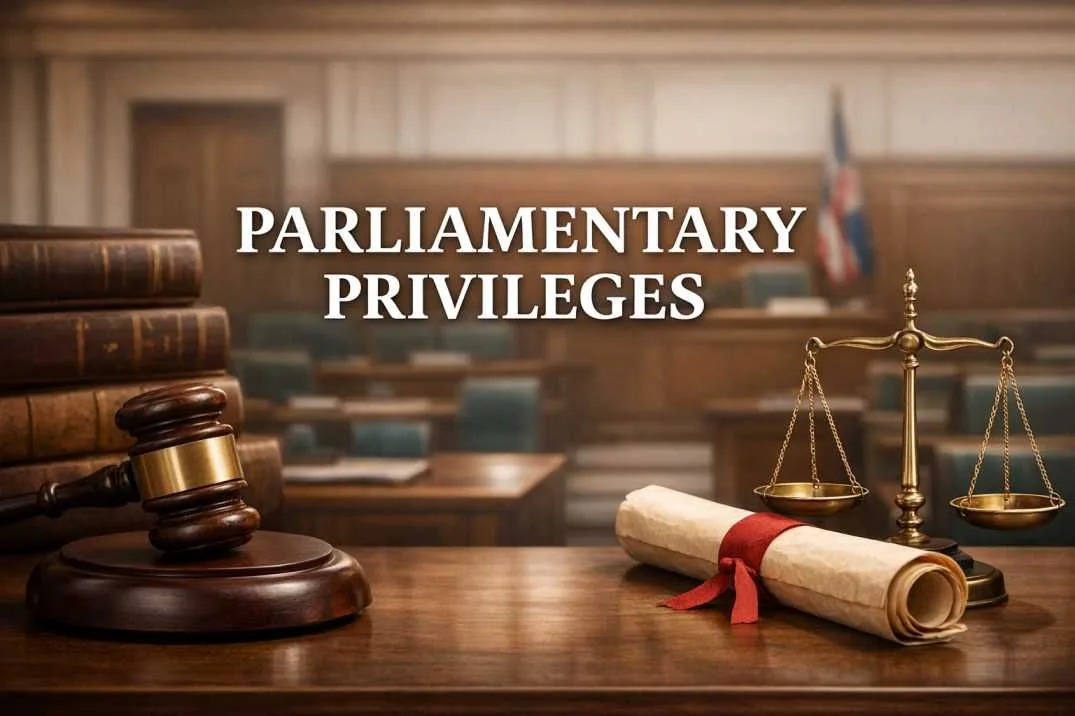
Parliamentary Privileges and Immunities are special rights and protections given to Members of Parliament (MPs) and Members of State Legislatures (MLAs and MLCs). These privileges help lawmakers perform their duties freely without fear, pressure, or unnecessary legal action. They protect the dignity and independence of Parliament and State Legislatures, which are important parts of India’s democratic system.
Thank you for reading this post, don't forget to subscribe!What are Parliamentary Privileges and Immunities?
Parliamentary privileges and immunities are special rights, freedoms, and exemptions provided to lawmakers. Their main purpose is to ensure that elected representatives can speak, debate, and make decisions without interference from outside authorities.
These privileges belong to both Parliament and State Legislatures. They are available only while a person is a member of the legislature. Once a member’s term ends, these privileges also end.
Origin of Parliamentary Privileges
The idea of parliamentary privileges in India came from the British parliamentary system. It first appeared in the Charter Act of 1833 and later developed through the Government of India Act, 1935, which gave legislators freedom of speech.
After independence, these privileges became part of the Constitution of India.
Constitutional Provisions
The Constitution provides important legal protection for parliamentary privileges.
| Article | Purpose |
|---|---|
| Article 105 | Gives MPs freedom of speech and immunity for speeches and votes in Parliament. |
| Article 122 | Prevents courts from questioning parliamentary proceedings because of procedural mistakes. |
| Article 194 | Gives similar privileges to members of State Legislatures. |
| Article 212 | Prevents courts from interfering in state legislative proceedings due to procedural irregularities. |
Apart from the Constitution, parliamentary privileges are also based on parliamentary conventions, rules of procedure, judicial decisions, and laws passed by Parliament.

Important Features
Some major features of parliamentary privileges are:
- They protect the independence of lawmakers.
- They help Parliament function without outside pressure.
- They apply to both individual members and the entire House.
- They remain valid only during a member’s term.
- India does not have a separate law that clearly defines all parliamentary privileges. Most are based on British parliamentary traditions.
In 2008, the Lok Sabha Committee of Privileges recommended that these privileges should not be fully codified into law.
Types of Parliamentary Privileges
Individual Privileges
Individual privileges belong to each Member of Parliament or State Legislature.
Freedom of Speech
Members can freely speak during debates in Parliament or State Legislatures without fear of legal action.
Immunity from Legal Proceedings
No court can take action against a member for anything said or any vote cast inside the House or its committees.
Protection for Official Publications
Reports, debates, votes, and proceedings officially published by Parliament cannot normally become the subject of legal cases.
Freedom from Arrest
Members cannot be arrested in civil cases during a legislative session and for 40 days before and after the session. However, this protection does not apply to criminal cases.
Collective Privileges
Collective privileges belong to the entire House.
These include:
- Publishing parliamentary debates and reports.
- Holding secret sittings when necessary.
- Making rules for conducting business.
- Punishing members or outsiders for breach of privilege.
- Receiving immediate information if a member is arrested.
- Calling witnesses and asking for official documents during inquiries.
- Protecting parliamentary premises from unauthorized legal actions.
Breach of Privilege and Contempt of the House
A breach of privilege happens when someone violates the rights or privileges of Parliament or its members. For example, disobeying Parliament’s lawful orders or insulting its authority may amount to a breach of privilege.
Contempt of the House refers to any act that prevents Parliament, its members, or its officers from performing their duties properly. Publishing removed parliamentary debates or making false attacks on the House may be treated as contempt.
Both actions can lead to punishment.
How is a Privilege Motion Raised?
A Member of Parliament can raise a question of privilege only with the permission of the Speaker of the Lok Sabha or the Chairman of the Rajya Sabha.
If permission is granted, the matter may:
- Be discussed directly by the House.
- Be sent to the Committee of Privileges for investigation.
The Committee studies the case, prepares a report, and submits its recommendations. The House then decides whether to accept or reject the report.
Only Parliament has the authority to decide questions related to parliamentary privileges.
Punishment for Breach of Privilege
If the House finds someone guilty of breaching parliamentary privilege, it can impose different punishments, including:

- Warning
- Reprimand
- Suspension
- Imprisonment during the session
- Expulsion of a member in serious cases
Important Supreme Court Judgments
P. V. Narasimha Rao Case (1998)
The Supreme Court ruled that MPs who accepted bribes and later voted in Parliament received constitutional protection under parliamentary immunity.
State of Kerala vs K. Ajith (2021)
The Court clarified that parliamentary privileges do not protect lawmakers from ordinary criminal laws applicable to every citizen.
Sita Soren vs Union of India (2024)
The Supreme Court overruled the 1998 judgment. It held that MPs and MLAs can be prosecuted for taking bribes because bribery is a criminal offence and not part of their legislative duties.
Criticism of Parliamentary Privileges
Many experts believe that the present system of Parliamentary Privileges and Immunities has several weaknesses. Since many privileges are not clearly defined in law, they sometimes create confusion and raise questions about transparency and accountability.
Lack of Transparency
Parliamentary privileges are often used through procedures that are not fully transparent. As a result, the public may not clearly understand why a privilege is invoked or how decisions are made. This reduces public confidence in the legislative system and makes it difficult to hold lawmakers accountable for their actions inside and outside Parliament.
Potential for Misuse
Some critics argue that parliamentary privileges have occasionally been misused by legislators to avoid legal accountability or silence criticism. The freedom of speech available inside the House has sometimes been used to make inflammatory or unverified statements that cannot be challenged in court. Since there are limited mechanisms to monitor the use of these privileges, the possibility of misuse remains a concern.
Ambiguity in Scope
Many parliamentary privileges are based on conventions instead of detailed written laws. Because of this, their exact scope is sometimes unclear. Different interpretations can lead to inconsistent decisions and create uncertainty about when and how these privileges should be applied.
Conflict with Equality Before Law
Certain privileges, such as protection from arrest in civil cases during legislative sessions, are sometimes viewed as being against the constitutional principle of equality before the law. Critics believe that lawmakers should not receive unnecessary legal protection that is unavailable to ordinary citizens.
Outdated Practices
Several parliamentary privileges are based on traditions inherited from the British colonial period. Some experts believe that these practices do not fully match the needs of a modern democracy, where transparency, accountability, and equal treatment under the law are considered essential values.
Parliamentary Privileges in Other Countries
Many democratic countries provide similar protections to lawmakers.
- United Kingdom: Freedom of speech, immunity from arrest, and control over parliamentary proceedings.
- Canada: Similar privileges under the Constitution Act and Parliament of Canada Act.
- Australia: Constitutional protection for freedom of speech and parliamentary independence.
Challenges
Parliamentary privileges also face several challenges.
- Codifying them may reduce Parliament’s independence.
- It could increase judicial interference.
- Fixed laws may reduce flexibility in handling new situations.
- Creating a detailed law would require long discussions and political agreement.
Way Forward
Parliamentary privileges should always be used responsibly. Lawmakers must avoid misusing these rights for personal or political benefit. Greater transparency, respect for citizens’ rights, proper training for legislators, and strict adherence to parliamentary rules can improve public trust. At the same time, Parliament must maintain its independence while ensuring accountability and fairness in the use of these special privileges.
FAQs
1. What are Parliamentary Privileges and Immunities?
Parliamentary Privileges and Immunities are special rights given to MPs and MLAs so they can perform their duties without fear or outside interference.
2. Which Articles of the Constitution deal with Parliamentary Privileges?
Articles 105 and 122 deal with Parliament, while Articles 194 and 212 deal with State Legislatures.
3. Why are Parliamentary Privileges important?
They protect the independence of lawmakers and ensure free discussion and smooth functioning of Parliament and State Legislatures.
4. What is a breach of parliamentary privilege?
A breach of privilege happens when someone violates the rights or privileges of Parliament, its members, or its committees.
5. Can MPs be arrested during a Parliament session?
MPs have protection from arrest only in civil cases during a session and for 40 days before and after it. This protection does not apply to criminal cases.
6. Who decides cases related to breach of privilege?
The Parliament or the concerned State Legislature decides cases related to breach of privilege. Courts generally do not decide such matters.
7. What is the Committee of Privileges?
The Committee of Privileges investigates cases of breach of privilege and submits its recommendations to the House.
8. What was the Sita Soren judgment of 2024?
The Supreme Court ruled that MPs and MLAs do not have immunity from prosecution for accepting bribes, even if they vote or speak in the legislature.