Charter Act 1833 – What Changed in British India Administration

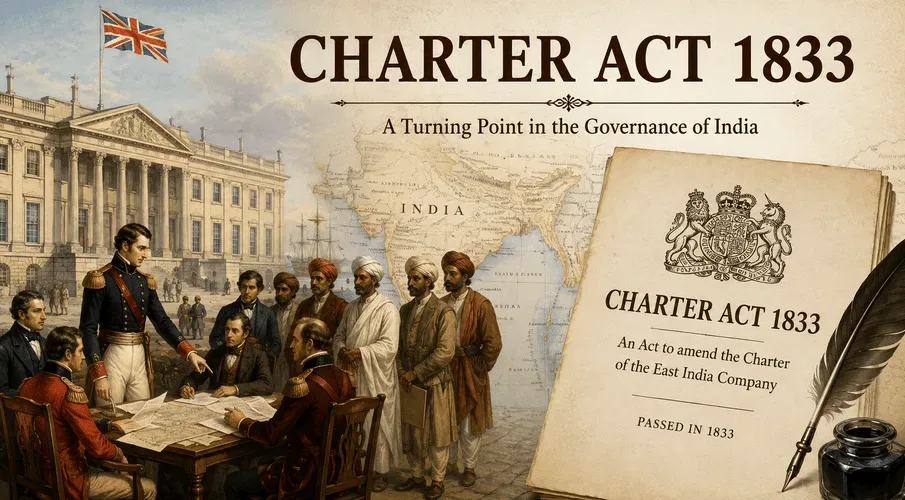
The Charter Act 1833 is one of the most important laws in Indian history during British rule. It brought major changes in the administration of India and completely transformed the role of the East India Company. Before this Act, the Company was both a trading and governing body. But after this Act, it became only an administrative organization.
Thank you for reading this post, don't forget to subscribe!This law was passed by the British Parliament and played a big role in shaping the future governance system of India.
Background of Charter Act 1833
To understand this Act properly, we must first know what was happening in Britain at that time.
Industrial Revolution Impact
The Industrial Revolution changed the entire economic system of Britain. New machines and factories were developed, and production increased rapidly. Because of this:
- Britain wanted free trade
- They needed more markets to sell goods
- They did not want restrictions from monopolies
Before industrialization, most people worked in agriculture or small-scale industries. But after the revolution, large industries became powerful.
Idea of Laissez-Faire
During this time, a new idea called Laissez-Faire became popular.
- It means “no government interference in business”
- People believed that trade and business should be free
- Government should not control industries
This idea strongly influenced British policies towards India.
Reform Act of 1832
The Reform Act of 1832 in Britain brought political changes:
- It increased the power of the middle class
- It reduced the influence of old elites
- It supported liberal ideas
Because of these changes, Britain wanted to reform its administration in India as well.
Renewal of East India Company Charter
The East India Company’s Charter needed renewal every 20 years. So, in 1833, the British Parliament reviewed it and introduced major changes through the Charter Act 1833.
About the Charter Act 1833
The Charter Act 1833 is also known as:
- Saint Helena Act 1833
- Government of India Act 1833
Key Points:
- It renewed the East India Company’s Charter for 20 years
- It ended all commercial activities of the Company
- It made the Company purely an administrative body
- It ended trade monopoly, including tea trade and China trade
- Control of Saint Helena island was transferred to the British Crown
This Act completely changed the nature of British rule in India.
Important Terms Explained
Industrial Revolution
- Period: 1760 to 1840
- Shift from manual work to machine-based production
- Started in Europe and spread globally
- Changed economy, society, and business
Continental System
- Introduced by Napoleon
- Aim: weaken Britain’s economy
- Method: ban trade with Britain
- Result: failed and led to Napoleon’s defeat
Laissez-Faire
- Economic policy of free trade
- No government interference
- Supports private business growth
Main Features of Charter Act 1833
Now let’s understand the important features of this Act step by step.
1. Office of Governor-General
This Act made a very big change in administration.
- The Governor-General of Bengal became the Governor-General of India
- He got full control over all British territories in India
- Bombay and Madras lost their legislative powers
- Power became centralized in one authority
First Governor-General of India
- Lord William Bentinck was the first Governor-General of India
This was the first step towards a unified government in India.
2. Centralization of Power
Before this Act:
- Different regions had separate powers
After this Act:
- Power was centralized in the Governor-General
- One authority controlled the whole country
This made administration more uniform.
3. Governor-General’s Council
The structure of the council was changed.
- Number of members increased to 4
- The fourth member was only for legislative work
- He had limited powers
Powers of Council:
- Make laws for entire India
- Amend or repeal laws
- Laws applied to British, Indians, and foreigners
This made law-making more organized.
4. East India Company Became Administrative Body
This is one of the most important changes.
Before 1833:
- East India Company was a trading company
- It earned profit through trade
After 1833:
- Trade activities were completely stopped
- It became only an administrative body
- It worked on behalf of the British Crown
The Company’s territories were held “in trust” for the British King.
5. End of Trade Monopoly
The Act ended all trade monopolies of the Company.
- No more control over tea trade
- No more trade with China
- Free trade allowed
This helped British private companies to enter Indian markets.
6. Attempt to Open Civil Services
This Act tried to introduce equality in jobs.
- Indians were allowed to apply for government jobs
- No discrimination based on race
However:
- This idea was opposed by the Court of Directors
- So it was not fully implemented
Later, in 1854, modern civil services were introduced based on merit.
7. Legalization of British Settlement
The Act allowed British citizens to:
- Settle freely in India
- Own land and property
This increased British presence in India.
8. Law Commission
A very important step was taken to improve the legal system.
- The first Law Commission was formed in 1833
- Lord Macaulay became its chairman
Purpose:
- To codify laws
- To create a uniform legal system
This later led to the formation of:
- Indian Penal Code (IPC)
- Other important laws
9. End of Slavery
Slavery existed in India during that time.
- The Act aimed to reduce slavery
- In 1833, slavery was abolished in British territories
This was an important social reform.
10. Laws to be Presented in British Parliament
- All laws made in India had to be presented in British Parliament
- This increased accountability
Significance of Charter Act 1833
The Charter Act 1833 is considered a turning point in Indian history.
1. Beginning of Centralized Administration
- Power was centralized under one authority
- Made governance more organized
2. Creation of Government of India
- First time a central government was formed
- Controlled all British territories
3. End of East India Company as a Trading Body
- Company became only an administrative agency
- Reduced its economic power
4. Introduction of Modern Civil Services Idea
- Open competition idea started
- Though not fully implemented, it laid the foundation
5. Legal Reforms
- Law Commission formed
- Laws started becoming uniform
6. Social Reform
- Steps taken to abolish slavery
- Improved human rights
7. Free Trade System
- Monopoly ended
- British traders entered Indian markets
8. Step Towards British Colonization
- British citizens allowed to settle
- Strengthened British control
Conclusion
The Charter Act 1833 played a major role in shaping the administrative structure of British India. It marked the end of the East India Company as a commercial organization and made it purely a governing body. The Act centralized power, introduced legal reforms, and opened the path for modern administration.
It also reflected the changing economic and political ideas of Britain, such as free trade and liberal governance. Even though some reforms were not fully implemented, this Act laid the foundation for future changes in India’s governance system.
Overall, the Charter Act 1833 was a major step in the development of modern administrative and legal systems in India.
FAQs on Charter Act 1833
1. What is the Charter Act 1833?
It is a law passed by the British Parliament that transformed the East India Company into an administrative body and centralized governance in India.
2. Who was the first Governor-General of India?
Lord William Bentinck was the first Governor-General of India.
3. What happened to the East India Company after this Act?
It lost all trading rights and became only an administrative body.
4. What was the main objective of the Act?
To centralize administration and end the Company’s trade monopoly.
5. What is the importance of the Law Commission?
It helped in creating a uniform legal system in India.
6. Did the Act allow Indians in government jobs?
Yes, it stated that Indians should not be restricted, but it was not fully implemented.
7. Why is this Act important?
It marked the beginning of centralized governance and modern administration in India.