



Demand for Two Time Zones in India: Reasons, Benefits and Challenges

The demand for two time zones in India has been a topic of discussion for many years. India follows a single time system called Indian Standard Time (IST), but due to its large size and geographical differences, many experts believe that one time zone is not enough.
Thank you for reading this post, don't forget to subscribe!In 2018, the Council of Scientific and Industrial Research through its lab National Physical Laboratory suggested that India should consider having two time zones. This idea became important because people living in the northeastern part of the country face problems due to early sunrise and sunset.
What is a Time Zone?
A time zone is a region where the same standard time is used. The idea of time zones was introduced by Sir Sandford Fleming in 1879.
Later, in the International Meridian Conference, the world was divided into 24 time zones.
Why do we have time zones?
- The Earth rotates on its axis.
- It takes 24 hours to complete one rotation.
- Every 15 degrees of longitude represents 1 hour difference.
So, the entire world is divided into 24 time zones to manage time properly.
Indian Standard Time (IST)
India follows a single time zone called Indian Standard Time (IST).
Key Facts about IST
- Based on longitude: 82.5° East
- Passes through Mirzapur in Uttar Pradesh
- IST = UTC + 5 hours 30 minutes
- Maintained by National Physical Laboratory
- Uses atomic clocks for accurate time
History of Time Zones in India
During British rule, India had three different time zones:
- Bombay Time
- Calcutta Time
- Madras Time
After independence, in 1906, India adopted a single time zone (IST) for simplicity and unity.
Why is There a Demand for Two Time Zones in India?
1. Large Geographical Size
India stretches from Gujarat in the west to Arunachal Pradesh in the east, covering almost 30 degrees of longitude. This is a large distance, enough to have more than one time zone.
Countries like the United States and Russia have multiple time zones because of their large size.
2. Early Sunrise in Northeast India
In northeastern states like Assam and Arunachal Pradesh:
- The sun rises as early as 4 AM in summer
- But offices open at 10 AM (IST)
This leads to wastage of daylight. People lose productive morning hours.
3. Effect on Daily Life (Circadian Rhythm)
The human body follows a natural clock called the Circadian Rhythm.
This controls:
- Sleep
- Wake-up time
- Eating habits
When the official time does not match sunlight, people feel:
- Tired
- Less productive
- Less efficient
4. Special Case of Northeast India
People in Northeast India have long demanded a separate time zone because:
- They start their day early
- They lose daylight due to late office timings
- Their lifestyle is different from the rest of India
Interestingly, tea gardens in Assam follow their own local time called “Chaibagaan Time”, which is one hour ahead of IST.
Suggestions for Two Time Zones
The National Physical Laboratory proposed two time zones:
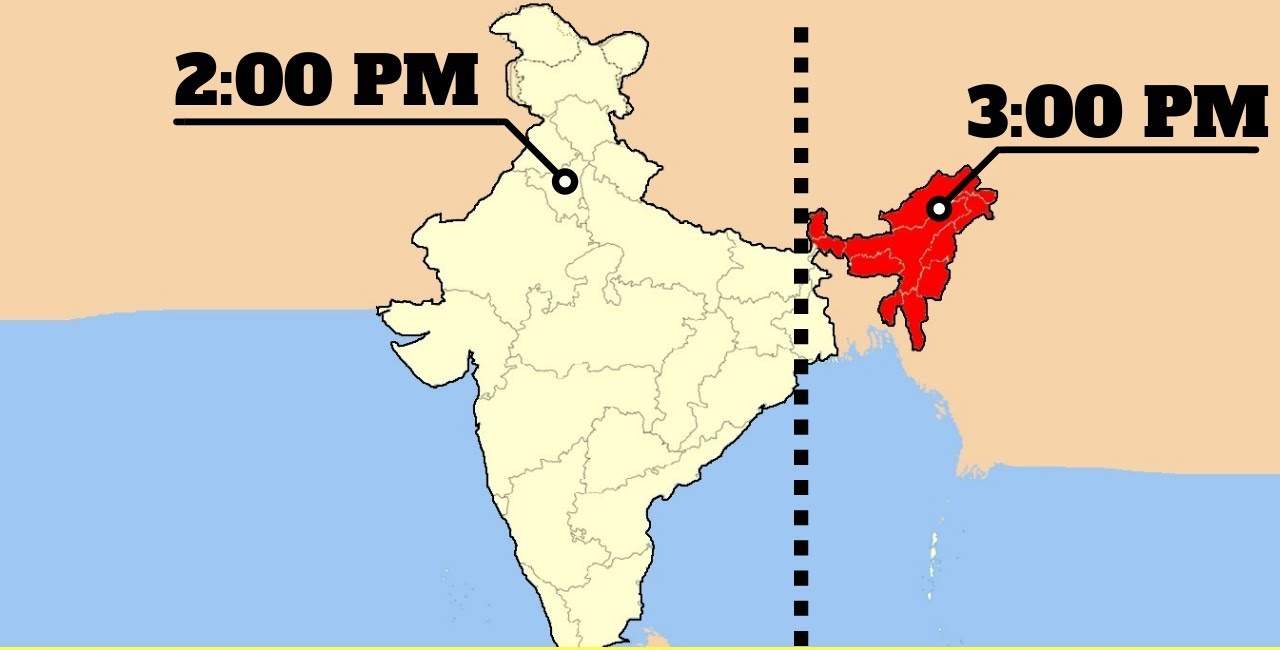
Proposed Time Zones
| Time Zone | Area Covered | Longitude Range |
|---|---|---|
| IST-I | Most of India | 68°E to 89°E |
| IST-II | Northeast India | 89°E to 97°E |
Difference between both: 1 hour
Advantages of Having Two Time Zones
1. Better Productivity
People can work according to sunlight:
- Early sunrise = early start
- Better use of daylight
This improves efficiency in offices, schools, and daily life.
2. Energy Saving
Using daylight properly can save electricity.
- Estimated savings: 2.7 billion units per year
- Money saved: around ₹1000 crore
Less electricity use also reduces pollution.
3. Environmental Benefits
Lower energy consumption means:
- Reduced carbon emissions
- Better climate protection
This helps India fight climate change.
4. Social Benefits
Two time zones can help:
- Reduce road accidents
- Improve women’s safety
- Promote healthier lifestyles
People will sleep and wake at proper times.
Disadvantages of Two Time Zones
1. Confusion in Travel and Transport
India has a large railway network.
- Different time zones may cause confusion
- Risk of accidents if not managed properly
2. Problems in Daily Coordination
- Banks, offices, and businesses may face timing issues
- People traveling between zones must adjust clocks
3. Border Confusion
At the boundary of two time zones:
- People may get confused
- Frequent time changes can create problems
4. Political and Social Concerns
Some fear that:
- Two time zones may create division
- Northeast may feel separated from the rest of India
5. Infrastructure Cost
To implement two time zones:
- New systems are needed
- Another time-keeping lab must be set up
This increases cost.
Alternatives to Two Time Zones
1. Shifting IST by 30 Minutes
The National Institute of Advanced Studies suggested:
- Move IST ahead by 30 minutes
- New time: UTC + 6:00
Benefits:
- Better daylight use
- Energy saving
- Simpler than two time zones
2. Daylight Saving Time (DST)
DST means:
- Move clocks forward in summer
- Move back in winter
Benefits:
- More daylight in evening
- Energy saving
- Boost tourism
However, India currently does not follow DST.
Time Zones Around the World
Countries with Multiple Time Zones
- United States – 9 time zones
- Russia – 11 time zones
Countries with Single Time Zone
- China follows one time zone despite large size
Special Case: France
- France has 12 time zones (due to overseas territories)
Understanding Time Standards
UTC vs GMT
- UTC (Coordinated Universal Time): Modern standard using atomic clocks
- GMT (Greenwich Mean Time): Based on the sun at Royal Observatory Greenwich
Time Zones in Extreme Regions
Poles
- No fixed time zones
- Scientists use convenient time
Space
- Astronauts on the International Space Station follow GMT
Way Forward
India needs careful planning before making any change.
Important steps:
- Study economic and social impact
- Analyze sunlight patterns
- Consult people from Northeast India
- Ensure smooth transport systems
The government must make a balanced decision that improves productivity without creating confusion.
FAQs
1. Why does India have only one time zone?
India adopted one time zone after independence to maintain unity and simplify administration.
2. Which part of India needs a different time zone?
Northeast India, especially states like Assam and Arunachal Pradesh.
3. What is IST based on?
IST is based on 82.5° East longitude passing through Mirzapur.
4. What is circadian rhythm?
It is the body’s natural clock that controls sleep and daily activities.
5. What is the main benefit of two time zones?
Better use of daylight, increased productivity, and energy saving.
6. What is “Chaibagaan Time”?
It is a local time followed in Assam tea gardens, one hour ahead of IST.
7. What is the alternative to two time zones?
Shifting IST by 30 minutes or using Daylight Saving Time.