
Sessions of Indian National Congress: Key Meetings & Highlights (1885–1946)

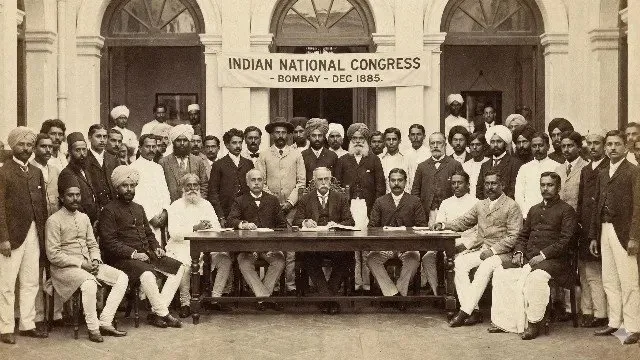
Sessions of Indian National Congress played a very important role in shaping India’s freedom struggle and political development. The Indian National Congress (INC) was established in December 1885 in Mumbai (then Bombay). Its main aim was to bring educated Indians together, discuss national issues, and gradually demand political rights from British rule.
Thank you for reading this post, don't forget to subscribe!The early leaders like Dadabhai Naoroji, Pherozeshah Mehta, W. C. Bonnerjee, and Surendranath Banerjee were mostly from Bombay and Calcutta. A retired British officer, Allan Octavian Hume, also played a key role in organizing the Congress.
The sessions of INC were not just meetings they were platforms where major decisions, resolutions, and movements were planned. Each session reflected the changing nature of the Indian freedom struggle, from moderate demands to complete independence.
Early Phase Sessions of Indian National Congress (1885–1905)
The early phase of the Congress is known as the Moderate Phase. During this period, leaders believed in peaceful methods such as petitions, discussions, and appeals to the British government.
First Session (1885, Bombay)
- President: W.C. Bonnerjee
- This session marked the birth of the Congress.
- 72 delegates attended the meeting.
Second Session (1886, Calcutta)
- President: Dadabhai Naoroji
- Participation increased significantly.
- Strengthened the national character of the Congress.
Third Session (1887, Madras)
- President: Badruddin Tyabji
- First Muslim President of Congress.
- Promoted unity among communities.
Fourth Session (1888, Allahabad)
- President: George Yule
- First English President of the Congress.
- Showed that even some British supported Indian demands.
Important Session (1896, Calcutta)
- President: Rahimtullah Sayani
- The famous song Vande Mataram was sung for the first time by Rabindranath Tagore.
Session (1899, Lucknow)
- President: Romesh Chandra Dutt
- Demand for permanent fixation of land revenue.
Session (1901, Calcutta)
- President: Dinshaw E. Wacha
- Mahatma Gandhi appeared for the first time on the Congress platform.
Extremist Phase Sessions of Indian National Congress (1905–1916)
This phase saw the rise of assertive nationalism. Leaders started demanding self-rule and adopted stronger methods.
Session (1905, Benaras)
- President: Gopal Krishna Gokhale
- Formal beginning of the Swadeshi Movement.
Session (1906, Calcutta)
- President: Dadabhai Naoroji
- Four important resolutions passed:
- Swaraj (Self-rule)
- Swadeshi
- Boycott
- National Education
Session (1907, Surat)
- President: Rash Behari Ghosh
- Famous Surat Split between Moderates and Extremists.
- Leaders like Bal Gangadhar Tilak represented Extremists.
Reunification and New Developments (1916–1920)
Session (1916, Lucknow)
- President: Ambica Charan Mazumdar
- Reunion of Moderates and Extremists.
- Lucknow Pact signed with the All-India Muslim League.
Session (1917, Calcutta)
- President: Annie Besant
- First woman President of the Congress.
Session (1919, Amritsar)
- President: Motilal Nehru
- Support given to the Khilafat Movement.
Gandhian Era Sessions of Indian National Congress (1920–1930)
This phase marked the dominance of Mahatma Gandhi and mass movements.

Special Session (1920, Calcutta)
- President: Lala Lajpat Rai
- Non-Cooperation Movement proposed by Gandhi.
Session (1920, Nagpur)
- President: C. Vijayaraghavachariar
- Congress reorganized on linguistic basis.
- Muhammad Ali Jinnah left Congress.
Session (1922, Gaya)
- President: C.R. Das
- Formation of Swaraj Party.
Session (1924, Belgaum)
- President: Mahatma Gandhi
- Only session presided over by Gandhi.
Session (1925, Kanpur)
- President: Sarojini Naidu
- First Indian woman President.
Session (1927, Madras)
- President: M.A. Ansari
- Opposition to British military use of Indian troops.
Session (1929, Lahore)
- President: Jawaharlal Nehru
- Declaration of Poorna Swaraj (Complete Independence).
- 26 January declared as Independence Day.
Towards Independence (1930–1947)
Session (1931, Karachi)
- President: Sardar Vallabhbhai Patel
- Resolution on Fundamental Rights and Economic Policy.
Session (1936, Lucknow)
- President: Jawaharlal Nehru
- Promotion of socialist ideas.
Session (1937, Faizpur)
- President: Jawaharlal Nehru
- First rural session of Congress.
Session (1938, Haripura)
- President: Subhas Chandra Bose
- National Planning Committee formed.
Session (1939, Tripuri)
- President: Rajendra Prasad
- Subhas Chandra Bose resigned and formed Forward Bloc.
Session (1940, Ramgarh)
- President: Abul Kalam Azad
- Plan for Civil Disobedience.
Final Phase and Independence
Between 1941 and 1945, no sessions were held due to major events like:
- Quit India Movement
- INA trials
- Negotiations like Cripps Mission and Cabinet Mission
Session (1946, Meerut)
- President: J.B. Kripalani
- Last session before independence.
Importance of Sessions of Indian National Congress
The sessions of the Indian National Congress played a vital role in India’s freedom struggle:
- They provided a platform for political discussion.
- Helped unite people across regions and religions.
- Introduced major movements like Swadeshi, Non-Cooperation, and Civil Disobedience.
- Developed leadership and political awareness.
- Gradually shifted demand from reforms to complete independence.
Conclusion
The Important Indian National Congress Sessions reflect the journey of India from political awakening to independence. Each session added a new chapter to the freedom struggle. From moderate demands in the early years to the bold declaration of Poorna Swaraj, the Congress sessions shaped the destiny of India.
Understanding these sessions helps us understand how leaders like Mahatma Gandhi, Jawaharlal Nehru, and Subhas Chandra Bose guided the nation towards freedom.
FAQs
1. When was the Indian National Congress founded?
The Indian National Congress was founded in 1885 at Bombay.
2. Who was the first President of INC?
W.C. Bonnerjee was the first President of the Indian National Congress.
3. Which session declared Poorna Swaraj?
The Lahore Session of 1929 declared Poorna Swaraj (complete independence).
4. Who was the first woman President of INC?
Annie Besant was the first woman President of the Congress in 1917.
5. Which session was presided over by Mahatma Gandhi?
The Belgaum Session of 1924 was the only session presided over by Mahatma Gandhi.
6. What was the importance of the Surat Session of 1907?
The Surat Session is known for the split between Moderates and Extremists.
7. What happened in the Lucknow Session of 1916?
The Lucknow Session marked unity between Moderates and Extremists and the Lucknow Pact with the Muslim League.
8. Which was the last session before independence?
The Meerut Session of 1946 was the last session before India’s independence.