Company Rule in India: Rise of British Power

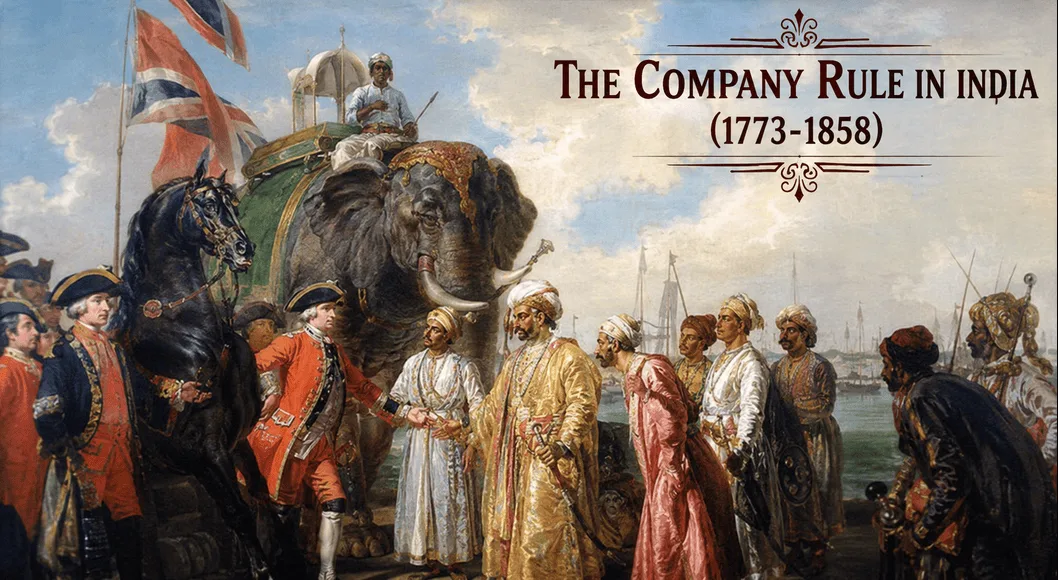
The Company Rule in India was an important period in Indian history when the British East India Company slowly changed from a trading company into a political power. Between 1773 and 1858, the Company expanded its control over large parts of India and introduced many laws and administrative changes. During this time, the British government also started interfering more directly in Indian affairs. The period finally ended after the Revolt of 1857, when the British Crown took direct control of India.
Thank you for reading this post, don't forget to subscribe!This phase of history changed India’s political system, economy, administration, judiciary, education, and society. Understanding the Company Rule helps us know how British power grew in India and how Indians suffered under colonial policies.
Beginning of the East India Company Rule
The British East India Company was established in 1600 by Queen Elizabeth I of England. Initially, the Company came to India only for trade. It traded in spices, silk, cotton, tea, and other goods. The Company set up trading centers in Surat, Madras, Bombay, and Calcutta.
Gradually, the Company became more powerful. It started interfering in Indian politics and took advantage of the weakness of Indian rulers.
The turning point came after the Battle of Buxar in 1764. In this battle, the East India Company defeated the combined forces of:
- Mir Qasim of Bengal
- Shuja-ud-Daula of Awadh
- Mughal Emperor Shah Alam II
After the victory, the Company received the Diwani rights in 1765. These rights allowed the Company to collect revenue from Bengal, Bihar, and Orissa. This gave the Company huge financial power.
Dual System of Government
From 1765 to 1772, the Company introduced a Dual System in Bengal.
Under this system:
- The Company collected revenue.
- Indian officials carried out administrative duties.
This system created confusion because the Company had authority but no responsibility, while Indian officials had responsibility but little power.
Problems of the Dual System
The Dual System caused many problems:
- Corruption increased among Company officials.
- Farmers were heavily taxed.
- Peasants suffered from exploitation.
- Bengal faced economic decline.
- The Company earned huge profits while common people became poorer.
The terrible Bengal Famine of 1770 also showed the failure of Company administration. Millions of people died because of hunger and poor governance.
The British government realized that the East India Company needed strict control. As a result, Parliament passed several Acts to regulate the Company’s activities in India.
Important Acts During Company Rule
Regulating Act of 1773
The Regulating Act of 1773 was the first major law passed by the British Parliament to control the East India Company
Main Features of the Regulating Act
1. Control Over the Company
The British government got the right to supervise the Company’s activities in India.
2. Governor-General of Bengal
The post of Governor of Bengal was changed to Governor-General of Bengal.
- Warren Hastings became the first Governor-General of Bengal.
He was assisted by a council of four members.
3. Control Over Madras and Bombay
The Presidencies of Madras and Bombay were brought under the control of Bengal.
4. Establishment of Supreme Court
A Supreme Court was established in Calcutta in 1774.
It included:
- One Chief Justice
- Three judges
The court handled civil and criminal cases.
Importance of the Regulating Act
The Act was the first step by the British government to regulate Indian administration. It reduced the independence of the East India Company and increased parliamentary control.
Pitt’s India Act of 1784
The Pitt’s India Act was passed to remove the weaknesses of the Regulating Act.
Main Features of Pitt’s India Act
1. Dual Control System
The Act introduced a system of dual control:
- The East India Company managed trade and administration.
- The British government controlled political matters.
2. Board of Control
A Board of Control was established to supervise:
- Civil administration
- Military affairs
- Revenue matters
The Board included important British ministers.
3. Reduced Council Members
The Governor-General’s council was reduced from four members to three.
4. Increased Power of Governor-General
The Governor-General became more powerful.
Importance of Pitt’s India Act
This Act clearly showed that the British government now had greater authority over Indian affairs. India slowly became a British possession.
Charter Act of 1793
The Charter Act of 1793 renewed the Company’s rights for another 20 years.
Main Features
- The Governor-General received greater powers.
- Senior officials needed royal approval.
- Company officials could not leave India without permission.
- Salaries of the Board of Control were paid from Indian revenue.
Importance
The Act strengthened British authority and increased administrative discipline.
Charter Act of 1813
The Charter Act of 1813 was very important because it ended the Company’s trade monopoly in India.
Main Features
1. End of Trade Monopoly
The East India Company lost its monopoly over Indian trade.
However, it still controlled:
- Trade with China
- Tea trade
2. Entry of Other British Traders
British traders were now allowed to trade in India.
3. Education Fund
The British government allocated one lakh rupees annually for:
- Education
- Promotion of literature
- Scientific learning
Importance
This Act was the first step toward government responsibility in education.
It also opened India to Christian missionaries and European influence.
Charter Act of 1833
The Charter Act of 1833 was a major step toward centralization in India.
Main Features
1. Governor-General of India
The post of Governor-General of Bengal became Governor-General of India.
- Lord William Bentinck became the first Governor-General of India.
2. End of Company Trade
The Company’s commercial activities completely ended.
The East India Company became only an administrative body.
3. Law Commission
A Law Commission was established.
- Lord Macaulay became the first law member.
The commission worked on codifying Indian laws.
4. Centralized Administration
The Governor-General received authority over all civil and military affairs.
Importance
This Act made the administration more centralized and uniform across India.
Charter Act of 1853
The Charter Act of 1853 introduced important administrative reforms.
Main Features
1. Open Competition for Civil Services
Civil service jobs were opened through competitive examinations.
2. Legislative Council
The Governor-General’s legislative council was expanded.
3. Separation of Functions
Legislative and executive functions were separated.
Importance
This Act was the final Charter Act passed for the Company. It introduced modern administrative ideas.
Government of India Act, 1858
The Revolt of 1857 changed British policy completely.
The British government blamed the East India Company for the revolt and ended Company rule in India.
Main Features of the Government of India Act
1. End of Company Rule
The East India Company was abolished.
India came directly under the British Crown.
2. Secretary of State for India
A Secretary of State for India was appointed in Britain.
He was assisted by a council of 15 members.
3. Introduction of Viceroy
The title of Governor-General was changed to Viceroy.
- Lord Canning became the first Viceroy of India.
Importance
This Act marked the beginning of direct British rule in India, also known as the British Raj.
Important Governors-General During Company Rule
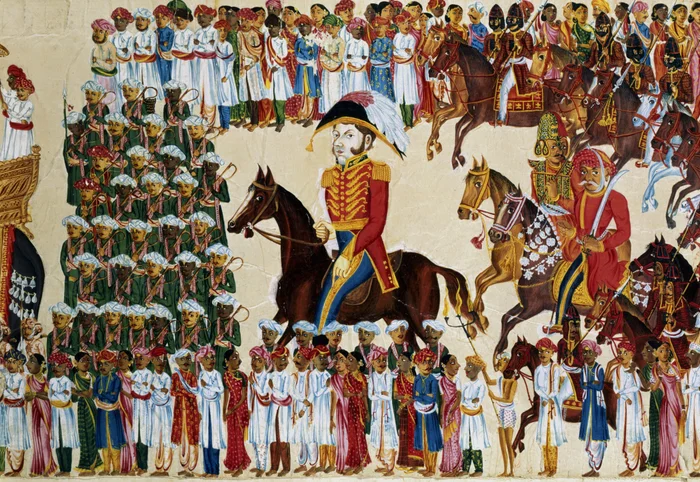
Warren Hastings (1772–1785)
Warren Hastings was the first Governor-General of Bengal.
Major Contributions
- Reformed revenue administration
- Improved judicial system
- Strengthened Company control in Bengal
He laid the foundation of British administration in India.
Lord Cornwallis (1786–1793)
Lord Cornwallis introduced many administrative reforms.
Cornwallis Code
The Cornwallis Code brought major judicial changes.
Features
- Separation of revenue and judicial administration
- European subjects came under courts
- Government officials became answerable to courts
- Rule of law was promoted
Civil Services
Cornwallis reorganized civil services and improved administration.
Judicial Reforms
He abolished District Fauzdari Courts and established circuit courts in:
- Calcutta
- Dacca
- Murshidabad
- Patna
Permanent Settlement
Cornwallis introduced the Permanent Settlement in Bengal in 1793.
Under this system:
- Zamindars collected taxes from farmers.
- Revenue amount was fixed permanently.
Effects
The system benefited zamindars but increased the suffering of peasants.
Lord Wellesley (1798–1805)
Lord Wellesley expanded British territory through the Subsidiary Alliance System.
Subsidiary Alliance
Indian rulers had to:
- Accept British troops
- Pay for British protection
- Avoid relations with other powers
This policy increased British political control.
Lord William Bentinck (1828–1835)
Lord William Bentinck introduced many social and administrative reforms.
Abolition of Sati
He banned the Sati system in 1829.
This was an important social reform.
Educational Reforms
English education was promoted during his rule.
Judicial Reforms
- Persian was replaced by English in courts.
- People could use local languages in courts.
Administrative Reforms
He abolished the Circuit Courts and transferred their duties to collectors.
Importance
Bentinck is remembered as a reformer who modernized administration.
Judicial Reforms During Company Rule
The British introduced a new judicial system in India.
Supreme Court at Calcutta
Established in 1774, it was the highest court in Bengal.
Sadar Diwani Adalat
Handled civil cases.
Sadar Nizamat Adalat
Handled criminal cases.
Codification of Laws
The British prepared modern legal codes:
- Civil Procedure Code (1859)
- Indian Penal Code (1860)
- Criminal Procedure Code (1861)
These laws formed the base of India’s legal system.
Economic Impact of Company Rule
The Company Rule badly affected the Indian economy.
Heavy Taxation
Farmers paid very high taxes.
Failure to pay taxes often led to loss of land.
Decline of Indian Industries
British policies destroyed traditional Indian handicrafts and industries.
Indian weavers and artisans suffered greatly.
Drain of Wealth
India’s wealth was transferred to Britain through:
- Revenue collection
- Trade profits
- Exploitation of resources
Dadabhai Naoroji later called this the “Drain of Wealth.”
Social and Educational Changes
The British introduced several social and educational reforms.
English Education
The British promoted English education.
Lord Macaulay supported Western education in India.
Missionary Activities
Christian missionaries opened schools and spread Western ideas.
Social Reforms
The British banned some harmful practices like:
- Sati
- Female infanticide
However, many Indians believed the British interfered too much in Indian traditions.
Causes of Discontent Against Company Rule
Many Indians became unhappy with Company rule because of:
- Heavy taxes
- Economic exploitation
- Loss of kingdoms
- Social interference
- Racial discrimination
- Poor treatment of soldiers
These reasons finally led to the Revolt of 1857.
Revolt of 1857
The Revolt of 1857 was the first major uprising against British rule.
It began among Indian soldiers but soon spread to different regions.
Major Leaders
- Rani Lakshmibai
- Bahadur Shah Zafar
- Tantia Tope
- Nana Sahib
- Kunwar Singh
Causes
- Political annexations
- Economic exploitation
- Religious fears
- Military grievances
Result
The revolt failed, but it forced the British government to end Company rule.
End of Company Rule
The East India Company ruled India for nearly 100 years after getting Diwani rights in Bengal.
During this period:
- British power expanded rapidly.
- Indian rulers lost independence.
- Economic exploitation increased.
- Administrative and legal systems changed.
After the Revolt of 1857, the British Crown took direct control of India in 1858. This marked the end of Company Rule and the beginning of direct British rule.
The Company Rule period remains one of the most important chapters in Indian history because it shaped modern India politically, economically, and socially.
FAQs on Company Rule in India
1. What was the Company Rule in India?
The Company Rule in India refers to the period when the British East India Company controlled large parts of India from 1765 to 1858.
2. When did the East India Company start ruling India?
The East India Company started its political rule in India after getting the Diwani rights of Bengal, Bihar, and Orissa in 1765.
3. Which battle helped the East India Company gain power in India?
The Battle of Buxar in 1764 helped the East India Company gain political and economic control in India.
4. Who was the first Governor-General of Bengal?
Warren Hastings was the first Governor-General of Bengal.
5. What was the Regulating Act of 1773?
The Regulating Act of 1773 was the first law passed by the British Parliament to control the East India Company’s administration in India.
6. What was the main feature of Pitt’s India Act of 1784?
Pitt’s India Act introduced a dual system of control between the British government and the East India Company.
7. Who became the first Governor-General of India?
William Bentinck became the first Governor-General of India under the Charter Act of 1833.
8. Which Act ended the East India Company’s trade monopoly?
The Charter Act of 1813 ended the East India Company’s monopoly over Indian trade.
9. What was the importance of the Charter Act of 1833?
The Charter Act of 1833 centralized British administration in India and ended the Company’s commercial activities.
10. Who introduced the Permanent Settlement in Bengal?
Charles Cornwallis introduced the Permanent Settlement in Bengal in 1793.