


Types of Orbit: Understanding Satellite Orbits Around Earth

Types of Orbit are different paths that satellites follow while moving around Earth. An orbit is a regular and repeating path in space where one object moves around another due to gravity. For example, the Moon moves around Earth in an orbit, and Earth moves around the Sun in another orbit.
Thank you for reading this post, don't forget to subscribe!Any object that moves around a planet in an orbit is called a satellite. Some satellites are natural, like the Moon, while others are man-made, such as communication and weather satellites.
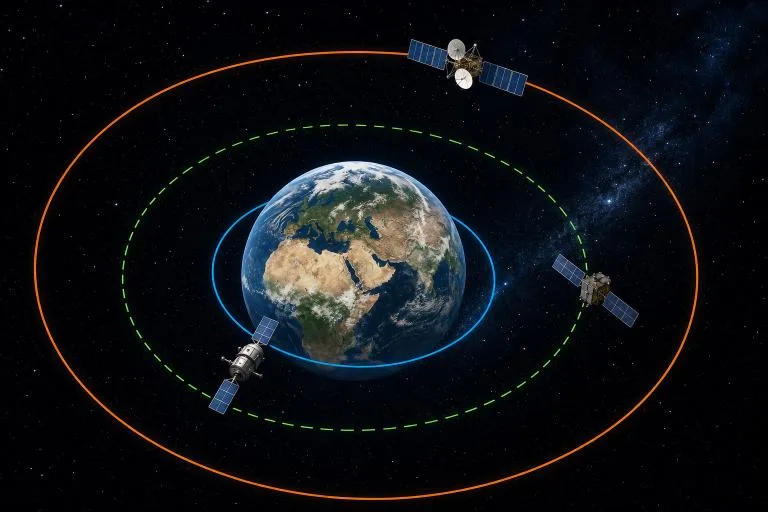
Satellites are placed in different orbits depending on their purpose. Based on their height from Earth, the three main types of orbit are:
- Low Earth Orbit (LEO)
- Medium Earth Orbit (MEO)
- High Earth Orbit (HEO)
Each orbit has different features and uses.
What Decides a Satellite’s Orbit?
The path of a satellite depends mainly on three things:
- Height of the satellite
- Eccentricity of orbit
- Inclination of orbit
These three factors decide how the satellite moves around Earth.
Height of Satellite
The height means the distance between the satellite and Earth’s surface.
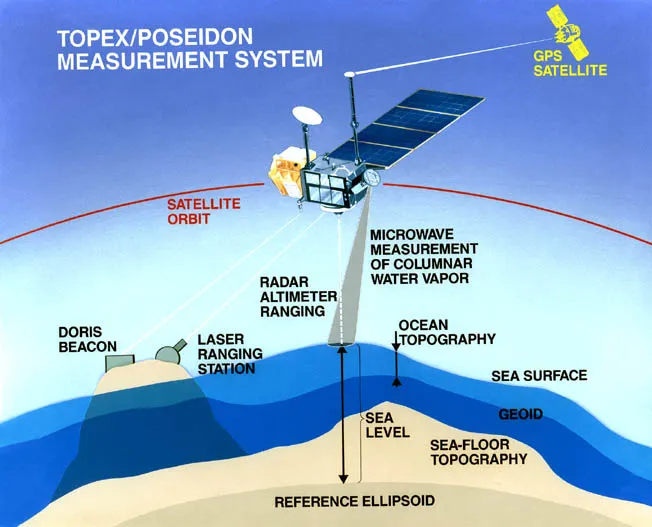
The height affects the speed of the satellite. A satellite closer to Earth moves faster because Earth’s gravity pulls it more strongly. A satellite farther from Earth moves slower.
For example:
- NASA’s Aqua satellite orbits Earth at about 705 km above the surface and completes one orbit in about 99 minutes.
- A communication satellite at around 36,000 km takes nearly 24 hours to complete one orbit.
The Moon is much farther away, about 384,403 km from Earth’s center, and takes around 28 days to complete one orbit.
A strange fact about orbital motion is that increasing a satellite’s speed is not always simple. If operators want a satellite to move faster, they often lower its orbit instead of directly speeding it up. A lower orbit increases orbital speed because Earth’s gravity becomes stronger.
Eccentricity of Orbit
Eccentricity describes the shape of an orbit.
An orbit can be:
- Circular
- Elliptical (oval-shaped)
A satellite with low eccentricity moves in a nearly circular orbit. A satellite with high eccentricity moves in a stretched elliptical orbit.
Important points:
- Eccentricity = 0 → Perfect circle
- Eccentricity close to 1 → Highly elliptical orbit
In an elliptical orbit, the satellite’s distance from Earth changes during movement. Sometimes it comes closer to Earth, and sometimes it moves farther away.
This helps certain satellites spend more time over specific regions.
Inclination of Orbit
Inclination is the angle between the satellite’s orbit and Earth’s equator.
Examples:
- 0° inclination → Orbit exactly above the equator
- 90° inclination → Orbit passes over both poles
- 180° inclination → Orbit moves opposite to Earth’s rotation
Inclination decides which parts of Earth the satellite can observe.
High Earth Orbit (HEO)
High Earth Orbit is located far from Earth. It begins at around 36,000 km above Earth’s surface.
At this height, satellites can match Earth’s rotation speed. This creates a special orbit called Geosynchronous Orbit.
In this orbit, the satellite takes exactly one day to complete one orbit.
Geostationary Orbit
A special type of geosynchronous orbit is called Geostationary Orbit.
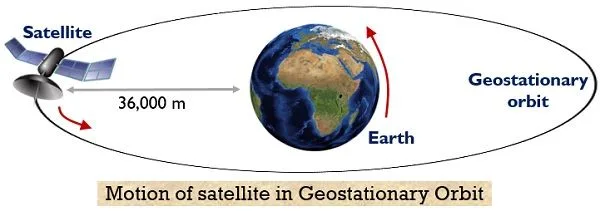
In this orbit:
- Satellite moves at the same speed as Earth’s rotation
- It stays above the same location on Earth
- From the ground, it appears motionless
This orbit is very useful for:
- Weather forecasting
- Television broadcasting
- Radio communication
- Mobile communication
Because the satellite always stays above one location, it can continuously observe the same area.
Many weather satellites use geostationary orbit to monitor storms and clouds.
Lagrange Points
Beyond high Earth orbit, there are special points in space called Lagrange Points.
At these points, the gravity of Earth and the Sun balance each other.
Objects placed here can remain stable with very little fuel.
There are five Lagrange Points.
First Lagrange Point (L1)
L1 lies between Earth and the Sun.
Satellites here get a continuous view of the Sun.
The Solar and Heliospheric Observatory (SOHO), operated by European Space Agency and NASA, observes the Sun from this point.
Second Lagrange Point (L2)
L2 lies behind Earth, opposite the Sun.
This location is excellent for space telescopes because a single heat shield can block heat from both Earth and Sun.
The James Webb Space Telescope operates near this point.
Third Lagrange Point (L3)
L3 lies on the opposite side of the Sun.
Communication with Earth from this point is difficult.
Fourth and Fifth Lagrange Points (L4 and L5)
These points lie 60 degrees ahead of and behind Earth in its orbit around the Sun.
They are very stable and useful for space observation.
Medium Earth Orbit (MEO)
Medium Earth Orbit lies between low and high Earth orbit.
Satellites here move faster than satellites in high orbit but slower than those in low orbit.
Two important medium Earth orbits are:
- Semi-synchronous orbit
- Molniya orbit
Semi-Synchronous Orbit
This orbit is about 20,200 km above Earth’s surface.
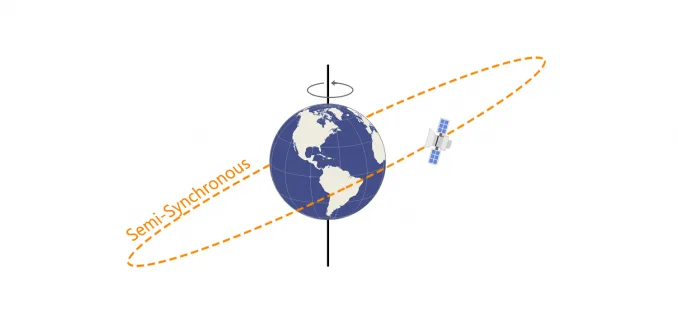
A satellite here takes 12 hours to complete one orbit.
In 24 hours, it passes over the same two places on Earth.
This orbit is widely used by navigation satellites.
The Global Positioning System (GPS) satellites use this orbit.
GPS helps in:
- Navigation
- Maps
- Location tracking
- Transportation
Because this orbit is highly predictable, it is perfect for navigation systems.
Molniya Orbit
The Molniya orbit was developed by Russia.
It has:
- High inclination
- High eccentricity
This orbit is very useful for observing areas near the North and South Poles.
Geostationary satellites do not work well in polar regions because they remain above the equator. Polar regions appear near the edge of their view.
Molniya orbit solves this problem.
Its main features:
- Inclination of 63.4°
- Eccentricity of 0.722
- One orbit takes 12 hours
Satellites in this orbit spend more time over high-latitude areas, making them ideal for northern countries.
Russian communication satellites use this orbit.
Low Earth Orbit (LEO)
Low Earth Orbit is the closest orbit to Earth.
Most scientific and observation satellites are placed here.
This orbit is commonly used for:
- Scientific research
- Earth observation
- Weather monitoring
- Imaging
- Space stations
Satellites in LEO move very fast.
They can complete one orbit in about 90 to 100 minutes.
Because they are close to Earth, they capture detailed images.
Most Earth observation satellites are placed in LEO.
Polar Orbit
A common type of low Earth orbit is the Polar Orbit.
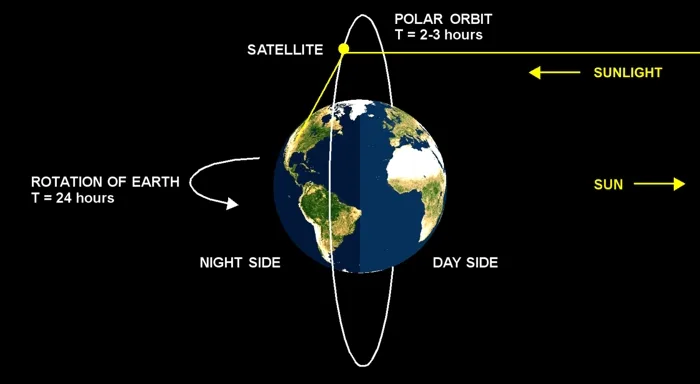
In this orbit, satellites move from:
- North Pole to South Pole
or - South Pole to North Pole
This allows satellites to observe almost the entire Earth.
As the satellite moves, Earth rotates below it. This helps the satellite scan different parts of the planet.
In one day, a polar satellite can observe most of Earth at least twice:
- Once during daytime
- Once during nighttime
This makes polar orbit highly useful for mapping and climate studies.
Sun-Synchronous Orbit
A special type of polar orbit is called Sun-Synchronous Orbit.
In this orbit, the satellite crosses the equator at the same local solar time every day.
For example:
If a satellite crosses one location at 10:30 AM, it will cross the next location at about 10:30 AM local time in the next orbit.
This gives scientists consistent lighting conditions.
This is very useful for:
- Taking satellite images
- Monitoring forests
- Tracking climate change
- Studying agriculture
Because sunlight remains similar in every image, comparison becomes easier.
Importance of Types of Orbit
Understanding the types of orbit is important because every satellite has a different job.
Different orbits serve different purposes:
| Orbit Type | Height | Main Uses |
|---|---|---|
| Low Earth Orbit | Up to 2,000 km | Imaging, research, weather |
| Medium Earth Orbit | 2,000–35,786 km | Navigation, communication |
| High Earth Orbit | Above 35,786 km | TV, radio, weather monitoring |
Without satellite orbits, many modern services would not work properly.
These include:
- GPS navigation
- Mobile communication
- Weather forecasting
- Internet services
- Space research
Satellites in different orbits help humans understand Earth and space better. They play a major role in science, communication, security, and daily life.
FAQs
Q1. What is an orbit?
An orbit is a fixed path in space along which a satellite or celestial object moves around another object due to gravity.
Q2. What are the main types of orbit?
The three main types of orbit are Low Earth Orbit (LEO), Medium Earth Orbit (MEO), and High Earth Orbit (HEO).
Q3. What is Low Earth Orbit (LEO)?
Low Earth Orbit is the closest orbit to Earth, usually up to 2,000 km above the surface. It is used for weather monitoring, scientific research, and Earth observation.
Q4. What is Medium Earth Orbit (MEO)?
Medium Earth Orbit lies between low and high orbit. It is mainly used for navigation satellites such as Global Positioning System.
Q5. What is High Earth Orbit (HEO)?
High Earth Orbit is located far from Earth, above 35,786 km. It is commonly used for communication and weather satellites.
Q6. What is a geostationary orbit?
A geostationary orbit is a special high Earth orbit where a satellite moves at the same speed as Earth’s rotation and appears fixed above one location.
Q7. Why are satellites placed in different orbits?
Satellites are placed in different orbits based on their purpose, such as communication, navigation, weather forecasting, or scientific research.
Q8. What is a polar orbit?
A polar orbit is an orbit in which satellites travel over Earth’s poles, allowing them to observe almost the entire planet.