Tectonic Plates: A Complete Guide to Earth’s Dynamic Surface

Tectonic Plates are massive pieces of Earth’s outer shell that constantly move and reshape the planet. These plates form the lithosphere, which includes the Earth’s crust and the uppermost part of the mantle. Though they appear stable to us, tectonic plates are always in motion, slowly drifting over a softer layer beneath them called the asthenosphere.
Thank you for reading this post, don't forget to subscribe!The theory of tectonic plates, also known as plate tectonics, was formally developed in 1967. Since then, it has become one of the most important concepts in physical geography and geology. It helps us understand earthquakes, volcanoes, mountain formation, and even the distribution of continents and oceans.
The lithosphere varies in thickness. Under oceans, it can be as thin as 5–100 km, while under continents it can reach up to 200 km. These rigid plates float over the semi-fluid asthenosphere, moving slowly but continuously over millions of years.
What Are Tectonic Plates?
Tectonic plates are large, irregular slabs of solid rock made up of continental and oceanic crust. Based on their composition, plates can be:
- Continental Plates – Mostly made up of landmass (e.g., Eurasian Plate)
- Oceanic Plates – Mostly made up of ocean floor (e.g., Pacific Plate)
Some plates contain both continental and oceanic parts. The size and shape of these plates vary widely, and their movement plays a major role in shaping Earth’s surface.
Major and Minor Tectonic Plates
The Earth’s lithosphere is divided into seven major plates and several smaller ones.
Major Plates
- Antarctic Plate
- North American Plate
- South American Plate
- Pacific Plate (largest, mostly oceanic)
- Indo-Australian Plate
- African Plate
- Eurasian Plate
These major plates are often surrounded by mountain ranges, ocean trenches, and transform faults.
Minor Plates
Some important smaller plates include:
- Cocos Plate
- Nazca Plate
- Arabian Plate
- Philippine Plate
- Caroline Plate
- Juan de Fuca Plate
Even though they are smaller, these plates play a crucial role in geological activities like earthquakes and volcanic eruptions.
Important Geological Features
Mountain Ridges
A mountain ridge is a long chain of mountains or hills forming a continuous elevated crest. These are often formed due to plate collisions.
Ocean Trenches
Ocean trenches are deep, narrow depressions in the ocean floor. They are the deepest parts of the Earth and are mainly found around the Pacific Ocean in a region known as the “Ring of Fire.”
Transform Faults
These are cracks in the Earth’s crust where two plates slide past each other horizontally. They are often associated with earthquakes.
The Indian Plate
The Indian Plate is one of the most important tectonic plates, especially for South Asia. It includes the Indian subcontinent and extends into the surrounding oceanic regions.
- In the east, it stretches toward Myanmar and the Java Trench.
- In the west, it touches parts of Pakistan and Balochistan.
- In the south, it connects with oceanic ridges near Antarctica.
The movement of the Indian Plate led to the formation of the Himalayas, one of the most famous mountain ranges in the world.

Asthenosphere: The Driving Layer
Below the lithosphere lies the asthenosphere, a semi-fluid layer of the mantle.
- Located about 100 km to 700 km below Earth’s surface
- Hotter and softer than the lithosphere
- Allows tectonic plates to move over it
This layer behaves like a slow-flowing fluid, enabling the movement of rigid plates above it.
Movement of Tectonic Plates
Tectonic plates are not fixed. They move slowly over the asthenosphere due to internal forces.
Speed of Movement
- Slowest: Arctic Ridge (~2.5 cm/year)
- Fastest: East Pacific Rise (>15 cm/year)
Though this movement seems small, over millions of years it causes major changes in Earth’s surface.
Driving Force
The movement is mainly caused by convection currents inside the Earth:
- Hot material rises from deep within the mantle
- It spreads out and cools near the surface
- Then it sinks back down
This continuous cycle pushes and pulls tectonic plates.
Subduction: A Key Process
Subduction occurs when one tectonic plate is forced beneath another.
- Usually happens when a denser oceanic plate collides with a lighter continental plate
- The sinking plate melts due to high temperature
- This creates magma, which rises to form volcanoes
Subduction zones are responsible for some of the most powerful earthquakes and volcanic eruptions.
Boundaries of Plates
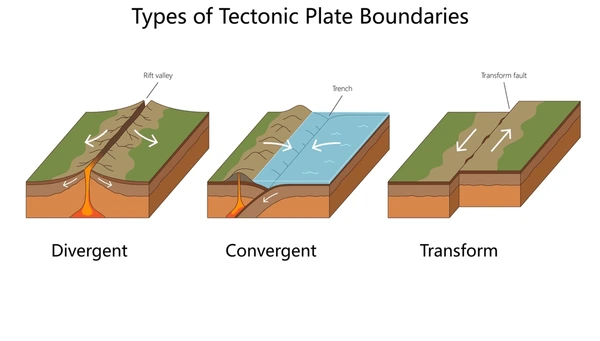
The movement of tectonic plates creates three main types of boundaries. These boundaries are very important because most earthquakes, volcanoes, and mountain formations happen here.
The three types of plate boundaries are:
- Convergent Boundaries – where plates move toward each other
- Divergent Boundaries – where plates move away from each other
- Transform Boundaries – where plates slide past each other
Each type of boundary has its own features and effects on Earth’s surface.
Convergent Boundaries (Destructive Boundaries)
A convergent boundary forms when two tectonic plates move toward each other and collide. These are also called destructive boundaries because one plate is often destroyed by going beneath the other.
Subduction Process
In many cases, one plate (usually the denser oceanic plate) is forced below the other plate into the mantle. This process is called subduction.
- The heavier plate sinks into the mantle
- It melts due to high temperature
- This forms magma
- Magma rises to the surface and creates volcanoes
Over millions of years, this process forms chains of volcanoes known as volcanic arcs.
Mountain Building and Island Arcs
Convergent boundaries also lead to:
- Formation of huge mountain ranges
- Creation of curved island chains called island arcs
If both plates are oceanic, volcanic islands form in a curved line parallel to the trench.
Types of Convergent Boundaries
There are three main types:
- Oceanic–Continental Convergence
- Oceanic plate goes under continental plate
- Example: Along the Washington–Oregon coast, the Juan de Fuca Plate goes beneath the North American Plate
- Oceanic–Oceanic Convergence
- One oceanic plate goes under another
- Example: Mariana Trench (deepest place on Earth), where the Pacific Plate goes under the Philippine Plate
- Continental–Continental Convergence
- Both plates are thick and resist subduction
- Leads to folding and mountain formation
- Example: Himalayas formed when the Indian Plate collided with the Eurasian Plate about 55 million years ago
Subduction Zones
A subduction zone is the area where one plate moves under another.
- It is one of the most active geological regions
- Causes powerful earthquakes
- Creates volcanoes and deep ocean trenches
These zones are often called the “biggest crash scenes on Earth” because of intense activity.
Divergent Boundaries (Constructive Boundaries)
A divergent boundary forms when two tectonic plates move away from each other. These are also called constructive boundaries because new crust is created here.
How It Works
- Plates pull apart
- Magma rises from the mantle
- Magma cools and forms new crust
This process is known as seafloor spreading.
Features of Divergent Boundaries
- Mid-ocean ridges
- Rift valleys
- Volcanoes
Example
The Mid-Atlantic Ridge is the most famous divergent boundary. It separates:
- American Plates from
- Eurasian and African Plates
It is the longest mountain range in the world, stretching about 10,000 miles under the ocean.
Seafloor Spreading
Seafloor spreading is the process by which new ocean floor is formed.
- Magma rises through cracks in the ocean floor
- Cold seawater cools the magma
- New crust is created
- Older crust moves away
Over millions of years, this process forms large underwater ridges.
Example
The East Pacific Rise is a major seafloor spreading center located in the Pacific Ocean and is part of the Ring of Fire.
Rift Valleys
A rift valley forms when tectonic plates move apart on land.
- It creates a long, deep valley
- Formed due to tectonic forces, not erosion
Example
The Great Rift Valley in Africa:
- Extends from the Middle East to Mozambique
- Contains volcanoes, hot springs, and earthquakes
- May eventually split Africa into two parts
Transform Boundaries (Conservative Boundaries)
A transform boundary forms when tectonic plates slide horizontally past each other.
- No crust is created or destroyed
- Plates get stuck due to friction
- Stress builds up over time
- Sudden release causes earthquakes
Faults
The cracks formed in these regions are called faults.
- Most faults are found along transform boundaries
- These areas are highly earthquake-prone
Example
The San Andreas Fault in California:
- Responsible for many major earthquakes
- Pacific Plate moves past North American Plate
- One of the most active fault systems in the world
Hotspots and Mantle Plumes
Not all volcanic activity occurs at plate boundaries. Some happen within plates at hotspots.
What Are Hotspots?
- Fixed locations where magma rises from deep within the mantle
- Create volcanoes even in the middle of plates
Mantle Plumes
- Columns of hot magma rising from deep inside Earth
- Cause thinning of the crust and volcanic activity
Examples of Hotspots:
- Iceland Hotspot
- Réunion Hotspot
- Afar Hotspot
These hotspots remain stationary while tectonic plates move over them, creating chains of volcanoes.
Importance of Tectonic Plates
Understanding tectonic plates is crucial because they:
- Explain earthquakes and volcanic eruptions
- Help predict natural disasters
- Explain the formation of mountains and oceans
- Provide insight into Earth’s history and future
Conclusion
Tectonic Plates are the foundation of Earth’s dynamic nature. Their slow but constant movement shapes continents, creates mountains, triggers earthquakes, and forms volcanoes. From the towering Himalayas to the deep ocean trenches, almost every major landform on Earth is connected to plate tectonics.
By studying tectonic plates, scientists can better understand natural hazards and the evolution of our planet. Even though we cannot see these plates moving, their effects are visible all around us, reminding us that Earth is a living, ever-changing system.
FAQs on Tectonic Plates
1. What are tectonic plates?
Tectonic plates are large pieces of Earth’s crust and upper mantle that move slowly over the asthenosphere. They shape the surface of the Earth.
2. How many tectonic plates are there?
There are seven major tectonic plates and several minor plates that together form the Earth’s lithosphere.
3. Why do tectonic plates move?
Tectonic plates move due to convection currents in the mantle. Hot material rises, cools, and sinks, creating a cycle that pushes the plates.
4. What happens when tectonic plates collide?
When plates collide, they form mountains, volcanoes, or deep ocean trenches. This process is called a convergent boundary.
5. What is a divergent boundary?
A divergent boundary is where two tectonic plates move away from each other, allowing magma to rise and form new crust.
6. What is a transform boundary?
A transform boundary is where plates slide past each other. This movement often causes earthquakes.
7. What is subduction?
Subduction is the process where one tectonic plate is forced beneath another into the mantle, leading to volcanic activity.
8. Which tectonic plate is the largest?
The Pacific Plate is the largest tectonic plate and is mostly oceanic.
9. What is the role of the Indian Plate?
The Indian Plate collided with the Eurasian Plate, forming the Himalayas, the highest mountain range in the world.
10. What are hotspots in tectonic plates?
Hotspots are fixed areas in the mantle where hot magma rises and creates volcanoes, even away from plate boundaries.