


Environmental Conventions: Global Agreements for Biodiversity Protection(Part-I)

Environmental Conventions are important international agreements made by different countries to protect nature and biodiversity. These conventions help nations work together to solve environmental problems like pollution, deforestation, wildlife loss, wetland destruction, and climate change.
Thank you for reading this post, don't forget to subscribe!Since environmental problems do not stop at national borders, countries need joint action. International conventions provide a legal framework that guides countries on how to protect forests, animals, water resources, and ecosystems.
What are Environmental Conventions?
An environmental convention is a legally binding agreement between governments. These agreements are created so countries can work together to reduce environmental damage and protect natural resources.
Making such agreements is not easy because every country has different needs, resources, and priorities. Still, many important conventions have been created in recent decades to tackle global environmental issues.
These conventions focus on problems such as:
- Loss of biodiversity
- Illegal wildlife trade
- Wetland destruction
- Land degradation
- Desertification
- Climate change
- Hazardous waste pollution
They help countries create common goals and shared responsibilities.
Why are Environmental Conventions Important?
Environmental conventions are important for many reasons.
1. Protect Human Health
Environmental damage can directly affect human health. Polluted air and water can cause serious diseases. These agreements help reduce such risks.
2. Improve Food Security
Healthy soil, water, forests, and biodiversity are necessary for agriculture. If nature is damaged, food production becomes difficult.
3. Support Economic Growth
Natural resources support industries like farming, tourism, and fisheries. Protecting them helps long-term economic development.
4. Reduce Climate Change Impact
Deforestation, pollution, and land degradation increase climate problems. Conventions encourage sustainable solutions.
5. Promote International Cooperation
Environmental problems are global. Conventions create a platform where countries discuss solutions together.
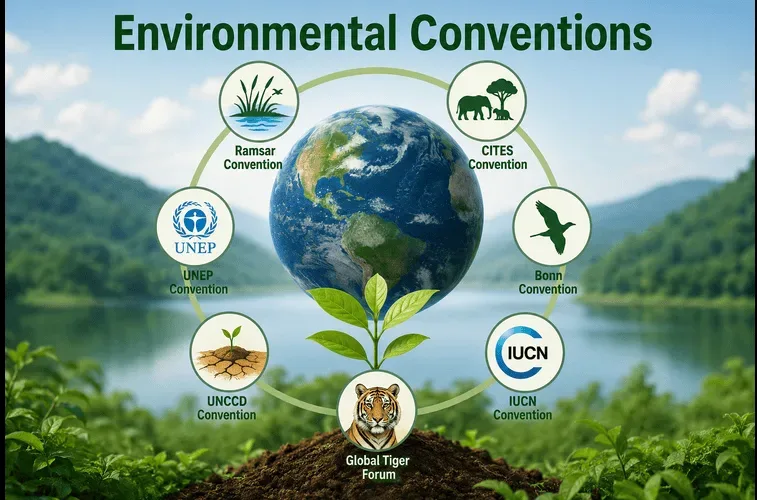
Ramsar Convention on Wetlands
The Ramsar Convention is one of the most important environmental conventions related to wetlands.
It was adopted in 1971 in Ramsar, Iran, near the Caspian Sea.
Its main goal is the conservation and wise use of wetlands.
Wetlands include:
- Lakes
- Marshes
- Swamps
- Floodplains
- Mangroves
- Rivers
Wetlands are important because they:
- Store water
- Prevent floods
- Support wildlife
- Improve water quality
- Store carbon
India became part of this convention in 1982.
Wetlands with international importance are called Ramsar Sites.
As of 2022, India had 54 Ramsar sites.
Some important Ramsar sites include:
| Wetland | State |
|---|---|
| Keoladeo National Park | Rajasthan |
| Loktak Lake | Manipur |
| Pala Wetland | Mizoram |
| Sakhya Sagar | Madhya Pradesh |
Montreux Record
The Montreux Record lists wetlands where ecological damage has happened or may happen due to pollution or human activities.
Two Indian wetlands in this record are:
- Keoladeo National Park
- Loktak Lake
CITES Convention
CITES stands for Convention on International Trade in Endangered Species of Wild Fauna and Flora.
This convention controls international trade of wild animals and plants.
It was created after a proposal by the International Union for Conservation of Nature in 1963 and officially came into force in 1975.
Its main goal is simple:
Trade should not threaten the survival of species.
Illegal wildlife trade is one of the biggest threats to biodiversity. Animals such as tigers, elephants, rhinos, and rare birds are often hunted for profit.
CITES helps prevent this.
Currently, more than 180 countries are members.
The CITES Secretariat is managed by the United Nations Environment Programme and is located in Geneva.
CITES does not replace national laws. Instead, each country must create its own rules to enforce the convention.
Bonn Convention (CMS)
The Bonn Convention is also called the Convention on Migratory Species (CMS).
This convention protects animals that migrate from one country to another.
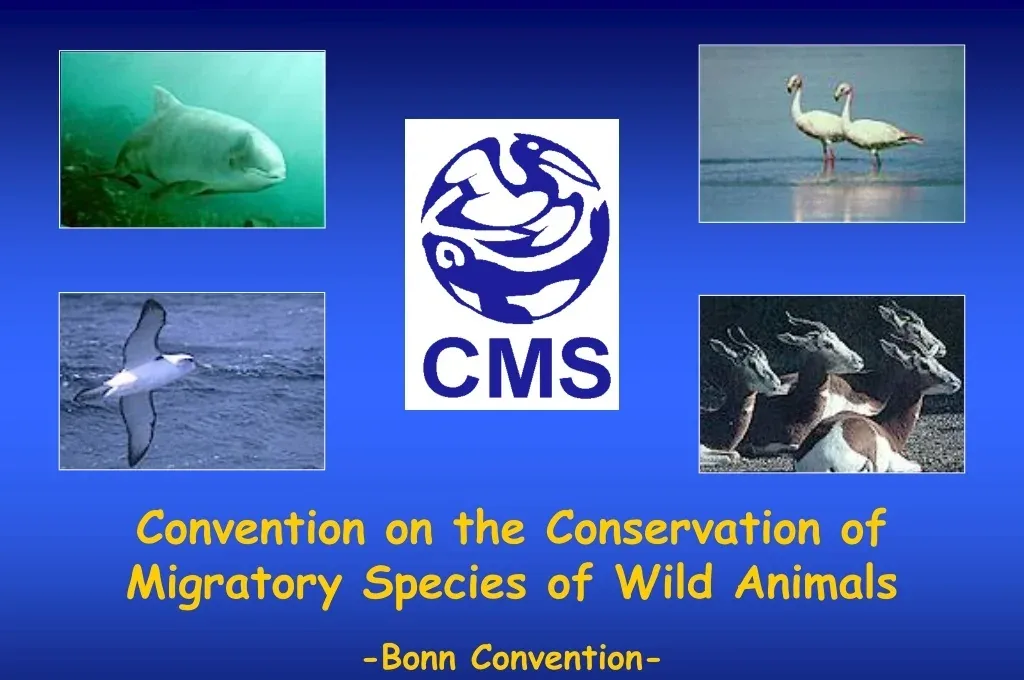
Examples of migratory species:
- Birds
- Whales
- Dolphins
- Sea turtles
- Bats
These animals cross national borders, so one country alone cannot protect them.
The convention came into force in 1983.
India hosted the 13th Conference of Parties in 2020 at Gandhinagar.
CMS has two appendices.
Appendix I
Includes species that are endangered and at risk of extinction.
Appendix II
Includes species needing international cooperation for protection and management.
This convention reminds countries to protect migratory animals living in or passing through their territories.
International Union for Conservation of Nature (IUCN)
The International Union for Conservation of Nature or IUCN was created in 1948.
It is headquartered in Switzerland.
IUCN is one of the world’s most trusted conservation organizations. It studies the health of biodiversity and suggests protection measures.
Its most famous contribution is the IUCN Red List.
The Red List measures the extinction risk of species.
It classifies species into categories such as:
| Category | Meaning |
| NE | Not Evaluated |
| LC | Least Concern |
| VU | Vulnerable |
| EN | Endangered |
| CR | Critically Endangered |
| EX | Extinct |
Species in Vulnerable, Endangered, and Critically Endangered categories are considered highly threatened.
The Red List is used worldwide to guide conservation decisions.
Global Tiger Forum
The Global Tiger Forum (GTF) is the only intergovernmental organization focused only on tiger conservation.
It was established in 1993 in New Delhi.
Its purpose is to protect tigers across countries where wild tiger populations still exist.
Major threats to tigers include:
- Poaching
- Habitat loss
- Human-wildlife conflict
- Illegal wildlife trade
Countries work together through GTF to improve tiger protection.
India plays a major role because it has the world’s largest tiger population.
United Nations Convention to Combat Desertification (UNCCD)
The UNCCD was established in 1994.
It focuses on:
- Desertification
- Drought
- Land degradation
Land degradation happens when fertile land becomes weak and unproductive due to:
- Deforestation
- Overgrazing
- Poor farming methods
- Climate change
UNCCD is the only legally binding global agreement on land degradation.
Its goal is to restore land and improve sustainability.
Healthy land provides:
- Food
- Water
- Shelter
- Employment
This convention brings together governments, scientists, communities, and businesses to protect land resources.
Currently, nearly every country in the world is part of UNCCD.
United Nations Environment Programme (UNEP)
The United Nations Environment Programme or UNEP is the leading environmental authority under the United Nations.
It was established in 1972 after the Stockholm Conference.
Its main role is to guide global environmental policies.
UNEP works in areas such as:
- Climate change
- Pollution control
- Biodiversity protection
- Sustainable development
- Waste management
In 1988, UNEP and the World Meteorological Organization created the Intergovernmental Panel on Climate Change (IPCC).
The IPCC studies climate science and provides important reports on global warming.
UNEP also supports many major environmental agreements, including:
- Convention on Biological Diversity (CBD)
- CITES
- CMS
- Vienna Convention
- Basel Convention
- Stockholm Convention
- Rotterdam Convention
- Minamata Convention
These agreements help the world fight pollution and protect biodiversity.

Environmental Conventions and the Future
Environmental conventions are essential for protecting Earth’s biodiversity. Forests, rivers, wetlands, animals, and ecosystems are under growing pressure from human activities.
Without global cooperation, many species may disappear forever.
These conventions help countries take collective action and create a safer future for both people and nature.
Protecting biodiversity means protecting life itself. Every country, community, and individual has a role in preserving the environment for future generations.
FAQs
Q1. What are environmental conventions?
Environmental conventions are international agreements between countries to protect the environment and natural resources.
Q2. What is the Ramsar Convention?
The Ramsar Convention is a global treaty for the conservation and wise use of wetlands.
Q3. What is CITES?
CITES is an agreement that controls international trade in endangered animals and plants.
Q4. What is the role of IUCN?
IUCN studies biodiversity and publishes the Red List of threatened species.
Q5. Why are environmental conventions important?
They help countries work together to solve global environmental problems like pollution, biodiversity loss, and climate change.