


Coastal Regulation Zone: Protecting India’s Coastal Areas

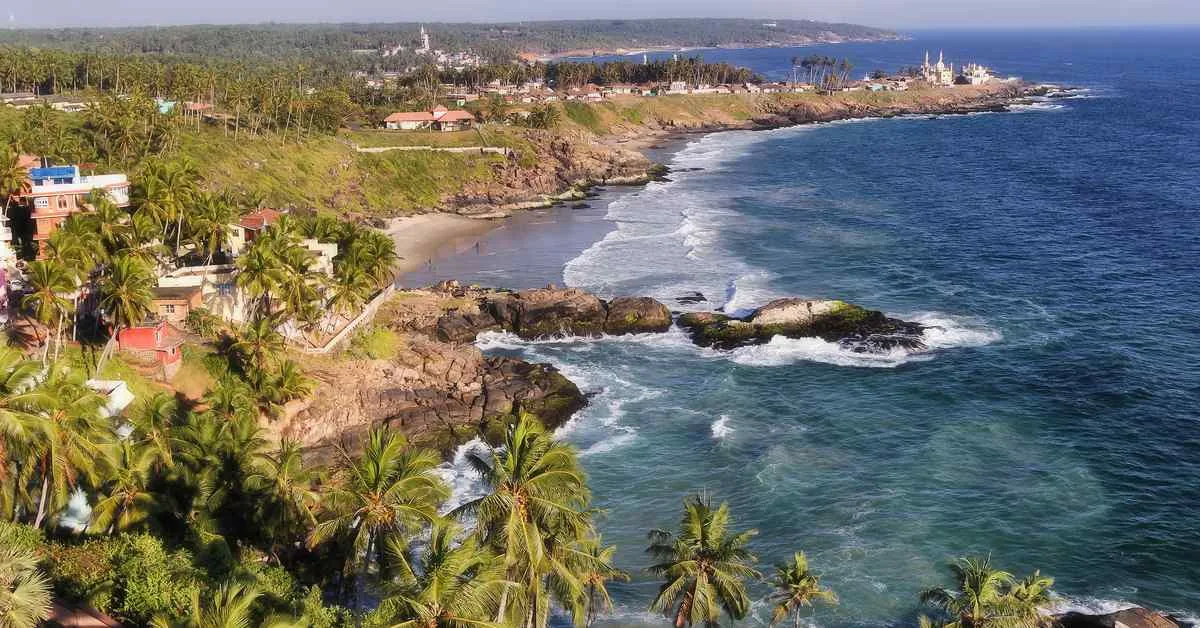
Coastal Regulation Zone (CRZ) is an important environmental policy in India that helps protect coastal areas from harmful development and pollution. India has a long coastline of about 7,500 kilometers, including beaches, mangroves, estuaries, creeks, and islands. These coastal areas are rich in biodiversity and also support millions of people, especially fishing communities.
Thank you for reading this post, don't forget to subscribe!Recently, the Coastal Regulation Zone came into news after four luxury apartment buildings in Maradu municipality near Kochi were demolished by Supreme Court order because they violated CRZ rules. This incident showed how important these regulations are for protecting coastal ecosystems.
What is Coastal Regulation Zone?
The Coastal Regulation Zone (CRZ) refers to coastal land areas that are affected by sea tides. In 1991, the Government of India declared certain coastal areas as CRZ under the Environment (Protection) Act, 1986.
These areas include:
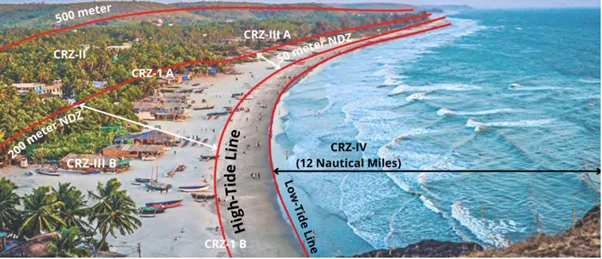
- Land up to 500 meters from the High Tide Line (HTL)
- The land between Low Tide Line (LTL) and High Tide Line (HTL)
The CRZ rules are made by the Ministry of Environment, Forest and Climate Change, while state governments enforce them through Coastal Zone Management Authorities.
Understanding HTL and LTL
High Tide Line (HTL)
The High Tide Line is the highest point up to which seawater reaches during high tide.
Low Tide Line (LTL)
The Low Tide Line is the lowest point up to which seawater remains during low tide.
What are Spring Tides?
Spring tides happen when the Sun, Moon, and Earth are in a straight line. During this time, tides become stronger and higher than usual. These occur twice every month:
- During the full moon
- During the new moon
These tidal measurements are important in deciding CRZ boundaries.
Why is Coastal Regulation Important?
India’s coastal areas are very sensitive. Uncontrolled construction and pollution can damage them permanently. CRZ regulations help in the following ways:
1. Protection of Sensitive Ecosystems
Coastal areas include important natural resources such as:
- Mangroves
- Coral reefs
- Sand dunes
- Salt marshes
- Turtle nesting beaches
These ecosystems protect coastal regions from cyclones, tsunamis, and erosion.
2. Support for Coastal Communities
Millions of people living near coasts depend on:
- Fishing
- Salt farming
- Tourism
- Small-scale trade
CRZ helps protect their livelihoods.
3. Climate Change Protection
Sea levels are rising due to climate change. Coastal areas are becoming more vulnerable to:
- Flooding
- Storm surges
- Strong cyclones
CRZ helps reduce such risks.
4. Balanced Development
Development is important, but it should not destroy nature. CRZ ensures balance between:
- Infrastructure growth
- Environmental conservation
History of CRZ Rules in India
India introduced CRZ rules to regulate activities near coastlines.
CRZ Notification 1991
The first CRZ notification was issued in 1991 by the Government of India.
Its main goal was to control harmful activities near coastal areas such as:
- Large building construction
- New industries
- Hazardous waste disposal
- Mining
- Land reclamation
Problems in CRZ 1991
Although important, CRZ 1991 had several weaknesses:
1. Same Rules for All Coastlines
India’s coastline is diverse, but the rules treated all coastal areas equally.
2. No Clear Approval Process
There was confusion about how projects could get CRZ clearance.
3. Weak Monitoring
There was no strong system to check whether approved projects followed rules.
4. Pollution Not Properly Addressed
Land-based pollution was not fully covered.
5. Problems for Local Communities
Traditional fishing communities often faced difficulties due to strict rules.
Because of these issues, changes were needed.
CRZ Notification 2011
After many amendments, the government introduced CRZ Notification 2011.
Its main objectives were:
1. Protect Coastal Areas
Prevent environmental damage in fragile coastal regions.
2. Protect Livelihoods
Support fishermen and local coastal communities.
3. Promote Sustainable Development
Encourage development based on scientific planning while considering:
- Natural disasters
- Sea-level rise
- Climate risks
Classification of Coastal Zones under CRZ 2011
Under CRZ 2011, coastal areas were divided into four categories.
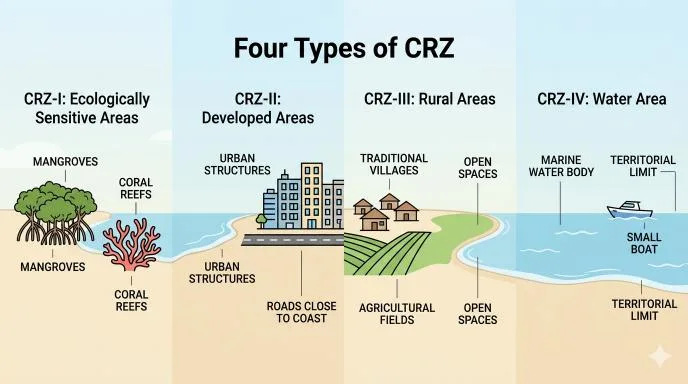
CRZ-I
This includes ecologically sensitive areas such as:
- Mangroves
- Coral reefs
- Biosphere reserves
- National parks
- Turtle nesting grounds
Rules for CRZ-I
No new construction is allowed except for limited activities such as:
- Strategic defense projects
- Atomic energy projects
- Essential public utilities
- Some roads or sea links without affecting tidal flow
This category receives the highest protection.
CRZ-II
This includes developed coastal areas inside municipal limits such as:
- Cities
- Towns
- Built-up villages
Examples include many urban coastal regions.
Rules for CRZ-II
Construction is allowed only on the landward side and according to guidelines.
Allowed activities include:
- Buildings
- Desalination plants
- Public infrastructure
However, strict planning rules apply.
CRZ-III
These are relatively untouched coastal areas, mostly rural regions.
These areas are not heavily developed.
CRZ-III is divided into two parts:
0–200 meters from HTL
This is called No Development Zone (NDZ).
No construction is generally allowed here.
Only limited activities may be permitted, such as:
- Agriculture
- Forestry
- Salt production
- Renewable energy projects
- Public utility projects
200–500 meters from HTL
Some development is allowed here, including:
- Houses for local communities
- Tourism-related projects
But projects must follow CRZ norms.
CRZ-IV
This includes water areas from LTL up to territorial waters.
Examples:
- Sea water areas
- Tidal rivers
- Backwaters
Rules for CRZ-IV
Traditional fishing is allowed.
However:
- Untreated sewage cannot be discharged
- Solid waste dumping is prohibited
This protects marine ecosystems.
Clearance Process under CRZ 2011
Projects in CRZ areas need approval before construction.
The approval process includes:
| Required Document | Purpose |
|---|---|
| Rapid Environmental Impact Assessment (EIA) | Study environmental impact |
| Disaster Management Report | Analyze disaster risks |
| Risk Management Report | Plan safety measures |
| CRZ Map | Show HTL and LTL boundaries |
| Pollution Board NOC | Confirm pollution control compliance |
Once approved, project clearance remains valid for five years.
Ecologically Sensitive Areas Given Special Protection
Some coastal areas in India are highly sensitive and receive special protection.
Important examples include:
- Sundarbans
- Gulf of Khambat
- Gulf of Kutch
- Karwar
- Vembanad Lake
- Bhitarkanika
- Coringa
These are called Critical Vulnerable Coastal Areas (CVCA).
Special management plans are prepared for them with help from local communities.
Protected Turtle Nesting Beaches
Some beaches in Goa are famous for turtle nesting, such as:
- Mandrem
- Morjim
- Galgibaga
- Agonda
These are protected under the Wildlife Protection Act, 1972.
No development is allowed in such sensitive nesting areas.
Shailesh Nayak Committee Report
The Shailesh Nayak Committee was formed in June 2014 to review CRZ rules.
The committee submitted its report in January 2015.
Main Recommendations
The committee suggested relaxing some CRZ rules to encourage:
- Tourism
- Port development
- Real estate growth
It also recommended giving more decision-making power to:
- State governments
- Local planning bodies
instead of central authorities.
The committee believed local governments could manage coastal development more effectively.
CRZ Notification 2018
Based on the committee’s recommendations and suggestions from coastal states, the government introduced CRZ Notification 2018.
This new notification aimed to make rules more practical while still protecting the environment.
Key changes included:
- More powers to states
- Easier clearance for some projects
- Better planning for densely populated coastal areas
- Support for tourism and economic development
However, environmental experts also raised concerns that excessive relaxation may harm fragile coastal ecosystems.
Challenges in Coastal Regulation
Even with CRZ laws, many problems continue.
Illegal Construction
Some builders ignore CRZ rules and construct illegal buildings.
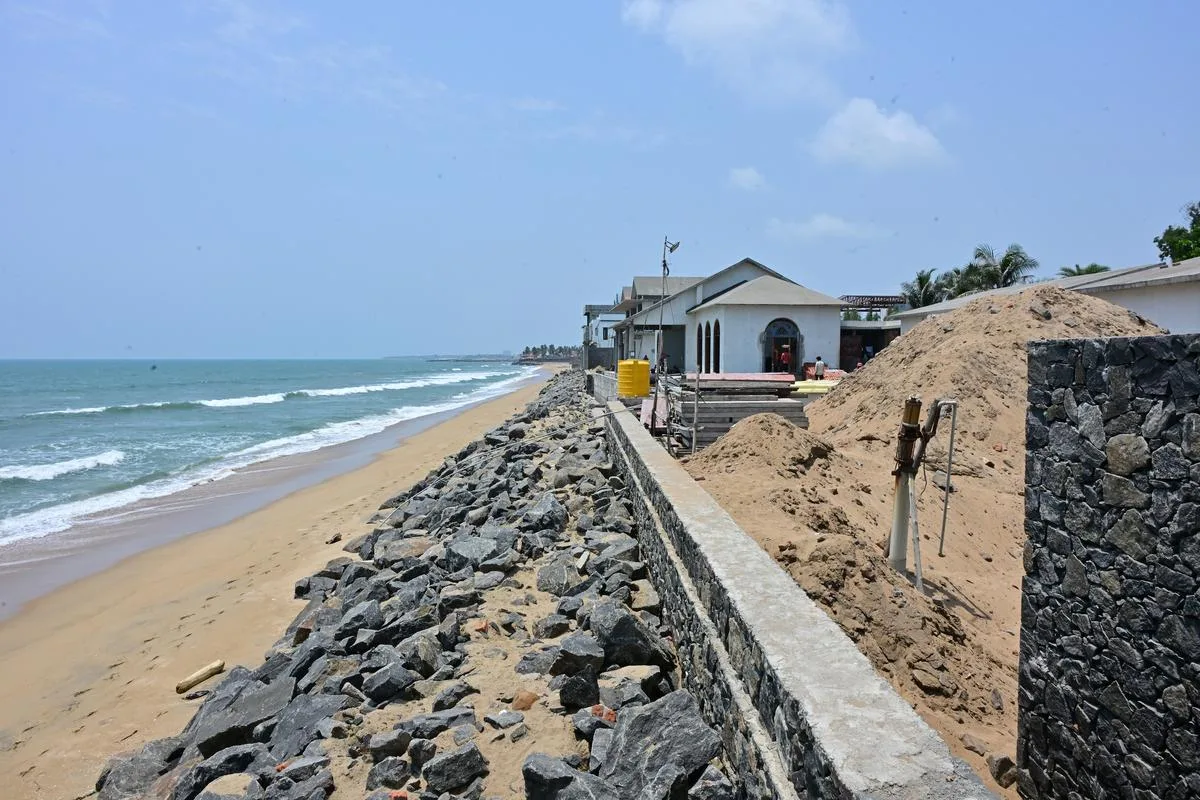
The Maradu demolition case is a major example.
Weak Enforcement
In some areas, local authorities fail to act against violations.
Rising Climate Risks
Cyclones and sea-level rise are increasing.
Pressure from Development
Ports, industries, tourism, and housing demand more coastal land.
This creates conflict between development and conservation.
Importance of CRZ for India’s Future
India’s coastal regions are valuable for both nature and economy. They support:
- Fisheries
- Tourism
- Shipping
- Biodiversity
- Coastal communities
Without proper regulation, these areas may face irreversible damage.
The Coastal Regulation Zone policy helps India ensure that development happens responsibly. It protects nature while allowing sustainable growth. As climate change increases coastal risks, strong CRZ implementation becomes even more important for India’s future.
FAQs
Q1. What is Coastal Regulation Zone (CRZ)?
Coastal Regulation Zone (CRZ) is a rule in India that controls development and construction near coastal areas to protect the environment.
Q2. When was CRZ introduced in India?
CRZ was first introduced in 1991 under the Environment (Protection) Act, 1986.
Q3. Why is Coastal Regulation Zone important?
CRZ is important because it protects coastal ecosystems, supports fishing communities, reduces climate risks, and prevents illegal construction.
Q4. What are the four CRZ categories?
The four categories are:
- CRZ-I
- CRZ-II
- CRZ-III
- CRZ-IV
Each category has different rules for construction and development.
Q5. What is High Tide Line (HTL)?
HTL is the highest point on land where seawater reaches during high tide.
Q6. What is Low Tide Line (LTL)?
LTL is the lowest point on land where seawater reaches during low tide.
Q7. What activities are restricted in CRZ areas?
Restricted activities include:
- Large construction projects
- Hazardous waste disposal
- Mining
- New industries in sensitive zones
Q8. What is the No Development Zone?
The No Development Zone is the area within 0–200 meters from the High Tide Line, where construction is mostly prohibited.