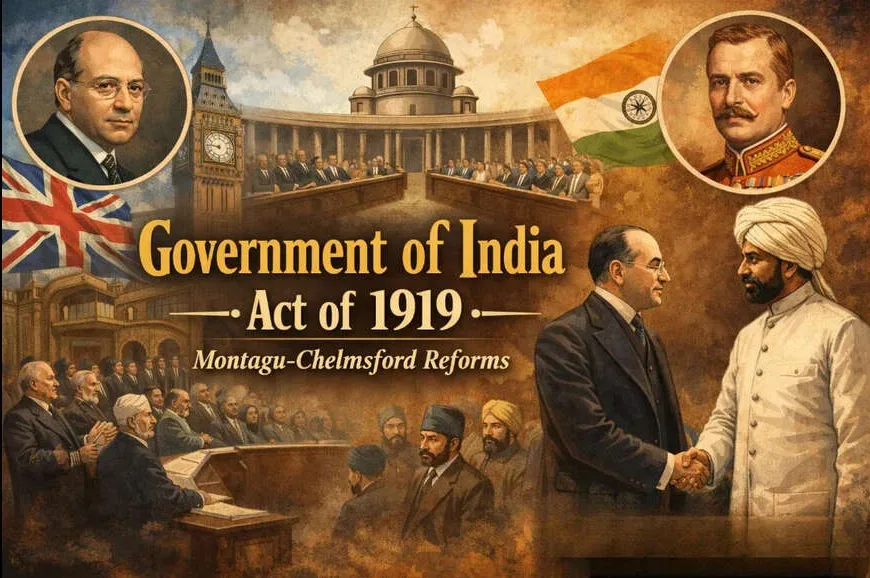
Government of India Act 1919: Montagu-Chelmsford Reforms Explained

Government of India Act 1919 was a landmark constitutional reform that reshaped British India’s governance. Enacted after the famous Montagu-Chelmsford Report, this Act fundamentally altered the relationship between Indians and their colonial rulers introducing bicameralism, dyarchy, and expanded voting rights for the first time.
Thank you for reading this post, don't forget to subscribe!Background and Origin
The roots of the Government of India Act 1919 lie in a document produced in 1918 by Edwin Montagu, the Secretary of State for India, and Lord Chelmsford, the Viceroy of India. Together, they prepared a comprehensive scheme of constitutional reforms popularly known as the Montagu-Chelmsford Reforms or the Mont-Ford Reforms.
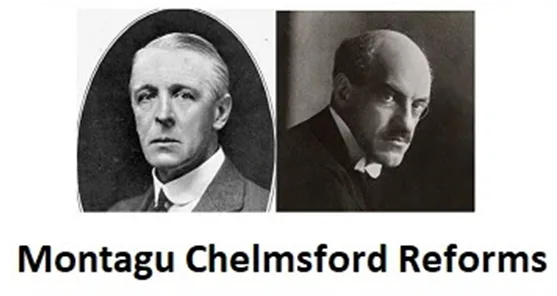
These reforms were a direct response to growing Indian nationalist sentiment, the contributions of Indian soldiers during World War I, and the demand for greater self-governance. The British government recognized that some form of political concession was necessary to maintain its hold over India while satisfying a restless population.
The Act came into force in 1921 and was specifically designed to ensure Indian representation in government structures at both the central and provincial levels. While it fell far short of true self-rule, it did represent a significant step in the evolution of India’s constitutional history.
Salient Features of the Government of India Act 1919
Central Level Reforms
Executive Structure
- The Act confirmed the Governor-General as the chief executive authority at the central level.
- The Viceroy’s Executive Council was to consist of eight members, of whom three were to be Indians a notable concession for the time.
- The Governor-General retained sweeping powers: he could restore cuts in grants, certify bills rejected by the legislature, and issue ordinances when required.
Bicameral Legislature
One of the most significant reforms at the central level was the introduction of a bicameral legislature, consisting of:
- Lower House — Central Legislative Assembly
- Upper House — Council of State
This was a fundamental structural change from the earlier unicameral setup.
Composition of the Lower House (Central Legislative Assembly)
- Total members: 145
- Tenure: 3 years
- 41 nominated members (26 official, 15 non-official)
- 104 elected members (52 General, 30 Muslims, 2 Sikhs, 20 Special)
Composition of the Upper House (Council of State)
- Total members: 60
- Tenure: 5 years
- Only male members were allowed
- 26 nominated members
- 34 elected members (20 General, 10 Muslims, 3 Europeans, 1 Sikh)
Powers of the Central Legislature
- Legislators could ask questions and supplementaries in sessions.
- They could pass adjournment motions and vote on a part of the budget.
- However, 75% of the budget remained non-votable, severely limiting financial oversight.
- The legislature had authority to make laws for the whole of India, covering all officers and citizens, whether present in India or not.
- The central government retained unrestricted control over provincial governments.
Restrictions on the Legislature
Several important restrictions were placed on the Central Legislature:
- Permission of the Governor-General was necessary to introduce bills relating to existing law amendments, foreign relations, armed forces, and relations with Indian states.
- The Indian legislature could not change or reverse any law passed by the British Parliament in relation to India.
- The legislature had virtually no control over the Governor-General and his Executive Council.
Powers of the Viceroy
- The Viceroy addressed the legislature and could call, adjourn, or dissolve its sessions.
- He could extend the three-year tenure of the legislature as he saw fit.
- All significant decisions ultimately rested with him, reinforcing the colonial power structure.
Provincial Level Reforms
Subjects Covered at Provincial Level
Provincial administration dealt with matters specific to individual provinces, including:
- Public health and medical facilities
- Local self-government
- Education and general administration
- Land revenue and water supply
- Famine relief, agriculture, and law and order
Introduction of Dyarchy
The most revolutionary feature at the provincial level was the introduction of Dyarchy a system of dual governance where power was divided between two sets of administrators.
Dyarchy was implemented in eight provinces:
The Governor was designated as the executive head in each province.
Division of Subjects: Reserved and Transferred
Provincial subjects were divided into two distinct categories:
Reserved Subjects (administered by the Governor through his executive council of bureaucrats):
- Law and order
- Finance and land revenue
- Irrigation
- Justice and police
- Press matters
Transferred Subjects (administered by ministers elected from the legislative council):
- Education
- Health and public welfare
- Local government
- Industry and agriculture
- Excise
All critical and high-revenue subjects were kept under reserved categories, while less powerful portfolios were transferred to Indian ministers. This arrangement was deliberately designed to limit Indian authority over sensitive administration.
In case of a constitutional breakdown, the Governor could take over even the transferred subjects, removing ministers entirely.
Restriction on Interference
- The Secretary of State for India and the Governor-General could interfere in reserved subjects freely.
- Their scope for interference in transferred subjects was restricted, giving Indian ministers limited but real authority in those areas.
Reforms in Provincial Legislatures
- Provincial legislative councils were significantly expanded.
- 70% of members were to be elected, a major democratic improvement.
- The system of communal and class electorates was further consolidated.
- Women were also given the right to vote a historic development.
- The legislative councils could reject the budget, but the Governor could restore it if necessary.
- Legislators enjoyed freedom of speech within the councils.
Powers of the Governor at Provincial Level
- The Governor could overrule ministers on any matter he considered special.
- He retained complete control over provincial finances.
- He could veto bills and issue ordinances.
- Legislative councils could initiate legislation but required the Governor’s assent to pass it.
Significance of the Government of India Act 1919
Political Awakening Among Indians
The Act brought Indians closer to the administrative machinery than ever before. Exposure to governance even in limited roles instilled a sense of responsibility and awareness. It awakened nationalist sentiment and pushed many Indians to strive for the larger goal of Swaraj (self-rule).
Expansion of Voting Rights
The franchise was extended considerably. For the first time, a meaningful number of Indians could vote, and constituencies were expanded across the country. Indians began to understand and value the electoral process, laying the groundwork for mass political participation.
Provincial Self-Government
The Act gave Indians real authority, however limited, over provincial administration. For the first time, Indian ministers were responsible for governing specific subjects. This was a practical training ground for self-government and prepared Indians to handle administrative responsibilities at a broader scale.
Drawbacks of the Government of India Act 1919
Despite its positive contributions, the Act had deep and serious limitations:
- No Responsible Central Government: The Act made no provision for a responsible government at the all-India level. Real power remained firmly with the Viceroy and his council.
- Promotion of Communalism: The communal electoral system with separate electorates for Hindus, Muslims, Sikhs, and others deepened religious divisions and encouraged communal thinking rather than national unity.
- Limited Franchise: The electorate was extended to only about one and a half million people out of a total Indian population of approximately 260 million a fraction too small to be called democratic.
- Weak Legislative Control: The central legislature had no real control over the Viceroy or his Executive Council. Financial control was largely absent, with 75% of the budget beyond legislative reach.
- Ministers Without Real Power: Provincial ministers had no control over finances or bureaucrats. They were frequently not consulted on important matters and could be overruled by the Governor at any time.
- Irrational Division of Subjects: The division between reserved and transferred subjects was widely criticized as artificial and impractical. Running parallel administrations over the same population created constant friction and inefficiency.
- Unrestricted Gubernatorial Powers: Governors enjoyed excessive authority. They could act against the decisions of their own councils and ministers, making democratic governance nearly impossible in practice.
Outcomes and Public Reaction
Congress Rejection
The Indian National Congress held a special session in August 1918 at Bombay under the presidency of Hasan Imam. The session declared the reforms “disappointing and unsatisfactory” and demanded effective self-government in its place.
Reactions from Leaders
- Bal Gangadhar Tilak described the Montford reforms as “unworthy and disappointing a sunless dawn.”
- Annie Besant declared the reforms unworthy of England to offer and India to accept.
- Veteran Congress leaders like Surendranath Banerjea were more moderate and favoured working within the reformed framework.
Rise of the Swaraj Party
The Act indirectly encouraged political mobilization. The Swaraj Party, founded in 1923, contested elections and won a substantial number of seats. In provinces like Bombay and the Central Provinces, it successfully disrupted governance by blocking supply bills, eventually forcing governors to abolish dyarchy in those regions.
Communal Violence
The communal electoral system embedded in the Act contributed to a rise in communal tensions. A significant number of communal riots took place between 1922 and 1927, worsening Hindu-Muslim relations significantly.
The Rowlatt Act, 1919
Even as the government extended political reforms, it simultaneously moved toward repression. In March 1919, it passed the Rowlatt Act, which authorized the imprisonment of any person without trial or conviction in a court of law. It suspended the right of Habeas Corpus, which had been a foundational civil liberty in British legal tradition. Ironically, every single Indian member of the Central Legislative Council opposed the Act yet it was passed regardless, exposing the limits of Indian representation under the 1919 framework.
Conclusion
The Government of India Act 1919 was a significant but deeply flawed chapter in India’s constitutional history. It introduced bicameralism, dyarchy, expanded franchises, and women’s voting rights all of which were genuine advances. However, it preserved colonial authority at every critical junction. Real power remained with the Viceroy and provincial governors, Indian ministers governed only peripheral subjects, and the communal electoral system planted seeds of division that would prove deeply damaging. Rather than satisfying Indian aspirations, the Act intensified the demand for complete self-rule, ultimately accelerating the independence movement that would culminate in 1947.
Frequently Asked Questions (FAQs)
Q1. What is the Government of India Act 1919?
It is a constitutional law enacted by the British Parliament that introduced the Montagu-Chelmsford Reforms, establishing dyarchy in provinces and a bicameral legislature at the centre.
Q2. When did the Government of India Act 1919 come into force?
The Act was passed in 1919 but came into force in 1921.
Q3. Who introduced the Montagu-Chelmsford Reforms?
Edwin Montagu, the Secretary of State for India, and Lord Chelmsford, the Viceroy of India, jointly produced the reform scheme in 1918.
Q4. What is dyarchy under the Government of India Act 1919?
Dyarchy was a system of dual governance at the provincial level where subjects were divided into reserved subjects, governed by the Governor through bureaucrats, and transferred subjects, governed by elected Indian ministers.
Q5. In how many provinces was dyarchy introduced?
Dyarchy was introduced in eight provinces: Assam, Bengal, Bihar and Orissa, Central Provinces, United Provinces, Bombay, Madras, and Punjab.
Q6. What were reserved and transferred subjects?
Reserved subjects included law and order, finance, and irrigation, controlled by the Governor. Transferred subjects included education, health, and agriculture, handled by Indian ministers.
Q7. Did women get voting rights under the Government of India Act 1919?
Yes, women were given the right to vote under the provincial legislative reforms introduced by this Act.
Q8. What was the bicameral legislature introduced by the Act?
The Act created two houses at the central level: the Lower House called the Central Legislative Assembly and the Upper House called the Council of State.
Q9. Why did the Indian National Congress reject the reforms?
Congress declared the reforms disappointing and unsatisfactory at its 1918 Bombay session, demanding genuine self-government instead of the limited concessions offered.
Q10. What was the connection between the Government of India Act 1919 and the Rowlatt Act?
Both were passed in the same period. While the Government of India Act offered limited political reforms, the Rowlatt Act simultaneously empowered the government to imprison individuals without trial, contradicting the spirit of democratic reform.