Indus Valley Civilisation MCQ’s & Important Key Facts

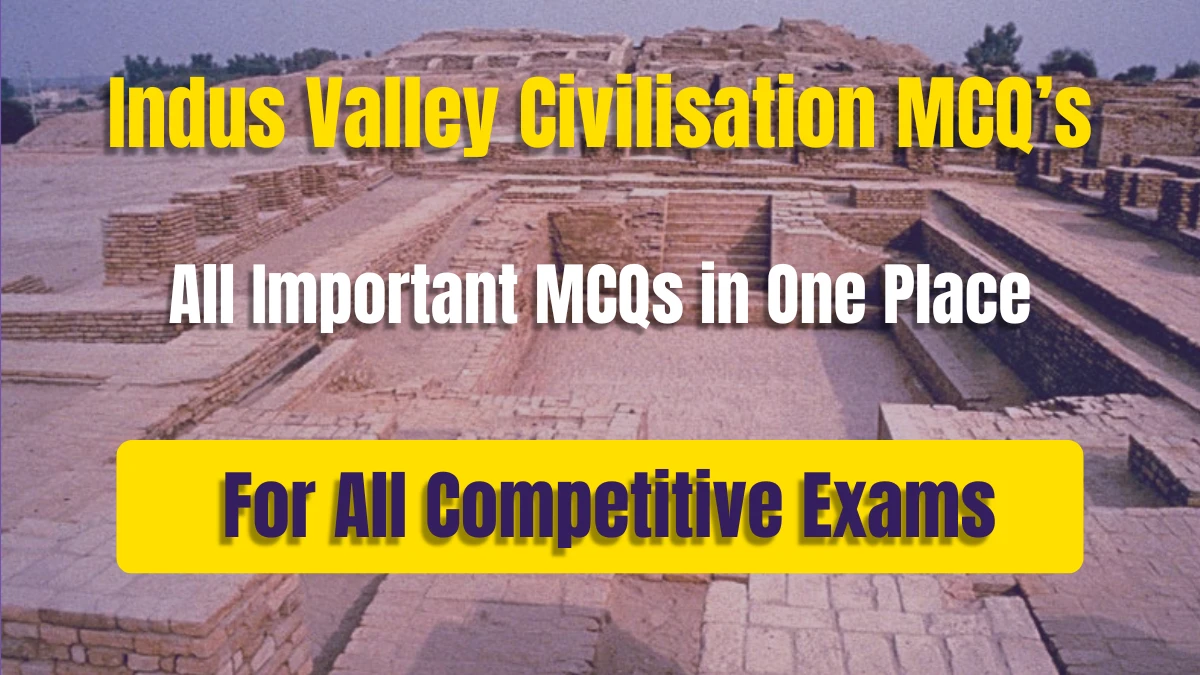
The Indus Valley Civilisation (IVC) is one of the oldest and most advanced civilisations of ancient India. It is known for its planned cities, strong drainage system, advanced trade network, and well-developed urban lifestyle. This topic is extremely important for competitive exams, especially for Static GK, SSC, Railway, Banking, Defence exams, and various state-level exams.
Thank you for reading this post, don't forget to subscribe!Below is a complete guide followed by important MCQ questions based on the most asked topics related to the Indus Valley Civilisation.
What is known about the Indus Valley Civilisation?
The Indus Valley Civilisation was an ancient urban civilisation that developed around 3300 BCE to 1300 BCE. It had planned cities, systematic drainage, multi-storied houses, public baths, granaries, and a strong trade network. The people knew about agriculture, crafts, pottery, metalwork, and measurement systems. It is also called the Harappan Civilisation.
What are 10 important facts about the Indus Valley Civilisation?
- It was one of the world’s earliest urban civilisations.
- It developed along the Indus River and its tributaries.
- Main cities: Harappa, Mohenjo-Daro, Dholavira, Lothal, Kalibangan.
- Known for town planning, grid-pattern roads, and brick houses.
- The famous Great Bath at Mohenjo-Daro.
- People used the dockyard at Lothal for sea trade.
- Standard weights and measures were widely used.
- The script of IVC remains undeciphered.
- Agriculture was well-developed; wheat and barley were the main crops.
- The civilisation declined around 1500 BCE due to various possible reasons like climate change, decline of trade, or river shifts.
Where is the Indus Valley located?
The Indus Valley Civilisation was mainly located in present-day India and Pakistan, especially around the Indus River and the Ghaggar-Hakra region.
What are the 4 major Harappan sites?
- Harappa – Punjab (Pakistan)
- Mohenjo-Daro – Sindh (Pakistan)
- Dholavira – Gujarat (India)
- Lothal – Gujarat (India)
What is special about the Indus Valley Civilisation?
The IVC is special because of its urban planning, drainage system, advanced craftsmanship, dockyard, planned streets, and architectural excellence. No other ancient civilisation had such a well-organised city layout.
Which is the oldest site of the Indus Valley Civilisation?
Mehgarh (in present-day Pakistan) is considered one of the earliest sites linked to the development of the Indus Civilisation.
Who founded the Indus Valley Civilisation?
No one “founded” it. It gradually developed through farming communities over thousands of years.
What are the 8 major characteristics of a civilisation?
- Town planning
- Social structure
- Agriculture
- Trade
- Writing system
- Architecture
- Religion and beliefs
- Craft and technology
What are the main features of the Indus River?
- One of the longest rivers in Asia
- Originates in Tibet (China)
- Flows through India and Pakistan
- Known for fertile plains
- Supported ancient settlements and agriculture
Which is the oldest civilisation in India?
The Indus Valley Civilisation is the oldest major civilisation in India.
What country is the Indus River in today?
Mostly in Pakistan, but it begins in Tibet and flows through India.
What did the Indus Valley people eat?
They mainly ate wheat, barley, rice, fruits, fish, and meat, and also drank milk.
What is Harappa famous for?
Harappa is famous for its urban planning, pottery, seals, granaries, and brick structures.
Who discovered Mohenjo-Daro?
R. D. Banerjee, an Indian archaeologist, discovered Mohenjo-Daro in 1922.
On which river is Harappa located?
Harappa is located on the Ravi River.
Why is the Indus Valley famous?
It is famous for its largest ancient urban culture, highly organised cities, and advanced lifestyle.
What was the Indus Valley religion?
The people worshipped the mother goddess, nature, animals and followed simple religious practices. There is no proof of temples.
What are the top 5 quick facts about the Indus Valley Civilisation?
- Known as the Harappan Civilisation
- Script remains undeciphered
- The Great Bath is the most famous structure
- Dholavira shows advanced water conservation
- Lothal had one of the earliest dockyards
What was the main crop of Harappa?
Wheat was the main crop. Barley and rice were also grown.