The Garo Tribe of Assam – A Living Heritage of Culture, Tradition, and Transformation

The Garo Tribe of Assam is one of the most fascinating and culturally rich indigenous communities of Northeast India. Deeply rooted in ancient traditions yet steadily adapting to modern transformations, the Garos stand as a symbol of harmony between heritage and progress. The Garo people, known for their matrilineal society and unique cultural identity, inhabit primarily the Karbi Anglong and Dima Hasao districts of Assam, with smaller settlements in Kamrup and Goalpara regions. This blog delves deep into their origin, culture, customs, religion, and the evolution of their society through time.
Thank you for reading this post, don't forget to subscribe!Origin and Migration of the Garos
The Garo Tribe of Assam traces its roots to the Garo Hills of present-day Meghalaya. Historically, some Garo families migrated from the Garo Hills to Assam during the early 20th century, mainly to work in tea plantations such as the Kakodonga Tea Estate in the Golaghat district. However, due to unfamiliarity with plantation work, many left the tea gardens and shifted towards agriculture, eventually settling permanently in the Bokajan area of Karbi Anglong in search of fertile land.
Their migration and subsequent settlement were part of a larger movement of hill tribes across Northeast India during colonial times, often driven by economic and agricultural needs. Today, the Garos of Assam maintain strong cultural and linguistic ties with their counterparts in Meghalaya, though they have developed distinct local identities over time.
Ethnic and Racial Identity
Ethnically, the Garos belong to the Mongoloid race and the Tibeto-Burman linguistic family, particularly the Bodo group. They proudly call themselves Achik-Mande, meaning “hill people,” where Achik means hill and Mande means man. Anthropological studies suggest that their ancestral homeland was somewhere in Tibet or northwestern China, from where they migrated centuries ago through various routes across the Himalayan corridor.
The Garos share several physical and linguistic traits with other tribes of Northeast India, such as the Khasis, Rabhas, and Bodos. They typically have short, sturdy physiques, round faces, dark-tan complexions, and cheerful dispositions features that reflect both their hill origin and resilience.
Sub-Tribes and Clan System
The Garo community is divided into several sub-groups, each possessing distinct linguistic and cultural nuances. Some of the recognized sub-tribes include:
A’wes, A’kawes, Chisak, Dual, Matchi, Matjangchi (or Matabeng), Ambeng, Chibok, Ruga, Ganching, Atong, and Megam.
Though these groups differ in dialects and customs, they all share a common Garo identity and uphold a similar social framework.
Clan Structure
In Garo society, clans are known as Chatchi. Scholars such as S.N. Barkataki and Milton Sangma differ slightly in their classification of clans. According to Barkataki, the original clans were Marak, Momin, and Sangma, from which sub-clans like Abeng, Areng, and Sira later branched off. Milton Sangma, however, suggests that the original clans were only Sangma and Marak, with others like Momin, Areng, and Shira evolving later.
Each clan is further subdivided into smaller units known as Ma’chong (meaning “motherhood”), symbolizing the matrilineal essence of the Garo family system. Interestingly, although Ma’chongs are often named after animals or natural objects, they are not considered totems.
Demographic Characteristics
According to census data from 1971, the Garo population in Assam was around 9,139. While these numbers have increased significantly in recent decades, the Garos still form a small fraction of the state’s total tribal population. Literacy among the Garos historically lagged behind the state average; however, access to education and government welfare initiatives have brought considerable improvements in recent years.
Matrilineal Family Structure
One of the most remarkable features of the Garo Tribe of Assam is its matrilineal system a social structure where lineage and inheritance pass through the female line. Much like the Khasis of Meghalaya, Garo women play a central role in family and social affairs.
The family lineage is traced through the mother, and all family property belongs to her. The father, after marriage, is considered an outsider and joins the wife’s household. The children bear the mother’s clan name, and the youngest daughter, known as Nokna, inherits the family property. If a woman has no daughter, she may adopt a niece from her sister’s family to continue the lineage.
This matrilineal tradition not only shapes inheritance but also reinforces women’s social status within Garo society.
Marriage and the NOKROM System
Marriage customs among the Garos are governed by strict exogamy, meaning marriage within the same clan is forbidden. The initiative for marriage typically comes from the girl’s family. Negotiated marriages, known as Do’sia, are common and involve simple rituals like sacrificing fowls followed by feasting and dancing.
A distinctive practice is the Nokrom system, where after marriage, the husband (son-in-law) lives in his wife’s family home and acts as a representative of his paternal clan. The Nokrom holds significant responsibilities managing property, participating in family decisions, and, in some cases, inheriting the role of the Nokma (village headman) upon the father-in-law’s death.
The Garo society also allows other forms of marriage, such as by elopement or mutual consent, though marriage by capture has faded with modern influence. Divorce is relatively easy and socially accepted, while polygamy, though permitted, is rare today.
Customary Law of Inheritance
Inheritance follows the matrilineal pattern. The youngest daughter, or Nokna, becomes the sole heiress of family property. This ensures that property remains within the mother’s lineage, reinforcing the importance of the female line. Sons do not inherit property but may manage it through their wives after marriage.
If a woman dies without daughters, her nearest female relative, usually a sister’s daughter, is adopted as the heiress, preserving continuity within the maternal clan.
Nokma: The Village Chief
The Nokma serves as both the village chief and the custodian of community land. Though the Garo society is matrilineal, the Nokma is typically a man often the Nokrom of the Nokma’s daughter. He administers land, settles disputes, and presides over the village council. Land cannot be sold without clan consent, emphasizing the communal aspect of ownership.
The Nokma’s authority extends to agricultural cycles, religious ceremonies, and community feasts. His leadership represents a balance between traditional governance and democratic consultation.
Religious Beliefs and Deities
Traditionally, the Garos were animists who believed in a Supreme Being and numerous deities governing different aspects of life and nature. Though most Garos in Assam have converted to Christianity, many still observe ancestral rituals alongside their new faith.
Some important deities in traditional Garo belief include:
- Tatara-Rabuga: The supreme creator deity.
- Saliang: The Sun God, honored during the harvest festival Wangala.
- Chorabudi: Protector of crops.
- Goera: God of thunder and lightning.
- Kalkame: Protector from wild animals and diseases.
- Susime: Goddess of wealth and prosperity.
Animal sacrifices, dances, and songs once formed the core of these religious observances, reflecting their deep reverence for nature.
Economic Life and Occupation
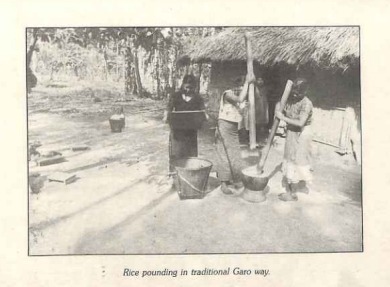
Agriculture is the backbone of the Garo economy. Traditionally practicing jhum (shifting) cultivation, they grow paddy, maize, and vegetables. Many have now transitioned to permanent cultivation and horticulture, producing pineapples and oranges in abundance.
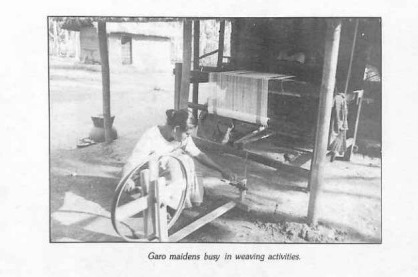
Livestock rearing, weaving, and sericulture (especially Endi silk) supplement their income. A notable number of Garos serve in security forces, reflecting their martial past and disciplined lifestyle.
Cultural Life and Arts
Language
The Garo language belongs to the Bodo group of the Tibeto-Burman family. It is rich in oral traditions, folklore, and songs, and efforts are ongoing to preserve it through education and literature.
Music and Dance
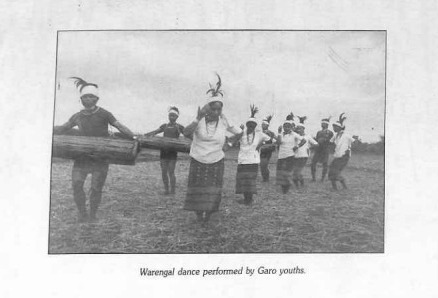
Music and dance are integral to Garo culture. The Wangala festival, also known as the “Festival of Hundred Drums,” celebrates the harvest season in honor of the Sun God, Saliang. Dressed in colorful attire, both men and women dance rhythmically to the beat of traditional drums like Dama, Kram, and Nadid.
Food Habits
Rice is their staple food, often accompanied by dried fish (Nakam), bamboo shoot curry, and meats. Rice beer, or chu, holds social and ritual significance, though Christian converts often abstain from it.
Traditional Attire and Ornaments
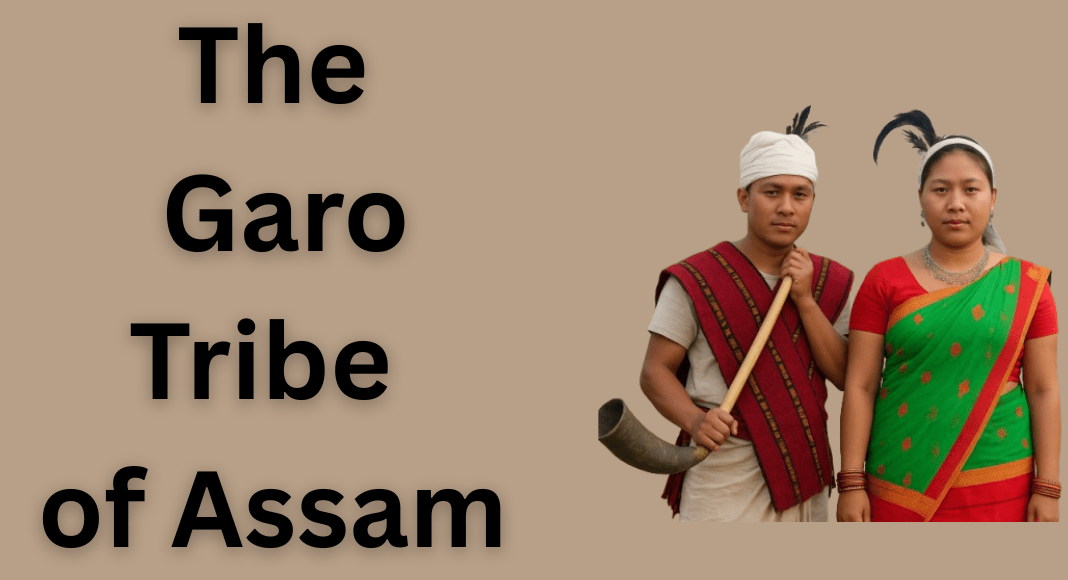
Men wear a short cloth known as Gando and a turban, while women wear a short wraparound skirt and blouse. During festivals, they adorn themselves with ornaments like Nadongbinr Sisha (earrings), Ripok (necklace), and Seng’ki (waistband). The younger generation, however, increasingly prefers modern attire except during cultural events.
Nokpante: The Bachelor’s Dormitory
The Nokpante or bachelor’s dormitory was once the cornerstone of Garo social education. Young boys lived and learned here, acquiring skills in dance, music, hunting, and moral discipline. Women were not allowed inside, and the Nokpante symbolized unity and brotherhood.
Although modern education and changing lifestyles have diminished its role, the spirit of the Nokpante still lives on in community life and youth gatherings.
Transformation and Modern Adaptation
Like many indigenous communities, the Garo Tribe of Assam has undergone significant transformation due to education, Christianity, and modernization. Yet, unlike many societies that lost their roots, the Garos have managed to retain their cultural essence.
Modern leadership, political awareness, and social development have coexisted harmoniously with traditional institutions like the Nokma and the Nokpante. The Garo people continue to celebrate their heritage while embracing progress proving that tradition and transformation can thrive together.
Conclusion
The story of the Garo Tribe of Assam is a testament to cultural resilience and adaptability. From their migration and matrilineal society to their vibrant festivals and evolving modern identity, the Garos embody the living spirit of Northeast India’s diversity. Their traditions, though ancient, are far from obsolete they are living threads that weave past and present into a single, colorful tapestry of human endurance and cultural pride.