


Aditya-L1 Studies Solar Blast Growth

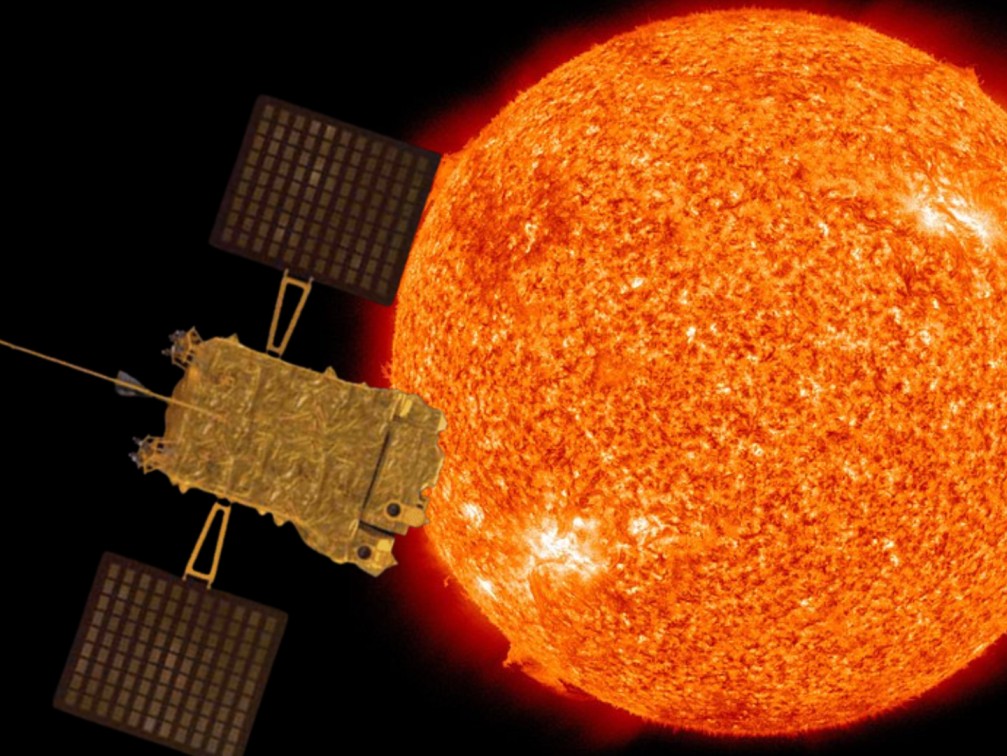
Aditya-L1 Solar Eruption research has revealed that a powerful solar eruption can expand unevenly as it moves away from the Sun. Scientists from the Indian Institute of Astrophysics (IIA), Bengaluru, reported this finding in a study published in The Astrophysical Journal Letters on 3 November 2026. The research examined a solar eruption observed on 5 August 2024 using India’s Aditya-L1 mission, NASA’s Solar Dynamics Observatory (SDO), and three-dimensional modelling.
The study focused on a Coronal Mass Ejection (CME), a large release of plasma and magnetic field from the Sun’s outer atmosphere. The findings provide new information about how these eruptions grow and move through space.

Aditya-L1 Observes Uneven Solar Expansion
The scientists found that the CME did not expand like a perfectly round bubble. Instead, it grew unevenly, with different parts of the eruption moving at different speeds.
This type of expansion is important because the shape and movement of a CME can change as it travels away from the Sun. These differences may affect its speed and direction, including whether it moves towards Earth.
The research used observations from Aditya-L1’s Visible Emission Line Coronagraph (VELC). The instrument studies the Sun’s corona, the outer atmosphere that is much fainter than the bright solar surface.
VELC Measures Plasma Movement
VELC recorded several measurements during the August 2024 event. The analysis found line-of-sight plasma velocities of up to 218 kilometres per second. It also measured a projected radial speed of 1,135 kilometres per second and a plane-of-sky lateral speed of 692 kilometres per second.
These measurements describe movement from different viewing directions. Line-of-sight velocity tracks motion towards or away from the observer, while plane-of-sky measurements show movement across the image. Combining these observations helps scientists build a clearer picture of the CME’s motion.
VELC also studies the green coronal emission line of iron, known as Fe XIV at a wavelength of 5303 angstroms. Spectroscopic observations of this line help researchers track plasma movement in the Sun’s low corona.
Why Uneven CME Expansion Matters
Coronal Mass Ejections can travel through space and, when directed towards Earth, interact with the planet’s magnetic environment. Such interactions may lead to geomagnetic disturbances and affect satellites, communication systems, navigation services and power infrastructure.
A CME’s direction and speed are therefore important for space-weather monitoring. If an eruption expands unevenly, its path and arrival time may be harder to estimate using a simple model.
The study’s observations and three-dimensional modelling can help scientists improve their understanding of how CMEs develop near the Sun. This knowledge may support better analysis of solar eruptions and their possible effects on Earth.
Aditya-L1 and Other Solar Observations
The report also describes other research involving VELC and additional solar observatories. A study published in Astronomy & Astrophysics on 15 October 2026 presented a joint analysis of eruptions observed by Aditya-L1/VELC and Europe’s Proba-3/ASPIICS instruments.
The researchers examined CMEs observed on 14 and 16 September 2025. The first event travelled at about 645 kilometres per second. The second moved at around 145 kilometres per second and showed stronger expansion during its early stage.
Joint observations allow scientists to compare solar eruptions from different instruments and viewing conditions. This can help reveal details that may be difficult to identify using one observatory alone.
Earlier VELC Observation of a Solar Flare
VELC also observed a CME on 16 July 2024 that was associated with an X1.9-class solar flare. The observation showed coronal dimming, a reduction in brightness in part of the corona that can occur during a solar eruption.
The instrument also recorded a redshifted Doppler velocity of about +10 kilometres per second. This indicated plasma moving away from the observer along the line of sight.
Together, these observations show how Aditya-L1 is helping scientists study the movement of solar material. By measuring plasma speed and examining the changing structure of CMEs, researchers can better understand how solar eruptions begin and develop.
The latest study adds to the growing body of solar research using Aditya-L1. Its findings highlight the value of observing the Sun’s inner corona, where eruptions begin to take shape and gain speed before travelling into space.