


Chandrayaan-3 Lunar Plasma Discovery Near Moon South Pole

Chandrayaan-3 Lunar Plasma findings have opened a new window into understanding the Moon’s environment, especially near its south pole. India’s Chandrayaan-3 mission has revealed that the region just above the lunar surface is far more electrically active than scientists earlier believed. Direct data collected by the Vikram lander shows that the plasma close to the Moon’s surface is denser and more energetic than past estimates made using remote methods.
Thank you for reading this post, don't forget to subscribe!This discovery is important because the Moon’s south pole is a key focus area for future exploration. The findings help scientists better understand how charged particles behave close to the surface and how this environment may affect instruments, landers and communication systems.
Chandrayaan-3 Lunar Plasma and the Moon’s Electrical Environment
Plasma is often called the fourth state of matter. It consists of charged particles such as electrons and ions. On the Moon, plasma forms due to several natural processes. One major source is the solar wind, a stream of charged particles flowing from the Sun. When sunlight strikes the lunar surface, it also causes photoelectric charging, releasing electrons into the surrounding space.
At certain times, the Moon passes through Earth’s magnetotail, a region where Earth’s magnetic field stretches far into space. During this period, particles from Earth can interact with the Moon, further shaping its plasma environment. Even though lunar plasma is very thin compared to Earth’s atmosphere, it reacts strongly to electric and magnetic forces, making it highly dynamic.
Chandrayaan-3 Lunar Plasma Measurements From Vikram Lander
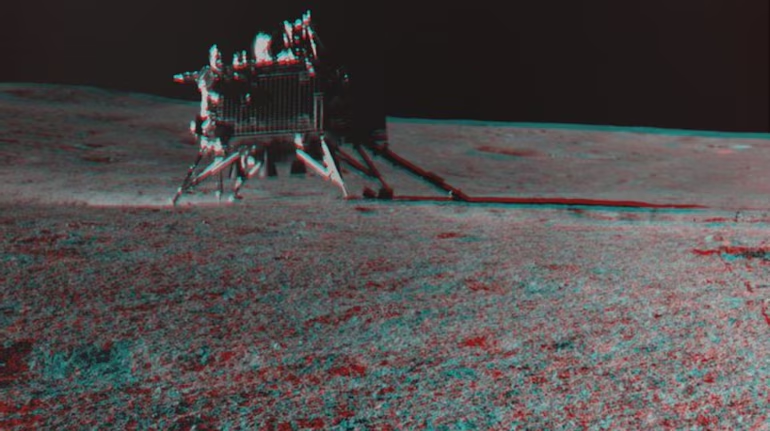
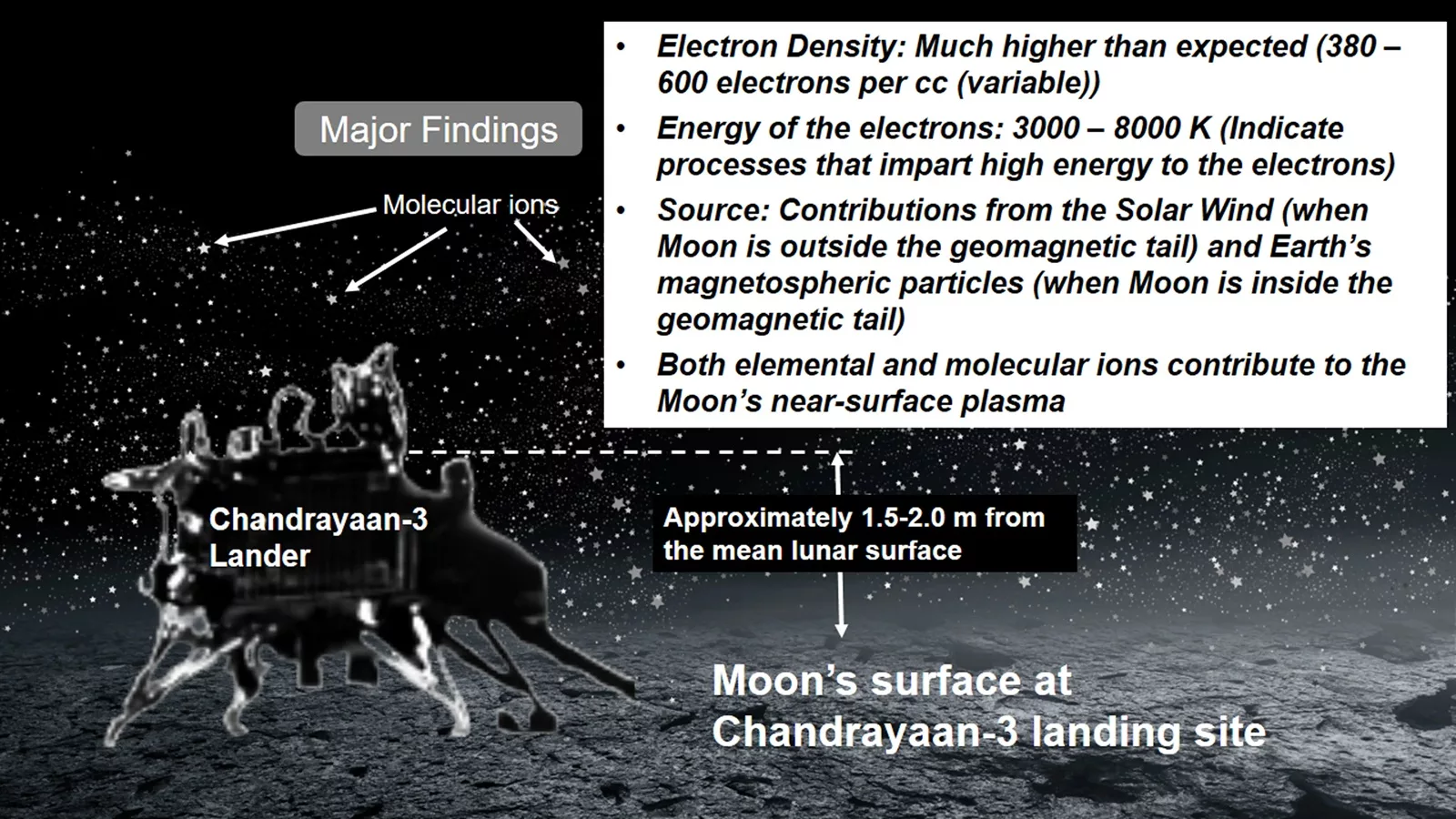
What makes Chandrayaan-3 Lunar Plasma observations special is that they come from direct, near-surface measurements. The Vikram lander carried a scientific instrument called RAMBHA-LP (Langmuir Probe), which recorded real-time data from the Moon’s south polar region at Shiv Shakti Point.
The probe measured electron densities ranging from 380 to 600 particles per cubic centimetre. These values are much higher than what scientists previously expected based on older radio-based studies. Along with density, the probe also measured electron energy levels. The electrons showed temperatures between 3,000 and 8,000 Kelvin, indicating that the plasma near the surface is much more energetic than assumed earlier.
Chandrayaan-3 Lunar Plasma Shows Strong Solar Influence
The data revealed that plasma conditions change depending on the Moon’s position in space. When the lunar surface is exposed to sunlight, interactions with the solar wind dominate. During these times, charged particles from the Sun play a major role in shaping the plasma layer.
When the Moon moves into Earth’s magnetotail, the plasma characteristics shift again. Particles from Earth’s magnetic environment influence the density and energy of the plasma. These changes show that the Moon’s plasma is not static but constantly responds to its surroundings.
Scientists also observed signs of molecular ions, possibly formed from traces of gases like water vapour and carbon dioxide. This adds new detail to the understanding of chemical processes occurring near the lunar surface.
Chandrayaan-3 Lunar Plasma Expands Knowledge of the Lunar Ionosphere
Before Chandrayaan-3, most knowledge about the Moon’s plasma came from indirect observations. These new findings provide the clearest picture yet of the lunar ionosphere near the south pole. The results show that this region is more complex and energetic than previously thought.
Understanding the plasma environment is important because it affects how dust moves, how surfaces become electrically charged and how instruments behave. Even small changes in plasma conditions can influence sensitive equipment placed on the Moon.
Chandrayaan-3 Lunar Plasma Data Supports Future Missions
As global interest in lunar exploration grows, the Moon’s south pole has become a priority area. This region is believed to hold water ice in permanently shadowed craters, making it valuable for long-term missions. The Chandrayaan-3 Lunar Plasma findings provide essential background information for planning safe and efficient operations in this area.
Plasma conditions can affect radio signals, navigation systems and surface instruments. Knowing how dense and energetic the plasma is helps engineers design systems that can work reliably on the Moon. The data also helps scientists predict how spacecraft materials may respond to electrical charging over time.
Chandrayaan-3 Lunar Plasma Strengthens India’s Space Research Role
The RAMBHA-LP instrument was developed by the Space Physics Laboratory at VSSC, highlighting India’s growing capability in advanced space science. By delivering high-quality, direct measurements from a challenging location, Chandrayaan-3 adds valuable information to global lunar research efforts.
These observations not only improve understanding of the Moon but also help scientists compare plasma environments across different planetary bodies. The mission shows how focused scientific instruments can uncover hidden details about seemingly quiet celestial surfaces.