Extreme Nuclear Transients: The Most Powerful Cosmic Explosions Ever Observed

Recent astronomical discoveries have uncovered an entirely new class of cosmic events more energetic and luminous than any previously known. Extreme Nuclear Transients (ENTs), as they are called, are colossal explosions caused when massive stars are violently torn apart by supermassive black holes at the centers of galaxies. These extraordinary events emit energy up to ten times greater than gamma-ray bursts (GRBs), previously considered the most powerful explosions in the universe. Scientists believe that studying ENTs will transform our understanding of black holes, stellar death, and the mechanisms that shape the evolution of galaxies.
Thank you for reading this post, don't forget to subscribe!Unveiling the Nature of the Universe’s Brightest Explosions
Extreme Nuclear Transients are extraordinary bursts of light and radiation triggered when a star, at least three times more massive than our sun, ventures too close to a supermassive black hole. The immense gravitational pull of the black hole stretches and compresses the star until it is completely destroyed. This catastrophic event produces a stream of stellar debris, some of which spirals into the black hole while the rest is ejected at incredible speeds.
The intense friction and collisions within this debris produce vast amounts of electromagnetic energy visible across billions of light-years. Unlike normal transient events that fade within days or weeks, ENTs can continue to shine for several years, particularly in radio wavelengths. This extended emission period allows scientists to monitor and study these events over long durations, gathering crucial data about how they evolve.
Extreme Nuclear Transients vs. Other Cosmic Phenomena
While astronomers have long studied gamma-ray bursts and tidal disruption events, Extreme Nuclear Transients stand apart in terms of both scale and intensity. Gamma-ray bursts occur when a massive star collapses into a black hole, releasing a jet of radiation. Tidal disruption events (TDEs) also occur when a star is pulled apart by a black hole, but typically these involve smaller stars and less massive black holes.
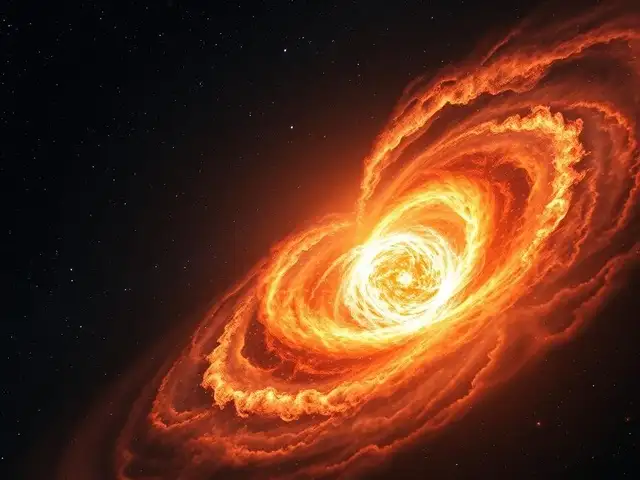
ENTs, by contrast, involve larger galaxies and supermassive black holes exceeding millions or even billions of solar masses. The stars involved are significantly more massive, and the resulting energy output is monumental. Moreover, ENTs are much rarer, which makes their discovery even more significant.
They are also distinct from fast X-ray transients (FXTs), which are brief, less energetic phenomena often linked to collapsing stars or compact binary systems. FXTs might last only a few seconds or minutes, while ENTs can remain detectable for years, making them a unique and vital window into long-term cosmic processes.
Discovery and Observation of Extreme Nuclear Transients
The first indications of Extreme Nuclear Transients emerged from data collected by the European Space Agency’s Gaia spacecraft, which has been mapping billions of stars in the Milky Way for over a decade. Researchers noticed several unusual light curves patterns of brightness that were highly unusual in both amplitude and duration.
Further investigation using instruments capable of detecting ultraviolet, X-ray, and optical emissions revealed that these anomalies were not supernovae or gamma-ray bursts. Instead, they represented a new type of phenomenon. Ground-based observatories confirmed the observations, while data from the Zwicky Transient Facility (ZTF) helped identify similar long-lived outbursts in other galaxies.
These findings suggest that Extreme Nuclear Transients are relatively rare, with only a few detected so far. However, as observational technology improves, astronomers expect to discover many more in the coming years.
Extreme Nuclear Transients and Their Role in Black Hole Research
One of the most exciting aspects of Extreme Nuclear Transients is their potential to illuminate the hidden behavior of supermassive black holes. Many black holes at the centers of galaxies remain dormant, not actively consuming surrounding matter and therefore invisible to telescopes. ENTs, however, temporarily awaken these sleeping giants, creating a burst of radiation that makes them observable.
By studying ENTs, scientists can infer how black holes accrete matter, how they influence their host galaxies, and how they grow over time. These insights are vital for understanding galactic evolution how galaxies form, merge, and transform over billions of years.
Upcoming projects such as the Vera C. Rubin Observatory and the Nancy Grace Roman Space Telescope will play crucial roles in this research. Equipped with artificial intelligence and advanced imaging systems, these observatories will help identify and monitor ENTs more efficiently, providing real-time data for analysis.
Extreme Nuclear Transients in the Context of High-Energy Cosmic Events
When placed within the larger framework of cosmic explosions, Extreme Nuclear Transients represent the peak of high-energy astrophysical activity. They are the universe’s ultimate powerhouses, surpassing all other known phenomena in both brightness and duration.
While gamma-ray bursts result from the collapse of massive stars forming black holes, and tidal disruption events involve smaller black holes shredding nearby stars, ENTs bridge the gap between these categories. They involve the most massive black holes and the most energetic interactions, releasing radiation across multiple wavelengths optical, radio, X-ray, and gamma-ray.
Furthermore, studying these events helps scientists test theories about gravity, relativity, and energy transfer in extreme environments. The immense forces at play during ENTs offer a real-world laboratory for exploring how matter and energy behave under conditions impossible to replicate on Earth.
Future of Research on Extreme Nuclear Transients
As technology continues to advance, astronomers are gearing up for a new era of cosmic discovery led by Extreme Nuclear Transients. Future missions will focus on capturing ENTs across multiple frequencies to better understand their structure and timeline. AI-based data analysis will allow for faster identification of transient events in vast astronomical datasets, helping scientists uncover even rarer cosmic occurrences.
With every new detection, ENTs provide crucial insights into the lifecycle of stars, the dynamics of galaxies, and the mysteries of black holes. They stand as shining beacons in the vast darkness of space reminders of both the universe’s beauty and its destructive power.