


Hera Mission Reveals DART Impact

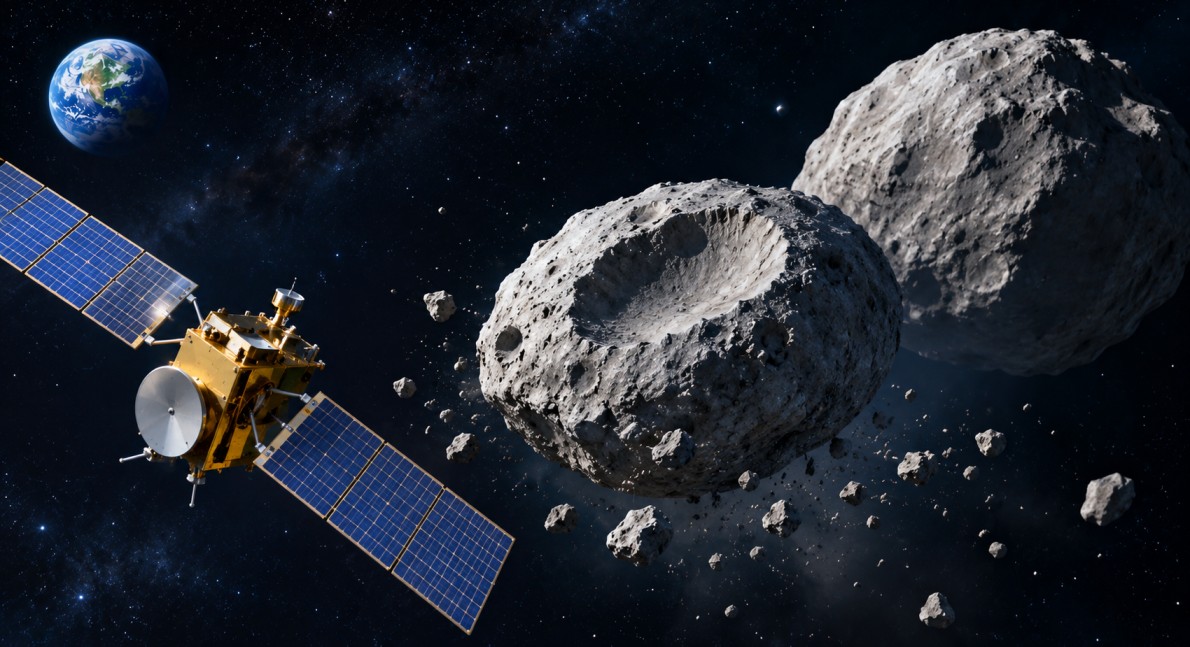
Hera Mission has revealed major changes to the asteroid moonlet Dimorphos following NASA’s Double Asteroid Redirection Test (DART) in 2022. On 25 November 2026, the European Space Agency (ESA) announced new observations from its spacecraft, which reached the Didymos-Dimorphos asteroid system in November.
The initial images show that the impact changed the shape and movement of Dimorphos. The findings are important for scientists studying planetary defence and how spacecraft could be used to change the path of an asteroid that may threaten Earth.

Major Changes to Dimorphos After the DART Impact
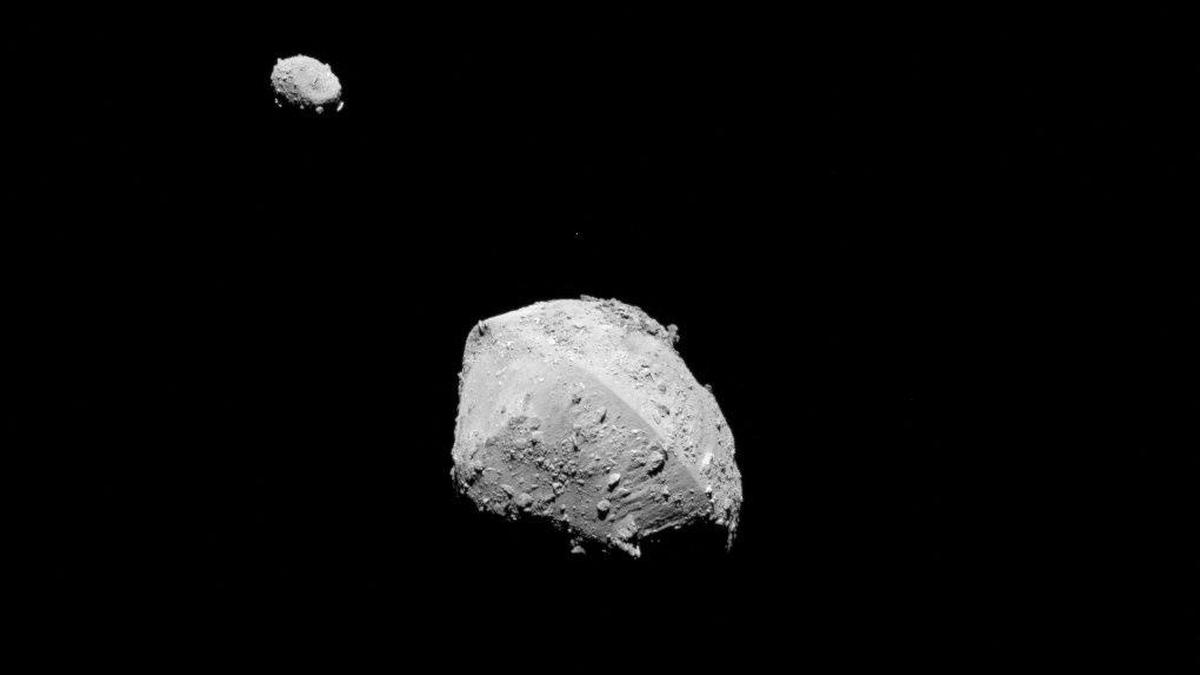
Dimorphos is a small moonlet measuring approximately 151 metres across. It orbits the larger asteroid Didymos, which has a diameter of around 730 metres.
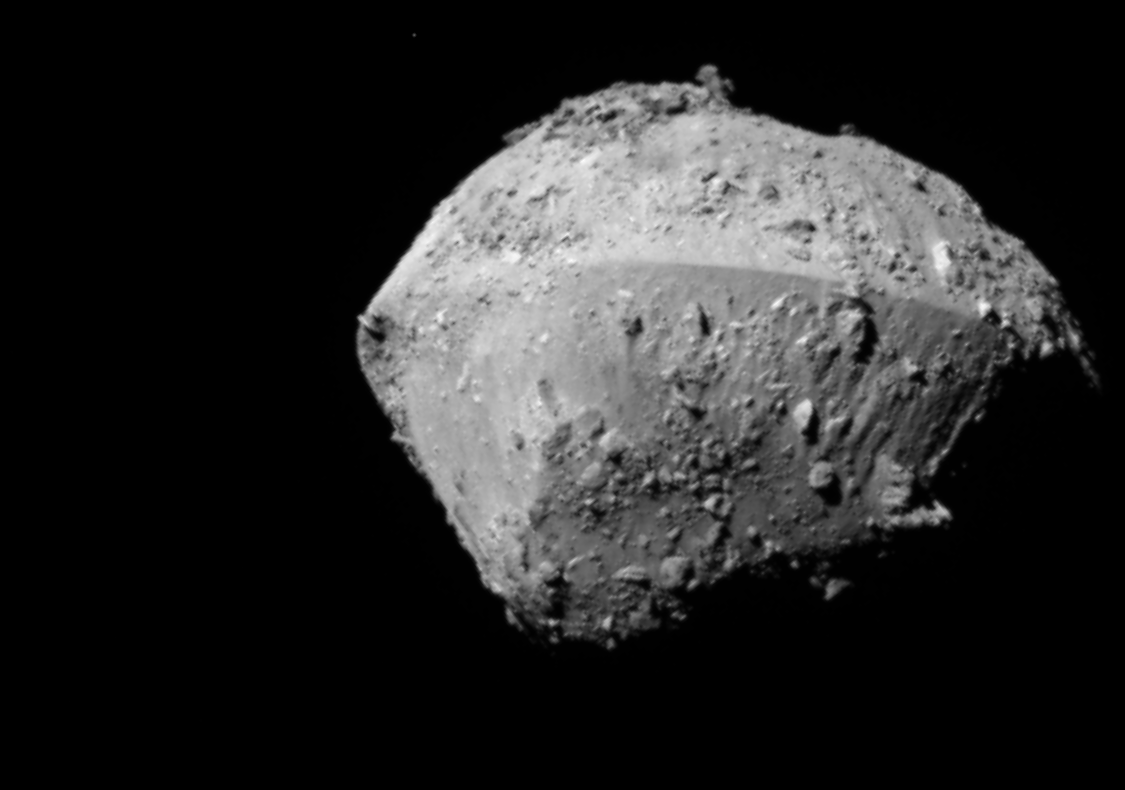
Images captured by Hera show that one side of Dimorphos has become noticeably flattened. A large, stadium-sized crater appears to extend across much of the moonlet’s width. These changes suggest that the collision had a major effect on its surface and overall structure.
Scientists have also found that Dimorphos is now tumbling in a chaotic way rather than maintaining its earlier synchronous rotation. This means its movement is more complex than simply keeping the same side facing Didymos as it orbits the larger asteroid.
Hundreds of previously unknown boulders have also been observed around the asteroid system. These rocks may provide further information about how material was displaced during and after the collision.
In comparison, the larger asteroid Didymos appears largely unchanged. Its existing boulder fields and central equatorial ridge remain visible in the new observations.
How NASA’s DART Mission Changed the Asteroid’s Orbit
NASA carried out the DART mission to test whether a spacecraft could deliberately change the movement of an asteroid. The spacecraft struck Dimorphos on 26 September 2022 at a speed of approximately 6.1 kilometres per second.
Before the impact, Dimorphos took around 11.92 hours to complete one orbit around Didymos. Following the collision, its orbital period decreased to approximately 11.37 hours.
This represented a reduction of about 33 minutes. The result showed that a spacecraft impact could change an asteroid’s movement, supporting the idea of using kinetic impact technology as a planetary defence method.
The impact also demonstrated that the material thrown away from an asteroid can influence the amount of momentum transferred to it. Understanding this process is important when planning future missions designed to move potentially dangerous asteroids.
Hera Mission Studies the Impact Site
The European Space Agency launched Hera in October 2024 to examine the effects of the DART collision in greater detail. It is ESA’s first planetary defence mission and forms part of an international effort to understand how asteroid deflection works.
While DART carried out the impact, Hera is designed to study the results. Its instruments will help scientists measure the physical properties of Dimorphos, examine its surface and improve estimates of the impact’s effects.
Hera’s principal investigator, Patrick Michel, and planetary scientist Sabina Raducan expressed their astonishment at the changes revealed by the spacecraft’s observations.
The mission is expected to continue studying the asteroid system until June 2027. During this period, Hera will move closer to the asteroids to collect higher-resolution images and more detailed scientific information.
Two CubeSats Will Explore the Asteroids
An important part of the next stage of the Hera Mission is the planned deployment of two small spacecraft, Milani and Juventas, in January 2027.
Both are shoebox-sized CubeSats designed to carry out specialised investigations around the asteroid system.
Juventas will use its JuRa radar instrument to study the internal structure of the asteroids. The radar operates at frequencies between 50 and 70 MHz and is designed to provide a resolution of around 10-15 metres. These observations may help scientists understand the internal layers and structure of Dimorphos.
Milani will study the surface composition of the asteroids using its ASPECT hyperspectral spectrometer. The instrument works across visible and near-infrared wavelengths from 0.65 to 2.50 microns. This will help researchers identify materials present on the asteroid surfaces.
Why the Hera Mission Matters for Earth’s Planetary Defence
Asteroids regularly travel through the Solar System, and some pass relatively close to Earth. Although most pose no danger, scientists monitor near-Earth objects to identify those that could become a threat.
The DART and Hera missions are helping researchers understand whether a spacecraft can safely change an asteroid’s path. DART demonstrated the impact method, while Hera is examining how the asteroid responded and how efficiently the collision transferred momentum.
The findings could improve future planetary defence plans by providing better information about asteroid size, density, surface material and internal structure.
The mission also shows the value of international cooperation in space research. NASA carried out the original impact test, while ESA’s Hera spacecraft is examining its results. Together, the missions are providing important information about how humanity might respond to a future asteroid threat.