
Solar Particle Events Tracked by New Detectors

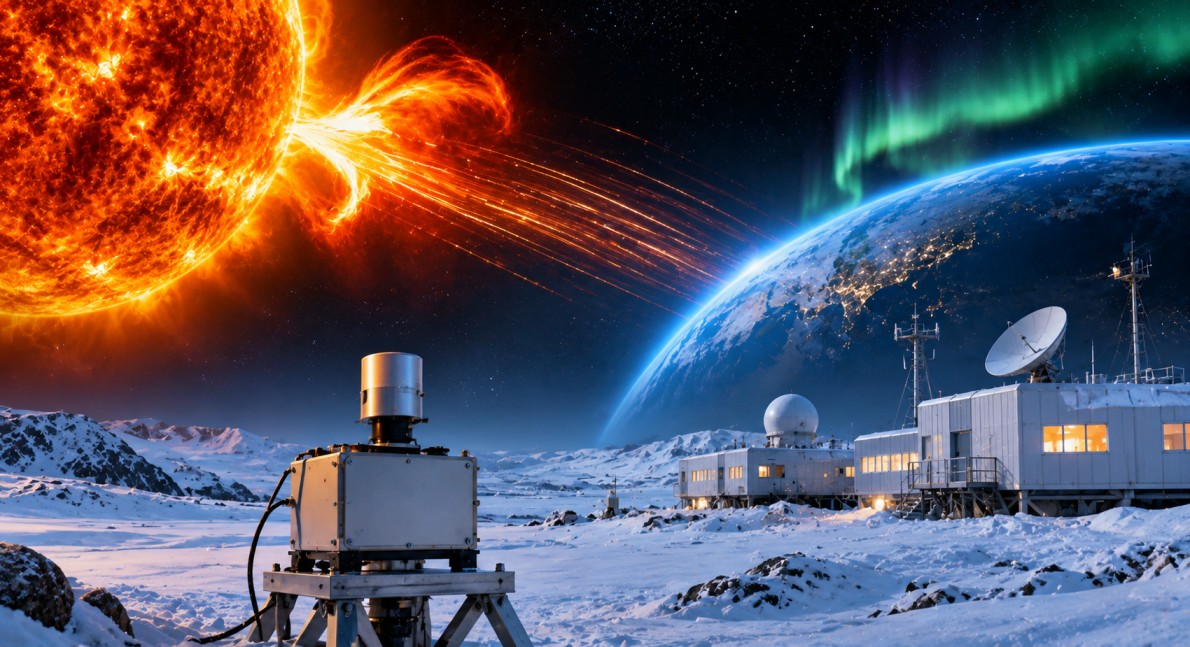
Solar Particle Events are powerful bursts of high-energy particles released by the Sun. These particles can travel through space and reach Earth, sometimes creating serious space-weather conditions. On November 26, 2026, the Indian Institute of Geomagnetism (IIG), Mumbai, reported a cost-effective method to detect rare and extreme solar particle events known as Ground-Level Enhancements (GLEs). The method uses compact detectors installed at India’s polar research stations in Ny-Ålesund and Antarctica.
This development could improve the way scientists monitor solar activity and understand its possible effects on Earth. It also highlights India’s contribution to global space-weather research.

Indian Polar Stations Detect a Rare Solar Event
Scientists from the Indian Institute of Geomagnetism detected signals from a Ground-Level Enhancement during a powerful solar storm on November 11, 2025. The event was identified as GLE #77.
The storm followed an intense X-class solar flare and a fast-moving coronal mass ejection (CME). A solar flare is a sudden release of energy from the Sun, while a CME sends large amounts of solar material and magnetic fields into space. Both can influence conditions in the space environment around Earth.
For the first time, IIG scientists detected the GLE signals simultaneously using instruments located in both the Northern and Southern Hemispheres. The detectors were operating at the Indian polar research stations in Ny-Ålesund and Antarctica.
The team used Sodium Iodide Thallium-activated, or NaI(Tl), scintillation detectors to record the event. These instruments can detect gamma rays by producing small flashes of light when radiation interacts with the detector material. Scientists then study these signals to understand high-energy events.
Why Ground-Level Enhancements Matter
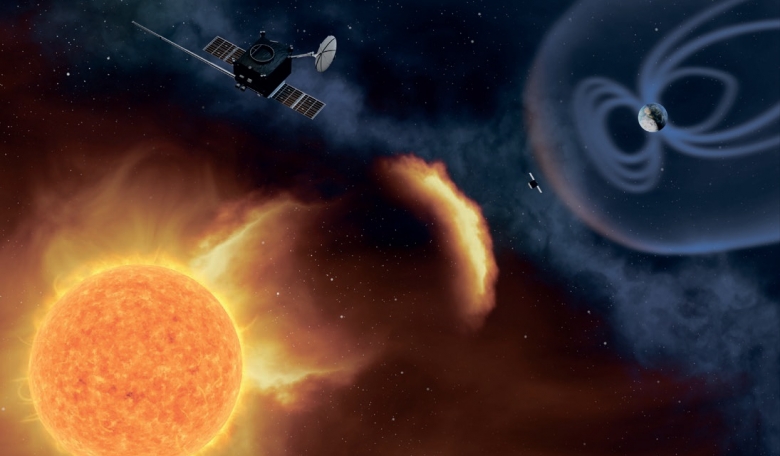
Ground-Level Enhancements are rare events in which high-energy solar particles reach Earth’s atmosphere and produce secondary particles that can be detected by instruments on the ground.
These events are important because they involve particles with energies generally above approximately 400 mega-electronvolts (MeV). This is much higher than the typical 10–100 MeV energy range associated with many solar particle events.
Such high-energy particles can create challenges for space-weather monitoring. They may also increase radiation exposure risks for astronauts and affect some aviation operations, particularly on routes at high latitudes. Understanding when these events occur helps scientists improve monitoring and assess potential risks.
Compact Detectors Can Support Global Monitoring
The IIG research, published in The Astrophysical Journal Letters, highlights the value of compact ground-based gamma-ray detectors in studying extreme solar events.
Traditionally, neutron monitors have played an important role in detecting GLEs. The new research suggests that NaI(Tl) detectors can provide additional information and complement these established monitoring systems.
Their relatively compact design and cost-effective use could support wider monitoring networks. Observations from different locations are particularly useful because solar particles do not always reach Earth’s atmosphere in the same way or with the same intensity.
The Indian Institute of Geomagnetism is an autonomous research institute under the Department of Science and Technology, Government of India. Its work covers geomagnetism and related areas of space and atmospheric science.
EarlyDetect AI Model Predicts Solar Flare Signs
Alongside improvements in detecting solar particle events, artificial intelligence is also helping researchers study solar activity before major events occur.
A research team led by the New Jersey Institute of Technology developed an AI-based model called EarlyDetect. The model identifies hidden patterns that may appear before solar flares and can provide an average warning time of 9.24 hours before a flare occurs.
EarlyDetect uses a Transformer-based architecture to analyse hourly maps of acoustic power and magnetic-field measurements. The data comes from NASA’s Solar Dynamics Observatory, which continuously observes the Sun.
The findings were published in the Journal of Geophysical Research: Machine Learning and Computation in August 2026.
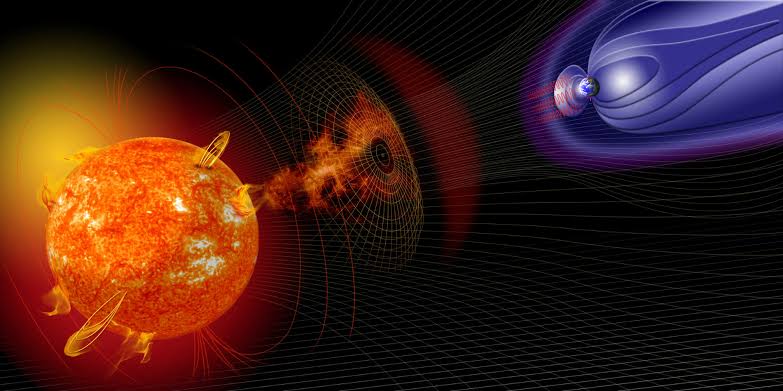
Solar flares and coronal mass ejections are important parts of space-weather research because powerful events can disturb Earth’s magnetic environment. Better prediction and detection methods may help scientists prepare for possible disruptions to satellites, communication systems, navigation services and power infrastructure.
The Growing Role of Technology in Space-Weather Research
The combination of ground-based detectors, satellite observations and artificial intelligence is creating new opportunities for solar monitoring. While AI models such as EarlyDetect focus on identifying possible warning signs before solar flares, instruments at polar stations help researchers detect high-energy particle events after they reach Earth’s atmosphere.
These technologies serve different purposes but can contribute to a more complete understanding of solar activity. The IIG detection of GLE #77 demonstrates how relatively compact instruments can add valuable observations to existing global monitoring systems.
As dependence on satellites, navigation and communication networks increases, reliable space-weather information is becoming more important. Continued research into solar particle events and early-warning systems can help improve scientific understanding of the Sun and its influence on Earth’s technological environment.