


Himalayan Fruit Fly Discovery: Two New Species Found in Himachal Pradesh

The Himalayan Fruit Fly Discovery has revealed two previously unknown species of fruit flies during a scientific research expedition in the foothills of the Himalayas. Entomologists conducted the study in the Solan region of Himachal Pradesh, expanding knowledge about insect diversity in India. The research was carried out by Maneesh Pal Singh from the College of Horticulture and Forestry along with British researcher David Lawrence Hancock. Their findings contribute significantly to the scientific understanding of the fruit fly subfamily Trypetinae and highlight the rich biodiversity present in the Himalayan ecosystem.
Thank you for reading this post, don't forget to subscribe!Research Expedition in Himachal Pradesh
The discoveries were made during detailed field surveys conducted in the Solan region of northern India. Researchers used traditional sweep nets along with a specialised female attractant known as Solan Bait. This patented lure helped scientists attract fruit flies that are usually difficult to observe in natural environments. After the fieldwork, the collected insects were carefully examined in laboratories using microscopes. Researchers studied wing patterns and tiny reproductive structures to confirm that the insects represented species not previously recorded in India.
Discovery of Acidoxantha paratotoflava
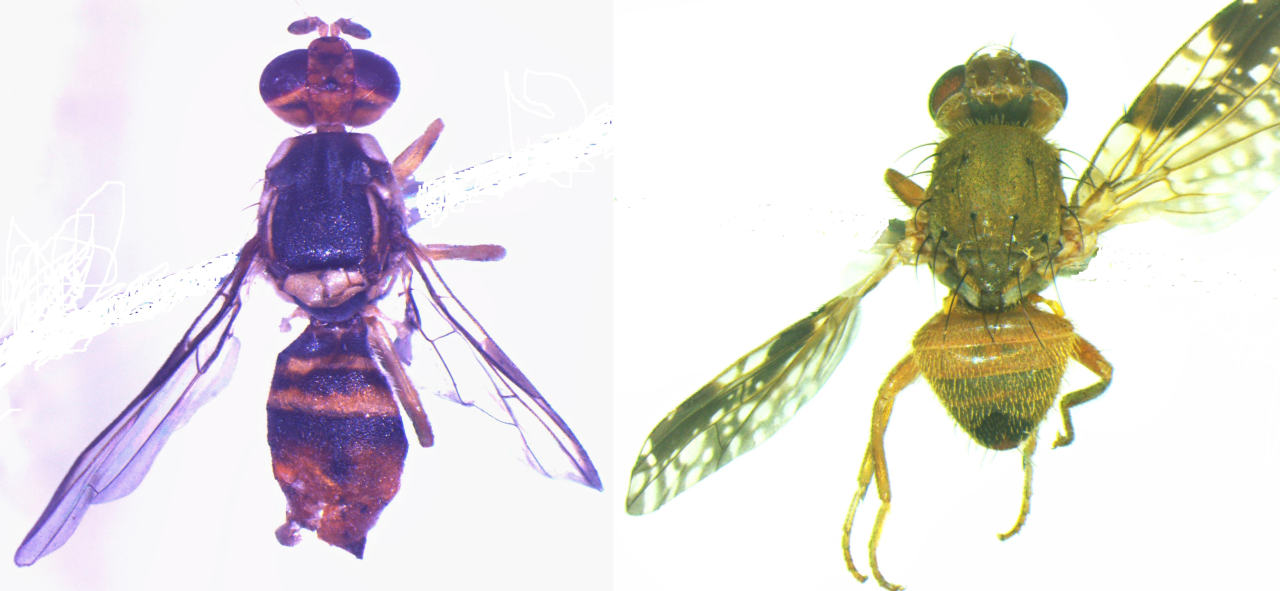
One of the new species identified during the Himalayan Fruit Fly Discovery is named Acidoxantha paratotoflava. This medium-sized fruit fly has a greenish-yellow body colour. It can be recognised by four distinct black stripes on its thorax and larger black markings on its abdomen. Scientists also discovered unique hook-like structures in the male reproductive organs, which confirmed that it is a separate species. The name reflects its similarity to another known species called Acidoxantha totoflava, which scientists believe may have been misidentified in earlier Indian records.
Identification of Hemilea suneriae
The second newly discovered species is Hemilea suneriae. This fruit fly has a reddish-brown body with numerous black dots across it. Its most notable feature is its unique wing pattern that includes a single transparent window, known as a hyaline indentation, inside a dark area of the wing. Most related species usually have two clear patches on their wings, making this species distinctive. The name suneriae was chosen in honour of Verma Suneri, the late mother of the lead researcher, making the discovery a personal tribute as well as a scientific achievement.
Ecological Importance of the Discovery
The Himalayan Fruit Fly Discovery also helped scientists solve a long-standing scientific puzzle. Researchers documented the male specimen of Euphranta nigripeda, a species that had been known only from female specimens since it was first described in 1913. The study also recorded the genus Rhagoletis in India for the first time. This group of fruit flies is known worldwide for affecting fruit crops. Additionally, the Silk Cotton tree, scientifically known as Bombax ceiba, was identified as a host plant for some of these insects. These findings highlight the ecological richness of the Himalayan foothills and emphasize the importance of continued research into insect diversity and ecosystem interactions in the region.