
TRST01 AI–Blockchain Climate Platform: Transforming Global Climate Governance at COP30

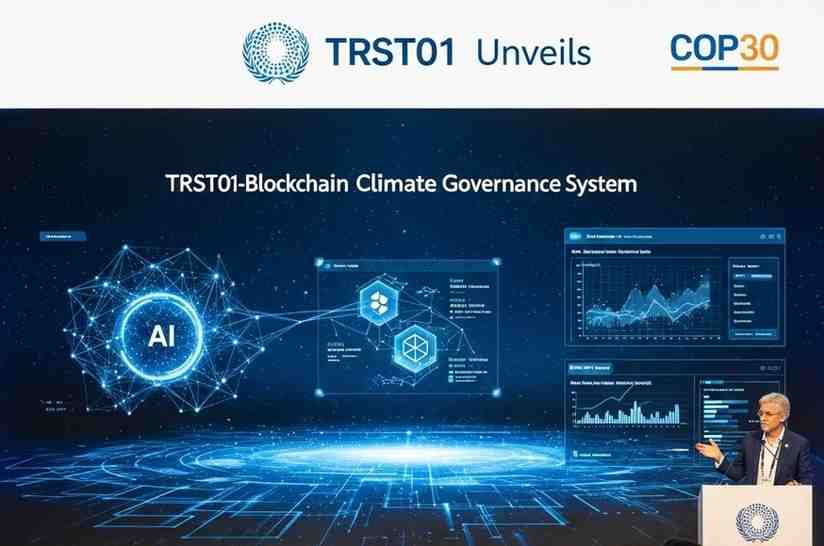
TRST01 AI–Blockchain Climate Platform has emerged as one of the most talked-about innovations at COP30, signalling a major shift in how countries may manage, verify and report their climate actions in the coming decade. As nations continue to face mounting pressure to meet their Paris Agreement commitments, the need for transparent, trustworthy and technologically advanced climate governance systems has never been greater. Against this backdrop, climatetech startup TRST01 has introduced its Paris Agreement Integrated Platform (PAIP), a comprehensive AI- and blockchain-powered ecosystem designed to modernise the global emissions management framework.
Thank you for reading this post, don't forget to subscribe!A new climate governance technology has taken centre stage at COP30 with TRST01 unveiling its Paris Agreement Integrated Platform. The system aims to modernise the global emissions framework by offering transparent, auditable and fully digitised climate governance tools.
Overview of the PAIP System – TRST01 AI–Blockchain Climate Platform
The Paris Agreement Integrated Platform (PAIP) is built to solve one of the most persistent challenges in global climate governance ensuring accuracy and trust in emissions data. By seamlessly integrating artificial intelligence with blockchain architecture, the platform provides countries with a unified space for tracking, verifying and managing their climate-related information.
The system connects every stage of the emissions value chain. It begins with national greenhouse gas inventories and extends through project origination, validation and monitoring to credit issuance, auctioning and final retirement. This end-to-end visibility ensures that each climate action, whether a national policy or a localised offset project, can be monitored and audited with scientific precision.
PAIP’s digital ecosystem also promotes interoperability among government agencies, private sector entities, climate registries and international climate bodies. It reduces paperwork, prevents data tampering and brings transparency to processes that have traditionally been fragmented or prone to inconsistencies. As countries face increasing scrutiny over their submitted climate reports, such a unified digital platform fills a long-standing gap in climate governance infrastructure.
Malawi Becomes First Adopter – TRST01 AI–Blockchain Climate Platform
In a significant milestone, Malawi has become the world’s first country to adopt the PAIP system. The platform has been integrated into Malawi’s newly created Environmental Treasury, a national mechanism designed to oversee climate finance, emissions tracking and environmental datasets.
For Malawi, adoption of the TRST01 platform marks a breakthrough in enhancing both climate transparency and investor confidence. The ability to maintain immutable records and enable real-time tracking of climate actions can reassure donors, international agencies and green investors that every intervention is traceable and verifiable.
This is particularly valuable for developing countries, which often face challenges in accessing finance due to concerns around data reliability and governance capacity. By incorporating PAIP at a national scale, Malawi is positioning itself as a leader in digital climate governance, setting an example for other nations preparing to strengthen their climate reporting and carbon market readiness.
Technology Stack and Capabilities
At the core of the TRST01 AI–Blockchain Climate Platform lies a multi-layered technological stack engineered to deliver accuracy, auditability and automation. The platform’s AI capabilities support data processing, anomaly detection and predictive modelling, adding scientific rigour to emissions verification.
Blockchain technology, meanwhile, ensures that every recorded climate action becomes an immutable entry protected from manipulation and permanently stored for long-term auditing. Smart contracts automate compliance pathways, ensuring that project developers and participating entities meet Protocol requirements without manual intervention.
Satellite analytics and machine learning enhance the system’s ability to validate field-level climate actions. Land-use changes, forest cover variations, project boundaries and carbon stock changes can be monitored remotely and pushed into the platform for verification. This reduces dependence on physical site visits and accelerates credit issuance processes.
Together, these technologies support efficient implementation of Article 6 of the Paris Agreement, which governs international carbon markets and cooperative approaches. Real-time monitoring, automated documentation and reliable verification mechanisms make the platform uniquely positioned to help countries meet evolving global standards.

Impact on Global Climate Governance
The TRST01 AI–Blockchain Climate Platform represents a new chapter in the global climate governance landscape. As more countries prepare to scale climate actions, the need for standardised, transparent and technology-enabled systems becomes increasingly critical.
PAIP offers governments a modernised way to manage emissions data while ensuring compliance with Paris Agreement obligations. It strengthens national reporting frameworks, simplifies participation in carbon markets and provides a trustworthy foundation for climate finance tracking. With transparent data flows and automated auditing, the platform reduces bureaucratic delays and eliminates opportunities for data manipulation key factors in restoring global confidence in emissions reporting.
For stakeholders across the climate ecosystem policymakers, investors, NGOs, carbon project developers and international climate bodies the platform offers reassurance that climate actions are measurable, reportable and verifiable. This trust is essential as the world moves toward deeper decarbonisation commitments and larger flows of climate finance.
With PAIP’s introduction at COP30, TRST01 has positioned itself as a driving force in the next generation of climate governance infrastructure. As adoption expands, the platform may help usher in a future where climate data is not just accessible, but fully trusted, automated and globally interoperable.