


India-France Space Deals

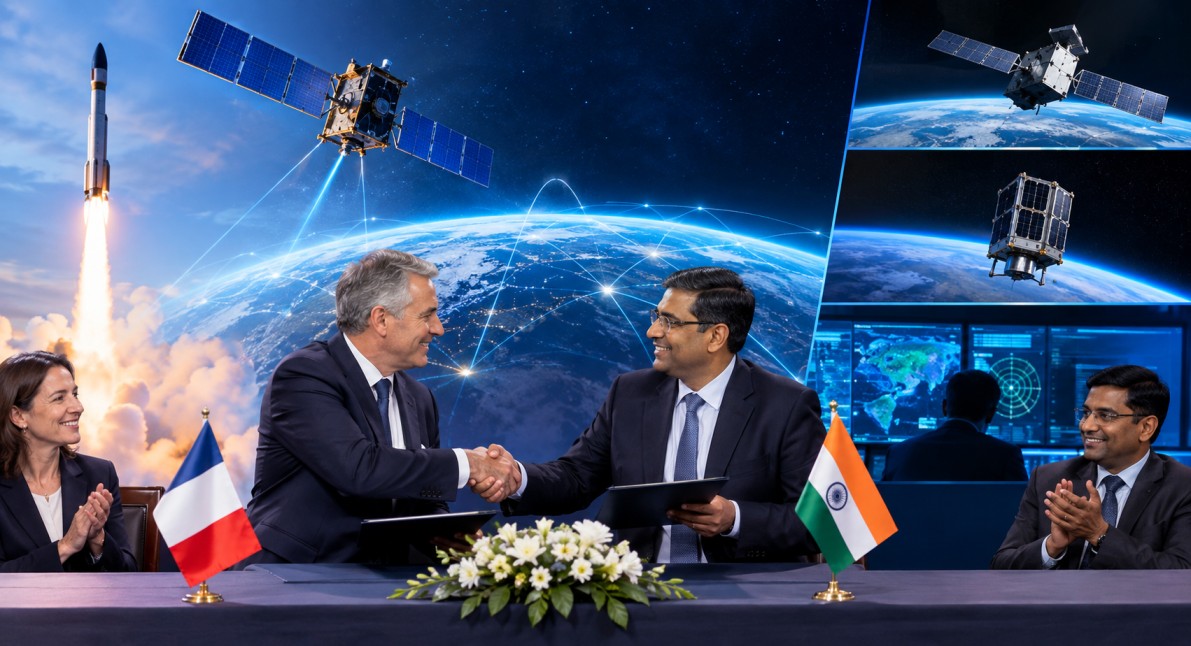
India-France Space cooperation received a new boost after Indian and French private space companies signed three agreements during the first International Space Summit in Paris on 10 September 2026. The agreements focus on satellite launches, space surveillance and microsatellite technology, highlighting the growing role of private companies in the global space industry.
The International Space Summit was held in Paris from 9 to 10 September. The event brought together space companies, investors and industry leaders from different countries. Around 51 announcements were made during the summit, covering investments and contracts worth about €20 billion.

India-France Space Cooperation
India-France Space cooperation has developed over several years through government agencies, research institutions and private companies. The two countries have worked together in areas such as satellite technology, Earth observation, launch services and space science.
France is one of Europe’s leading space powers and has an established space industry supported by the French space agency CNES. India has also expanded its space capabilities through the Indian Space Research Organisation and the growth of private space companies.
The latest agreements show that cooperation is now extending further into commercial space activities. Private firms from both countries are becoming increasingly involved in developing and supplying space technologies.

Safran Space and Dhruva Space Agreement
One of the major agreements announced in Paris involved French company Safran Space and Indian company Dhruva Space. The companies signed contracts worth more than €5 million.
The agreement covers several technologies, including communication systems, inertial navigation units, optical payloads and ground stations. These technologies are planned for use in India’s SBS-III space-surveillance constellation.
The SBS-III programme is expected to involve 52 satellites between 2027 and 2030. Such a constellation can help monitor objects in Earth’s orbit, including operational satellites and space debris.
Space surveillance is becoming increasingly important as the number of satellites in orbit continues to rise. Governments and space companies need accurate information about objects in space to support safe satellite operations.
Space Surveillance and Growing Orbital Activity
The rapid growth of commercial satellites has increased the need for better space-monitoring systems. Thousands of objects are now being tracked around Earth, including active spacecraft, rocket parts and other debris.
Space-surveillance technology can help operators understand where these objects are located and how they are moving. This information can be useful when planning satellite operations and avoiding possible collisions.
The SBS-III constellation therefore represents an important part of India’s efforts to develop stronger space-monitoring capabilities. The involvement of French technology companies also adds an international dimension to the programme.
French Company to Launch Indian Satellites
Another agreement was signed between French launch-services company RIDE! and Indian company TakeMeToSpace. Under the agreement, RIDE! will launch two satellites for the Indian company.
TakeMeToSpace is an Indian space technology company working on orbital data-centre concepts. Orbital data centres are designed around the idea of carrying out computing and data-related activities in space using satellite infrastructure.
The agreement reflects the growing demand for commercial launch services as more private companies develop their own satellites and space missions.
Microsatellite Technology Partnership
AXISCADES Technologies Limited of India also signed a commercial cooperation agreement with French company U-Space. The partnership focuses on India’s microsatellite market.
Microsatellites are small spacecraft that can be used for several purposes, including communication, Earth observation, scientific research and technology demonstrations. Their smaller size can allow companies to develop and launch specialised missions with fewer resources than some larger traditional satellites.
The growing microsatellite market is closely linked to the rise of private space companies. Businesses are increasingly developing smaller spacecraft for specific commercial and scientific needs.
International Space Summit in Paris
The International Space Summit provided a platform for companies and investors to announce new partnerships across the global space sector. The 2026 summit recorded 51 announcements connected with around €20 billion in investments and contracts.
The announcements covered different parts of the space economy, including satellite systems, launch services, space infrastructure and related technologies.
The event also highlighted how space activity is moving beyond traditional government-led programmes. Private companies are now playing a larger role in satellite manufacturing, launch services, data applications and space infrastructure.

Private Space Industry Gets a Bigger Role
The new India-France agreements come at a time when both countries are encouraging greater participation from private companies in space activities.
India has opened more opportunities for private space businesses in recent years, allowing startups and established technology companies to work on satellite systems, launch vehicles and space applications. France and the wider European space sector are also developing commercial space capabilities.
Partnerships between companies from different countries can help businesses share technology, manufacturing capabilities and market opportunities. They can also support the development of new services for a rapidly changing space economy.
India-France Space Ties Expand
The latest deals add a commercial layer to the long-standing India-France Space relationship. Government-level cooperation between the two countries has already covered satellite applications, Earth observation and other space-related activities.
The new private-sector agreements bring together companies working on satellite technology, launch services and microsatellites. They also show the growing importance of international partnerships as the space industry expands.
With satellite numbers increasing and new commercial missions being planned, areas such as space surveillance, affordable launches and small satellite technology are becoming increasingly important for the next phase of the global space sector.