
LHS 1903 Planetary Pattern Surprises Astronomers

LHS 1903 Planetary Pattern has surprised astronomers after scientists discovered a rare inside-out arrangement of planets around a distant star. The system, known as LHS 1903, is located about 116 light-years away in the constellation Lynx. This small and cool M-dwarf star, also called TOI-1730 or G 107-55, hosts a compact group of planets that do not follow the usual pattern seen in most planetary systems.
Thank you for reading this post, don't forget to subscribe!The discovery was made using the CHEOPS satellite, operated by the European Space Agency. CHEOPS was launched in 2019 to study planets outside our solar system. Its precise measurements allowed scientists to study the sizes and positions of the planets in detail. What they found has challenged current ideas about how planets are formed.
A System That Looked Normal at First
At first glance, the LHS 1903 system seemed ordinary. The closest planet to the star, LHS 1903b, is a rocky world orbiting very near the star. Beyond it are two gaseous planets, LHS 1903c and LHS 1903d. This arrangement fits the standard model of planet formation. According to this model, rocky planets form close to a star where it is hot, and gas giants form farther away where temperatures are lower.
This pattern is also seen in our own solar system. Mercury, Venus, Earth, and Mars are rocky planets near the Sun, while Jupiter and Saturn are gas giants located farther out. Because of this, scientists expected other systems to follow a similar rule.
However, the discovery of a fourth planet changed everything.

The Unexpected Outer Rocky Planet
Astronomers from the University of Warwick, led by Thomas Wilson, identified a fourth planet at the outer edge of the system, named LHS 1903e. Surprisingly, this distant planet is rocky instead of gaseous. This creates a rare sequence: rocky, gaseous, gaseous, and then rocky again.
This “inside-out” pattern is unusual because current theories suggest that planets far from their stars should collect thick layers of gas and grow into gas giants. Cooler temperatures at greater distances usually allow gas to remain stable and accumulate around a planet’s core.
The rocky nature of LHS 1903e does not match this expectation. It raises important questions about how and when the planet formed.
Challenging Planet Formation Theories
Planet formation begins in a disc of gas and dust that surrounds a young star. These discs, called protoplanetary discs, provide the material that forms planets. Close to the star, intense heat allows only heavy materials like rock and metal to survive. Farther away, gases such as hydrogen and helium can gather and create thick atmospheres.
The presence of a rocky planet far from the star suggests that something different happened in this system. Scientists considered several possibilities. One idea was that LHS 1903e may have once had a thick atmosphere that was later stripped away by a massive collision. Another idea was that the planet formed closer to the star and later moved outward through orbital migration.
However, detailed computer simulations and orbital studies ruled out these explanations. The movements of the planets do not show signs of large shifts or violent impacts. This means scientists needed another explanation.
LHS 1903 Planetary Pattern and Formation in a Gas-Poor Environment
Researchers now believe that the planets in this system may not have formed at the same time. Instead, they may have formed one after another. By the time LHS 1903e began forming, most of the gas in the protoplanetary disc may have already disappeared.
If there was not enough gas left, the planet could not grow into a gas giant. It would remain rocky, even though it was located far from the star. This suggests that planet formation can continue even after most of the surrounding gas has faded away.
Such a gas-depleted formation process is rarely observed. The LHS 1903 Planetary Pattern may be one of the first clear examples of this type of development. It shows that planet formation is more flexible and complex than previously thought.
Why M-Dwarf Systems Matter
M-dwarf stars like LHS 1903 are smaller and cooler than our Sun. They are also the most common type of star in the Milky Way galaxy. Many exoplanets discovered in recent years orbit M-dwarf stars.
Because these stars are so common, understanding how their planets form is very important. Some scientists believe that rocky planets around M-dwarfs could even host conditions suitable for life. Discoveries like this help improve our understanding of how diverse planetary systems can be.
In 2026, space exploration continues to advance rapidly. New telescopes and missions are searching for Earth-like planets and studying distant galaxies. Each new finding adds to our knowledge and sometimes forces scientists to rethink old theories.
LHS 1903 Planetary Pattern Highlights Space’s Surprises
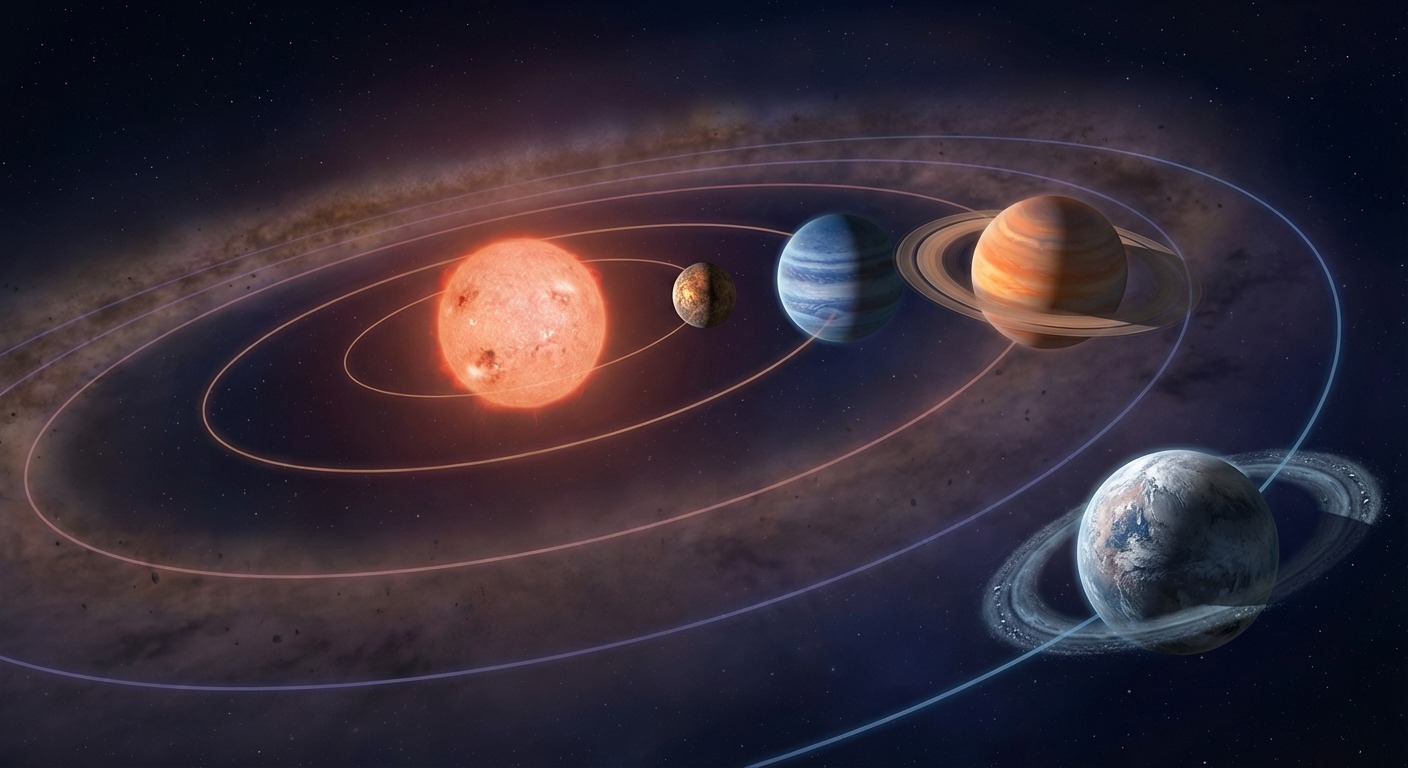
The LHS 1903 Planetary Pattern shows that the universe does not always follow simple rules. Even with advanced satellites like CHEOPS, space continues to reveal unexpected structures.
As more systems are studied, scientists may discover similar inside-out patterns elsewhere. This could lead to new models of how planets form and evolve. For now, the discovery of a rocky planet at the outer edge of this system stands as a powerful reminder that our understanding of the cosmos is still growing.
With each new observation, astronomy moves closer to answering big questions about the origin of planets and the diversity of worlds beyond our solar system.