NASA ESCAPADE Mars Mission: Twin Satellites to Uncover Red Planet’s Atmospheric Secrets

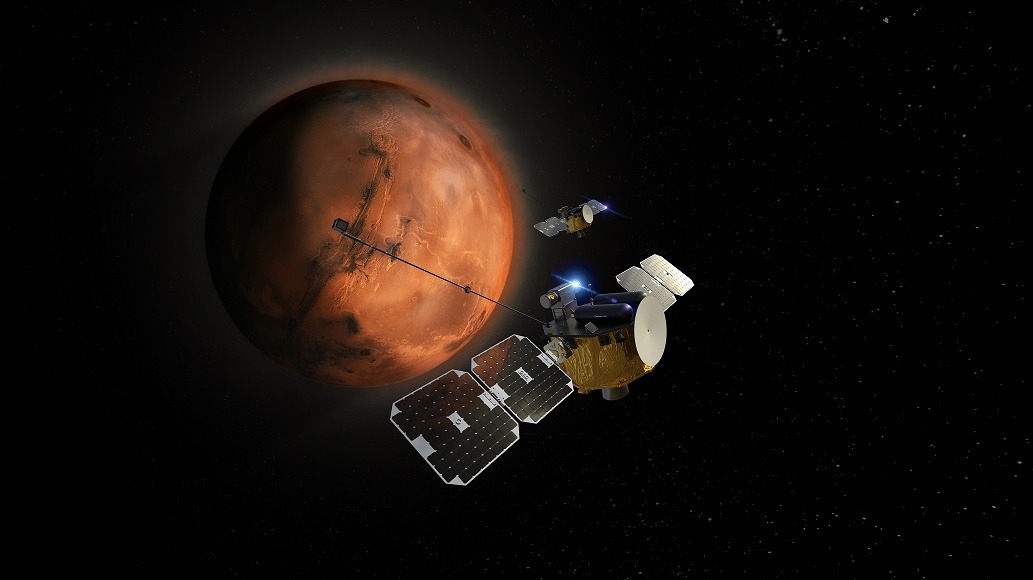
NASA ESCAPADE Mars Mission is the latest step in humanity’s quest to understand the Red Planet’s evolution and prepare for future human exploration. The mission, short for Escape and Plasma Acceleration and Dynamics Explorers (ESCAPADE), will send two identical small satellites nicknamed Blue and Gold to study how the solar wind interacts with and gradually strips away Mars’ atmosphere.
Thank you for reading this post, don't forget to subscribe!Launched aboard Blue Origin’s New Glenn rocket, this cost-effective dual-spacecraft mission will create the most detailed 3D view yet of Mars’ magnetic and atmospheric environment. The mission aims to unravel how the planet lost its once-thicker atmosphere, transforming from a potentially habitable world with flowing water into the barren desert we see today.
NASA ESCAPADE Mars Mission: Unraveling the Red Planet’s Atmospheric Mystery
At the heart of the NASA ESCAPADE Mars Mission lies a critical question: What caused Mars to lose its atmosphere? Billions of years ago, Mars had rivers, lakes, and possibly even oceans. However, it eventually lost most of its atmosphere, leaving behind a cold, thin, and dry world. Scientists believe that the solar wind a stream of charged particles from the Sun played a major role in this transformation.
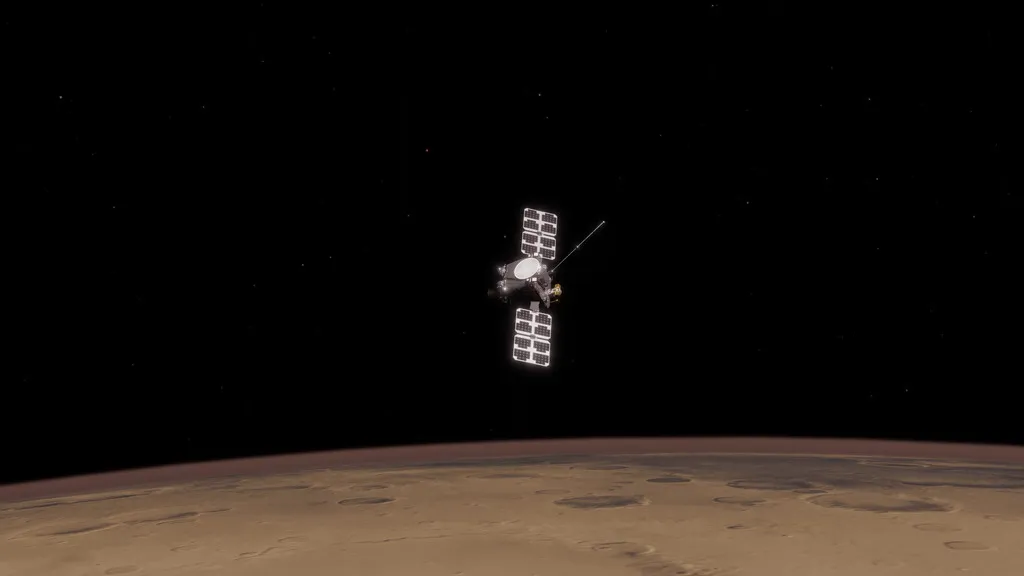
ESCAPADE will focus on the boundary region where Mars’ patchy crustal magnetic fields interact with the solar wind. This is where high-energy particles collide with atmospheric molecules, gradually stripping them away into space. By simultaneously measuring these interactions at different points around Mars, the twin satellites will reveal how this process operates on a global scale and how quickly it changes during solar storms.
NASA ESCAPADE Mars Mission: What the Mission Will Study
The ESCAPADE mission aims to deepen our understanding of how energy and plasma from the Sun influence Mars’ upper atmosphere. Using synchronized measurements from both spacecraft, scientists will map:
- The structure of Mars’ magnetosphere, which is weak and uneven compared to Earth’s protective magnetic field.
- The rate and pattern of atmospheric escape, quantifying how much gas Mars continues to lose to space.
- The interaction of ions and electrons in the upper atmosphere and how solar wind pressure affects them.
This data will allow researchers to reconstruct how Mars evolved from a wetter, warmer planet into a frozen desert. It also provides vital information for future human missions, helping predict radiation exposure risks for astronauts and equipment on the Martian surface.
NASA ESCAPADE Mars Mission: Twin Spacecraft and Instruments
Each of ESCAPADE’s twin satellites Blue and Gold is equipped with a compact yet powerful suite of scientific instruments designed to analyze Mars’ space weather environment.
Key instruments include:
- A magnetometer, which measures local magnetic fields to help map Mars’ crustal magnetism.
- Electrostatic analyzers, capable of detecting ions and electrons within the solar wind and Mars’ ionosphere.
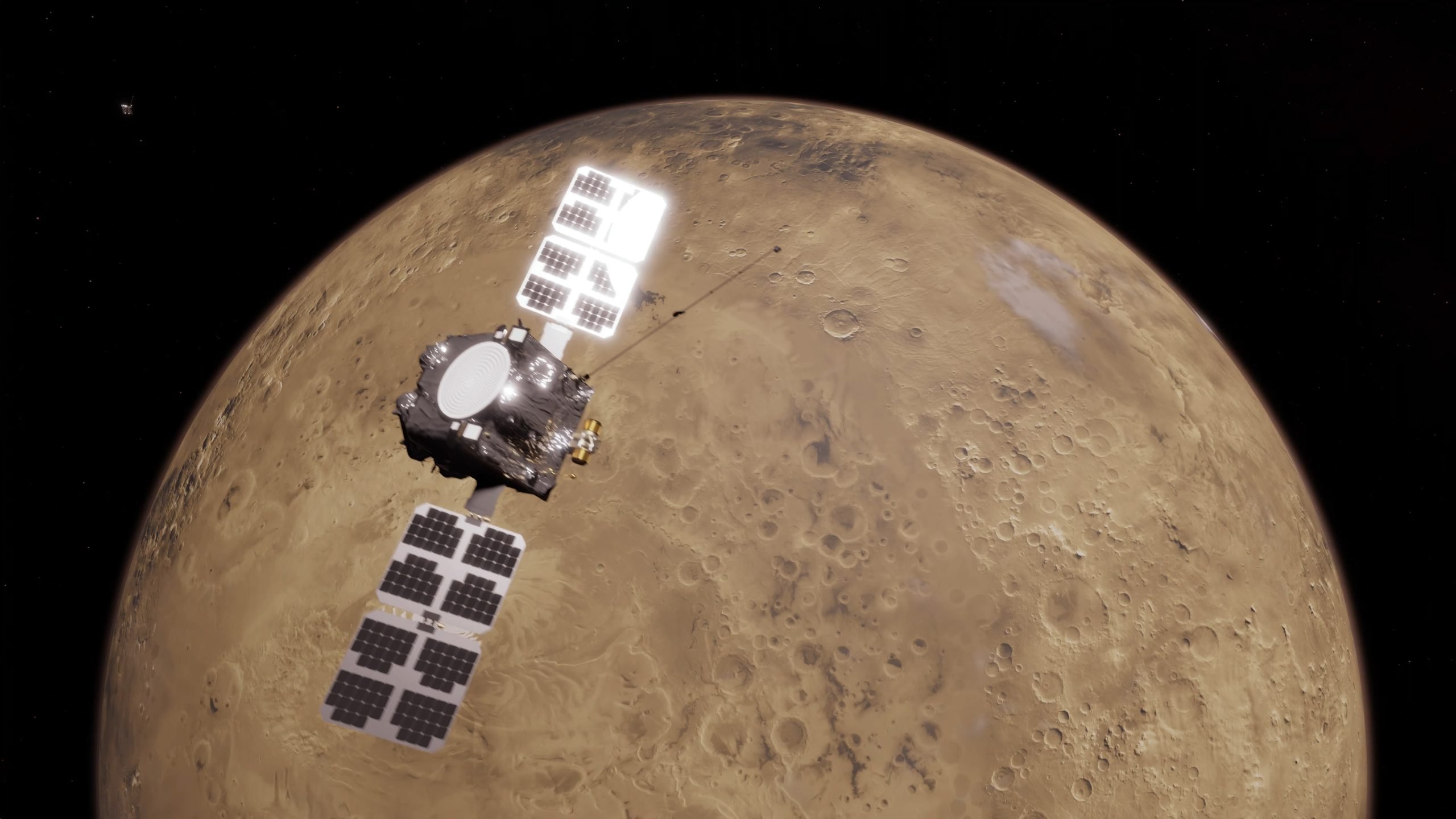
These two spacecraft will fly in coordinated elliptical orbits around Mars, occasionally separating and converging to capture the same region from different angles. This stereo-style observation allows scientists to track dynamic phenomena like shifting plasma currents and electric fields that single satellites might miss.
Together, they will produce a dynamic, three-dimensional view of Mars’ magnetized environment and the complex processes that drive atmospheric escape.
NASA ESCAPADE Mars Mission: Innovative Journey to Mars
Unlike traditional Mars missions that follow a Hohmann transfer orbit, the NASA ESCAPADE Mars Mission will take a unique route. After launch, the twin spacecraft will first travel to a Sun–Earth Lagrange point a gravitationally stable zone where they can perform system checkouts and calibrations.
From there, they will execute an Earth flyby maneuver to gain additional velocity and redirect their trajectory toward Mars. This innovative approach provides greater flexibility in launch timing and reduces costs compared to traditional deep-space transfer methods.
The spacecraft are scheduled to arrive at Mars in 2027, after which they will spend several months adjusting their orbits before beginning synchronized science operations. This journey also serves as a testbed for future small-satellite missions, demonstrating how multiple spacecraft can collaborate to study planetary environments efficiently.
NASA ESCAPADE Mars Mission: Advancing Space Science and Exploration
The ESCAPADE mission not only enhances our understanding of Mars but also strengthens our ability to explore other planets. By learning how solar and magnetic forces strip planetary atmospheres, scientists can apply similar models to Venus, Earth, and exoplanets beyond our solar system.
Moreover, ESCAPADE’s data will fill critical gaps between previous missions such as MAVEN (Mars Atmosphere and Volatile Evolution Mission) and upcoming human exploration efforts. It will help scientists determine how solar radiation affects potential landing sites, communication systems, and protective measures for astronauts.
NASA ESCAPADE Mars Mission: Importance for Astronaut Safety
As humanity moves closer to sending astronauts to Mars, understanding space weather hazards becomes a top priority. The NASA ESCAPADE Mars Mission will provide essential insights into when and where solar storms increase radiation intensity and atmospheric loss rates.
This knowledge will help design shielding strategies for habitats and spacecraft, improving safety for human crews. It will also assist in selecting safe landing sites by identifying regions less affected by charged particle bombardment.
By mapping real-time changes in Mars’ magnetosphere and ionosphere, ESCAPADE’s data will play a crucial role in forecasting solar-driven risks for both robotic and human explorers.
NASA ESCAPADE Mars Mission: A Cost-Effective Step Toward the Future
ESCAPADE represents a new generation of low-cost, high-efficiency planetary missions. Built by the University of California, Berkeley’s Space Sciences Laboratory and managed by NASA’s Small Innovative Missions for Planetary Exploration (SIMPLEx) program, it demonstrates how small satellites can perform big science at a fraction of traditional mission costs.
The mission also symbolizes NASA’s shift toward collaborative, flexible exploration models, paving the way for fleets of coordinated spacecraft that can study complex planetary systems in detail.
With its innovative design, cooperative flight path, and groundbreaking scientific goals, the NASA ESCAPADE Mars Mission stands as a milestone in planetary research bridging the gap between robotic exploration and the next era of human missions to Mars.