STAR Supersonic Missile: India’s Leap Toward Smarter Defence Training and Readiness

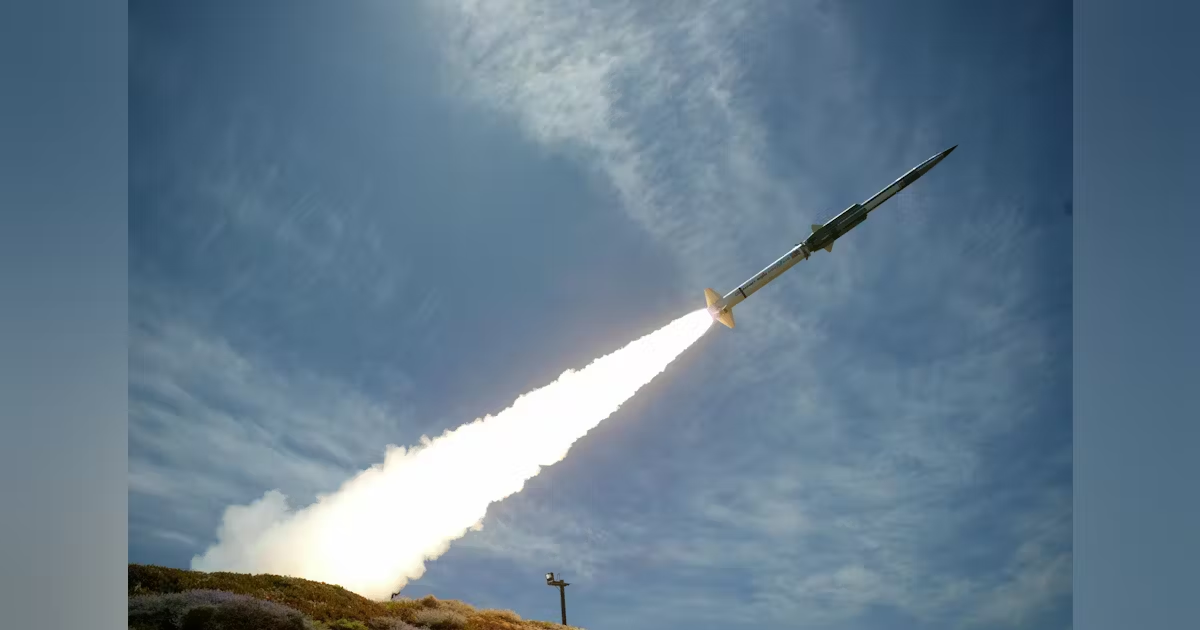
India’s STAR Supersonic Missile represents a major stride in the nation’s journey toward military modernization and self-reliance. Designed to emulate the speed, agility, and complexity of modern cruise missile threats, STAR (Supersonic Target) serves as a critical training tool for India’s armed forces. Developed indigenously, the system plays a vital role in preparing defence personnel for real-world combat situations by providing realistic and high-speed target simulations. Capable of reaching speeds between Mach 1.8 and Mach 2.5, STAR’s performance places it among the most advanced supersonic target systems in the world.
Thank you for reading this post, don't forget to subscribe!STAR Supersonic Missile: A Game Changer for Military Preparedness
Unlike conventional target drones or subsonic systems, STAR’s supersonic capability provides the armed forces with a realistic simulation of hostile missile attacks. It enables India’s Army, Navy, and Air Force to practice tracking, interception, and countermeasure operations in conditions that closely mimic modern warfare. By replicating missile threats with precise flight profiles, the system strengthens the military’s reaction time and tactical proficiency during both peacetime training and wartime scenarios.
The introduction of STAR marks a new era in India’s pursuit of defence self-reliance. It complements the country’s broader vision of Atmanirbhar Bharat (Self-Reliant India), reducing dependence on foreign suppliers for high-speed target systems.
Recent Developments: Progress Toward Operational Deployment
As of mid-2025, STAR has entered Phase-III of its development cycle, with full-scale prototypes undergoing intensive testing. These tests include integrated propulsion, guidance, and control systems that push the limits of flight accuracy and stability.
Combat-style flight trials have demonstrated the missile’s agility and precision under varied conditions, signaling that operational deployment is on the horizon. Once deployed, STAR will become a cornerstone of India’s tri-service joint training exercises. The Army, Navy, and Air Force will be able to practice coordinated defensive operations against supersonic threats a significant boost to overall combat readiness.
Technical Brilliance: Engineering the STAR
The STAR Supersonic Missile stands out for its advanced two-stage propulsion system. It begins with a solid booster rocket, which provides a rapid initial lift-off, propelling the missile into its flight path. Once airborne, a Liquid Fuel Ramjet (LFRJ) engine takes over, maintaining sustained supersonic speed and maneuverability.
The missile’s flight envelope is highly versatile. It can perform sea-skimming maneuvers as low as 12 feet above the surface, imitating low-level cruise missile attacks that challenge radar systems. Conversely, it can execute steep dives from altitudes of up to 10 kilometers, simulating high-altitude strike trajectories.
With operational ranges spanning 55 to 175 kilometers and flight durations between 50 and 200 seconds, STAR offers multiple training configurations. This adaptability makes it suitable for short-range interception drills as well as extended air-defence simulations.
Variants Designed for Versatility
To cater to the diverse needs of India’s armed forces, STAR has been developed in two main variants:
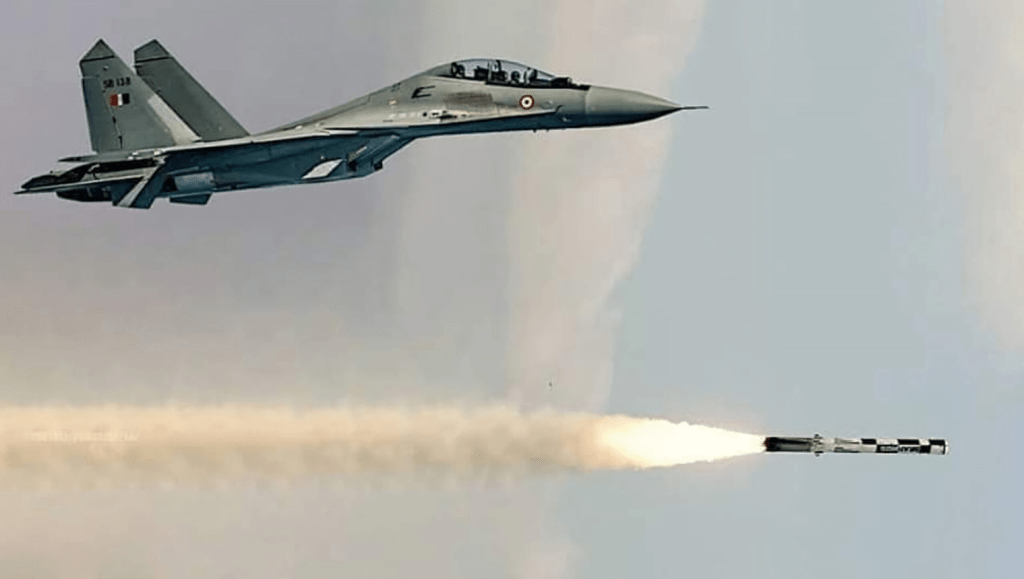
- Air-Launched STAR – This version is deployed from fighter aircraft such as the LCA Tejas, enabling simulation of air-to-air and air-to-ground missile threats. It can replicate scenarios involving anti-radiation and anti-AWACS (Airborne Warning and Control System) roles, offering realistic challenges for air defence crews. The air-launched variant has already been integrated into joint-force exercises like Operation Sindoor, enhancing interoperability among different branches of the military.
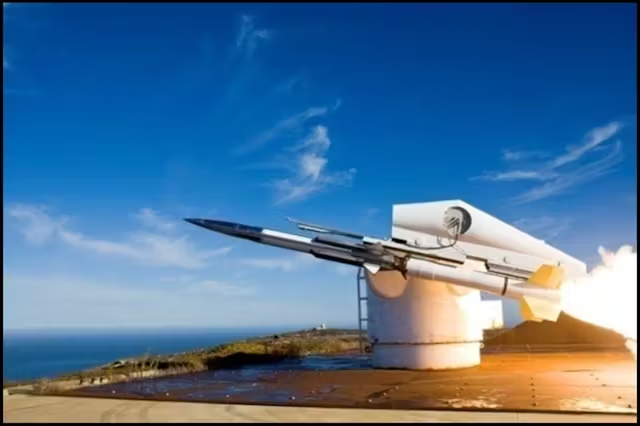
- Ground-Launched STAR – Mounted on mobile truck-based platforms, this version can be launched from coastal bases or inland ranges. It supports naval and land-based training exercises, simulating incoming sea-skimming missiles or fast-approaching aerial targets. The ground-based system’s mobility and rapid deployment capability make it ideal for dynamic combat environments.
Strategic Importance: Powering Atmanirbhar Bharat
One of STAR’s most significant contributions lies in its strategic value for defence self-reliance. India has historically relied on imported target systems for missile training. With STAR, that dependence is diminishing rapidly. The missile’s indigenous design, cost-effectiveness, and reusability position it as a sustainable training solution for years to come.
Moreover, the technological insights gained from STAR’s development especially in ramjet propulsion and guidance are paving the way for future missile programs such as Astra Mk3 and advanced anti-aircraft systems. By mastering these technologies domestically, India is building a robust foundation for next-generation missile research.
Impact on India’s Defence Ecosystem
The introduction of the STAR Supersonic Missile is reshaping India’s approach to military readiness and defence innovation. Its modular design allows the armed forces to customize simulations based on evolving global threat patterns. Whether simulating low-level cruise missile attacks or high-altitude intrusions, STAR provides flexibility and realism that were previously unavailable in India’s training systems.
The missile also reflects the broader trend of indigenization and innovation in India’s defence sector. With state-owned organizations and private industry collaborating more closely, the ecosystem for missile and aerospace technology is expanding rapidly. Defence analysts view STAR as a symbol of technological maturity, demonstrating India’s ability not only to produce world-class weapon systems but also to refine them through iterative innovation.
Looking Ahead
In the coming years, STAR is expected to evolve beyond a target missile system. Experts suggest that its architecture could serve as a base platform for tactical weapons capable of striking enemy radars or surveillance aircraft. Such an evolution would reinforce India’s deterrence capabilities while maintaining cost efficiency.
As the nation continues to enhance its defence capabilities, the STAR Supersonic Missile stands as a shining example of indigenous excellence. It embodies speed, precision, and innovation all essential attributes for a modern military force. With each successful test, STAR brings India closer to achieving strategic autonomy and operational superiority in the supersonic domain.