Webb Telescope Dark Matter Map Offers Unprecedented View of the Universe

Scientists have unveiled the Webb Telescope Dark Matter Map, the most detailed picture yet of the invisible matter shaping the universe. This new discovery, based on observations from the James Webb Space Telescope, provides an extraordinary look into how galaxies formed and evolved during one of the most important phases in cosmic history. By mapping dark matter more accurately than ever before, researchers are beginning to understand the hidden framework that holds the universe together.
Thank you for reading this post, don't forget to subscribe!Unseen Matter That Shapes the Cosmos
Most people are familiar with stars, planets, and galaxies, but all the ordinary matter in the universe makes up only a small fraction about 15% of the total matter. The rest, a mysterious substance called dark matter, cannot be seen directly. It does not emit, absorb, or reflect light, making it invisible to conventional telescopes. However, scientists know it exists because of the gravitational influence it exerts. Dark matter affects the rotation speeds of galaxies, the structure of galaxy clusters, and even bends light from distant objects through a phenomenon called gravitational lensing.
Dark matter acts like an invisible scaffold for the universe. Without it, galaxies would not form in the way we see them today. Understanding dark matter is essential to explaining the evolution of cosmic structures and the formation of stars and galaxies over billions of years.
Gravitational Lensing: Nature’s Cosmic Magnifier
The Webb Telescope Dark Matter Map was created using a method known as weak gravitational lensing. As light from distant galaxies travels to Earth, it passes through regions with massive objects like galaxy clusters. The gravity of these objects slightly bends the light, subtly distorting the shapes of the background galaxies.
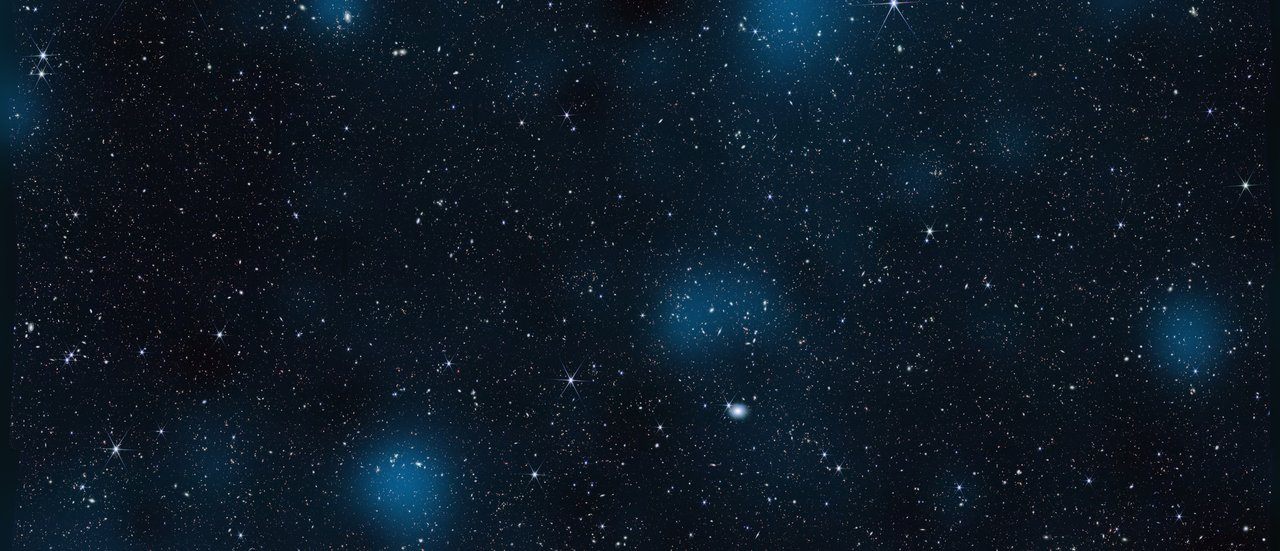
By studying the shape distortions of nearly 250,000 galaxies, astronomers can reconstruct the distribution of both ordinary and dark matter across vast distances. This technique allows scientists to “see” the invisible matter and map it in three dimensions, providing a much clearer picture of the cosmic web the network of filaments and voids that stretches across the universe.

How Webb Improves Upon Hubble
Previous large-scale maps of dark matter relied on data from the Hubble Space Telescope. While Hubble has given us remarkable views of the universe, Webb’s advanced infrared instruments and greater light-gathering power take this research to a new level. Webb offers nearly double the resolution of Hubble, while also observing light from much farther back in time.
The new map reaches 8 to 10 billion years into the past, a crucial period when galaxies were actively forming and merging. This means scientists can study not only the current distribution of dark matter but also how it influenced galaxy formation during the universe’s most dynamic era.
Revealing the Cosmic Web
The Webb Telescope Dark Matter Map unveils the universe’s cosmic web with unprecedented clarity. It highlights dense clusters of galaxies, enormous dark matter filaments connecting these clusters, and vast empty voids where little matter exists. These features closely match predictions made by the Lambda-CDM cosmological model, the standard model of the universe.
Lambda-CDM suggests that dark matter forms the backbone of the cosmos. Galaxies develop inside “dark matter halos,” which are gravitational wells where ordinary matter can gather. Mapping these halos helps scientists refine theories about how galaxies form, merge, and evolve over billions of years.
Implications for Understanding the Universe
This new map has far-reaching implications for cosmology. By pinpointing the locations of dark matter halos and the filamentary structures that connect them, astronomers can test and improve computer models of galaxy formation. They can also better understand the relationship between dark matter and ordinary matter, shedding light on why the universe appears the way it does today.
The data from Webb will also help explore questions about dark energy, the mysterious force driving the universe’s accelerating expansion. Since the distribution of dark matter affects how galaxies cluster and move, scientists can compare these observations with predictions to learn more about the underlying physics of the cosmos.
A New Era of Cosmic Mapping
The James Webb Space Telescope is changing the way we see the universe. With the Webb Telescope Dark Matter Map, researchers now have a more detailed and accurate view of the invisible structures that govern galaxy formation and cosmic evolution. This work is part of a broader effort to understand the universe’s history, from its nearly uniform beginnings to the rich, complex structures we observe today.
Future observations with Webb promise even deeper insights. By combining these findings with other surveys, astronomers hope to trace the growth of dark matter and galaxies across cosmic time. This could answer some of the most fundamental questions in astronomy: How did the universe evolve? What role does dark matter play in shaping it? And how did galaxies like our Milky Way come to exist?
The unveiling of the Webb Telescope Dark Matter Map marks a major milestone in our quest to uncover the hidden universe. For the first time, scientists can see the intricate web of dark matter that connects galaxies and influences the cosmos on the largest scales. This discovery brings us closer to understanding the invisible forces that have shaped everything from the tiniest stars to the largest galaxy clusters.