El Nino and La Nina (ENSO): Complete Guide to Climate Patterns

El Niño and La Niña are two powerful climate phenomena that play a major role in shaping global weather patterns. These events are part of a larger system known as the El Niño–Southern Oscillation (ENSO), which refers to periodic changes in ocean temperatures and atmospheric pressure in the equatorial Pacific Ocean. Understanding El Niño and La Niña is very important because they influence rainfall, temperature, agriculture, and even natural disasters across the world.
Thank you for reading this post, don't forget to subscribe!What is ENSO (El Niño–Southern Oscillation)?
The El Niño–Southern Oscillation is a natural climate cycle involving changes in sea surface temperature and atmospheric pressure in the central and eastern Pacific Ocean.
- ENSO has three phases:
- El Niño (Warm Phase)
- La Niña (Cool Phase)
- Neutral Phase
- These phases occur every 2 to 7 years.
- Each event typically lasts 9 to 12 months, but sometimes longer.
What is El Niño?
El Niño is the warm phase of the El Niño–Southern Oscillation (ENSO), characterized by unusual warming of surface waters in the eastern tropical Pacific Ocean. It is not just an oceanic event but a combined ocean-atmosphere phenomenon that affects global climate patterns.
Origin and Discovery of El Niño
El Niño was first recognized by fishermen along the coast of Peru, who observed unusually warm ocean waters that affected fish availability.
- The term El Niño was given by Spanish immigrants.
- It means “The Little Boy”, referring to the Christ child, as the event often appears around Christmas.
- Over time, the term came to represent large-scale and irregular climate changes, not just coastal warming.
El Niño does not follow a fixed cycle. It occurs irregularly every 2 to 7 years, making it difficult to predict accurately.
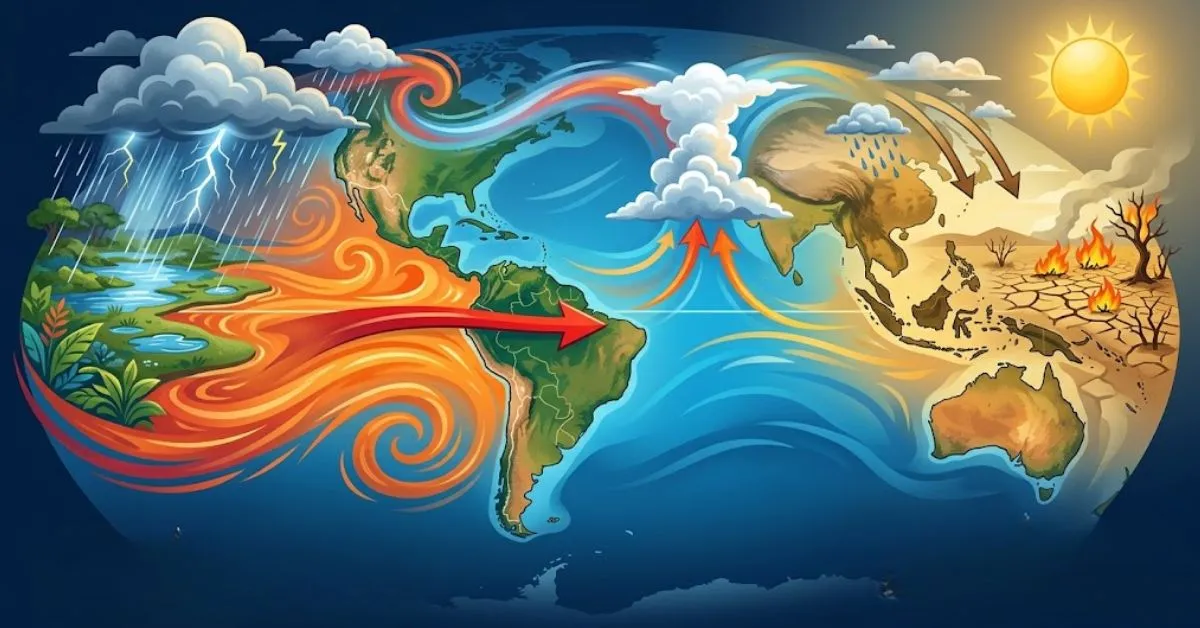
El Niño and Southern Oscillation Connection
Scientists later discovered that El Niño is closely linked with changes in atmospheric pressure known as the Southern Oscillation.
- The Southern Oscillation refers to changes in air pressure over the tropical Pacific Ocean.
- During El Niño:
- Ocean waters in the eastern Pacific become warmer
- Air pressure above this region decreases
This connection between ocean temperature and air pressure is called the ENSO system.
Key Features of El Niño
- Warm ocean water shifts towards South America
- Trade winds weaken or reverse
- Upwelling of cold, nutrient-rich water decreases
- Air pressure drops in the eastern Pacific
Normal Conditions vs El Niño
Normal Conditions
- Strong trade winds push warm water toward Asia and Australia
- Cold water rises near South America (upwelling)
- Stable and balanced weather patterns
During El Niño
- Trade winds weaken
- Warm water moves eastward
- Upwelling decreases significantly
- Weather patterns become unstable worldwide
Monitoring El Niño
Scientists, governments, and organizations monitor El Niño using advanced technologies:
- Scientific buoys floating in oceans
- Satellites
- Climate models
A buoy is a floating device used in the ocean to measure:
- Temperature
- Winds
- Ocean currents
- Humidity
These buoys send daily data to scientists around the world, helping them track and predict El Niño events.
Oceanic Niño Index (ONI)
An important tool used is the Oceanic Niño Index (ONI).
- Measures deviation from normal sea surface temperatures
- Helps classify El Niño into:
- Weak
- Moderate
- Strong
Intensity of El Niño
- Weak: ~4–5°F increase
- Strong: ~14–18°F increase
- Strong events can cause global climatic changes
Impact of El Niño
To understand El Niño’s impact, we must compare it with normal Pacific conditions, where trade winds maintain balance. When this balance is disturbed, major climate changes occur.
1. Impact on Ocean
- Changes ocean temperature and currents
- Reduces nutrient supply
- Harms coastal fisheries, especially in South America
2. Increased Rainfall
- Heavy rainfall in South America
- Flooding in Peru and Ecuador
- Coastal erosion increases
3. Drought Conditions
- Severe drought in:
- Indonesia
- Australia
- Parts of India
- Water shortages occur as rivers dry and reservoirs shrink
- Agriculture suffers due to lack of irrigation
4. Health Impacts
- Floods and droughts create conditions for diseases such as:
- Cholera
- Dengue
- Malaria
5. Wildfires
- Drought conditions lead to forest fires
- Causes air pollution and respiratory diseases
6. Positive Effects
- Reduces the number of hurricanes in the Atlantic Ocean
7. Regional Impacts
South America
- Heavy rainfall and flooding
- Damage to infrastructure and agriculture
Western Pacific (Asia & Australia)
- Drought conditions
- Threat to water supply and farming
- Normally:
- Sea level is higher in Indonesia
- Temperature is warmer than South America
Upwelling and Its Importance
During normal conditions:
- Cold, nutrient-rich water rises to the surface (called upwelling)
- Supports marine life and fisheries
During El Niño:
- Upwelling weakens
- Marine productivity declines
Major El Niño Events in History
1982–83 Event
- One of the strongest events of the 20th century
- Sea temperatures increased by 9–18°F above normal
1997–98 Event
- First fully monitored El Niño event
- Caused:
- Drought in Indonesia, Malaysia, and the Philippines
- Heavy rainfall and floods in Peru and California
- Unusually warm winter in the United States (“year without a winter”)
What is La Niña?
La Niña is the cool phase of the El Niño–Southern Oscillation, characterized by an unusual cooling of sea surface temperatures in the eastern and central Pacific Ocean.
Meaning of La Niña
The term La Niña means “The Little Girl” in Spanish. It is also sometimes referred to as:
- El Viejo
- Anti-El Niño
- Cold Event
Scientific Definition
La Niña events represent periods of below-average sea surface temperatures in the east-central equatorial Pacific.
- It is identified when temperature drops by more than 0.9°F (≈0.5°C)
- The condition must persist for at least five consecutive overlapping three-month periods
Key Features of La Niña
- Stronger-than-normal trade winds
- Increased upwelling of cold, nutrient-rich water
- High pressure over the eastern Pacific
- Low pressure over the western Pacific
- Cooler ocean temperatures in the eastern Pacific
Conditions During La Niña
La Niña develops due to the build-up of cooler-than-normal water in the tropical Pacific (between the Tropic of Cancer and Tropic of Capricorn).

Atmospheric Conditions
- Low pressure over the western Pacific → leads to heavy rainfall
- High pressure over central and eastern Pacific → leads to less rainfall and fewer clouds
Rainfall and Climate Patterns
Increased Rainfall Regions
- Southeast Asia
- Australia
- Southeastern Africa
- Northern Brazil
Dry Regions
- West coast of South America (Peru, Ecuador)
- Gulf Coast of the United States
- Pampas region of South America
Impacts of La Niña
1. Global Weather Effects
- Heavy rainfall and flooding in Asia and Australia
- Drought conditions in parts of South America
2. North America
- Stronger winds along the equatorial Pacific
- Increased hurricane activity in the Caribbean and Atlantic
- Higher chances of tornadoes in the United States
3. Europe
- Milder winters in Northern Europe (e.g., UK)
- Colder winters in Southern and Western Europe
- Increased chances of snowfall in the Mediterranean region
4. South America
- Drought in Peru and Ecuador
- Positive impact on fisheries due to nutrient-rich cold waters
5. Western Pacific Region
- Increased risk of cyclones and landfall in Asia and China
- Heavy flooding in Australia
- Warmer temperatures in:
- Western Pacific
- Indian Ocean
- Somali coast
Major La Niña Event (2010)
The 2010 La Niña event was one of the most destructive in recent history:
- Triggered severe flooding in Queensland, Australia
- Over 10,000 people were evacuated
- Economic damage exceeded $2 billion
El Niño vs La Niña (Difference)
| Feature | El Niño | La Niña |
|---|---|---|
| Ocean Temperature | Warmer | Cooler |
| Trade Winds | Weak | Strong |
| Rainfall | South America | Asia & Australia |
| Indian Monsoon | Weak | Strong |
| Duration | Shorter | Longer |
ENSO and India
Impact of El Niño in India
- Weak monsoon
- Drought conditions
- Reduced agricultural output
- Water shortages
Impact of La Niña in India
- Strong monsoon rainfall
- Good agricultural production
- Better water availability
La Niña and Indian Climate
- Brings colder winters
- Cold air flows from Siberia
- Less impact of western disturbances
- Temperature drop even in southern India
Importance of El Niño and La Niña
Understanding El Niño and La Niña is crucial because:
- Helps in weather forecasting
- Supports agriculture planning
- Reduces disaster risks
- Helps governments prepare for floods and droughts
Conclusion
El Niño and La Niña are powerful climate drivers that affect weather across the globe. While El Niño brings warming and often droughts, La Niña brings cooling and increased rainfall. These phenomena are closely linked to the ENSO cycle, making them important for scientists, farmers, and policymakers alike.
In countries like India, where agriculture depends heavily on the monsoon, understanding El Niño and La Niña can make a huge difference in economic planning and disaster management.
FAQs on El Niño and La Niña
1. What are El Niño and La Niña?
El Niño and La Niña are opposite climate patterns in the Pacific Ocean. They are part of the El Niño–Southern Oscillation (ENSO) and affect global weather, rainfall, and temperature.
2. What is the main difference between El Niño and La Niña?
- El Niño → Warming of ocean water
- La Niña → Cooling of ocean water
- El Niño weakens monsoon, while La Niña strengthens it in India.
3. How often do El Niño and La Niña occur?
They usually occur every 2 to 7 years and may last from 9 months to 2 years depending on intensity.
4. What causes El Niño?
El Niño occurs due to:
- Weakening of trade winds
- Eastward movement of warm ocean water
- Reduced upwelling near South America
5. What causes La Niña?
La Niña is caused by:
- Stronger trade winds
- Increased upwelling of cold water
- Cooling of the eastern Pacific Ocean
6. How do El Niño and La Niña affect India?
- El Niño → Weak monsoon, drought risk
- La Niña → Strong monsoon, more rainfall and better agriculture
7. What is the Oceanic Niño Index (ONI)?
The Oceanic Niño Index (ONI) measures changes in sea surface temperature in the Pacific Ocean to identify El Niño or La Niña events.
8. Which is more dangerous: El Niño or La Niña?
Both can be dangerous:
- El Niño → Droughts, heatwaves, wildfires
- La Niña → Floods, cyclones, heavy rainfall
The impact depends on region and intensity.
9. Do El Niño and La Niña affect global weather?
Yes, they influence:
- Rainfall patterns
- Temperature changes
- Storms and hurricanes
- Agriculture worldwide
10. Why is El Niño called “Little Boy”?
The term El Niño was given by Peruvian fishermen because it appears around Christmas and refers to the Christ child.