Human Values: Definition, Types, and Importance in Daily Life

Human Values are the basic principles that guide our behavior and decisions. They help us understand what is right and wrong and teach us how to live a meaningful life. These values shape our character and improve our relationships with others.
Thank you for reading this post, don't forget to subscribe!Human values are important because they make society peaceful, fair, and caring. Without values, people may become selfish and careless. Values such as honesty, love, peace, and kindness help us become better human beings.
What are Human Values?
Human values are standards or beliefs that tell us what is important in life. They influence our thoughts, actions, and decisions. These values help us choose the right path even during difficult situations.
For example, if a person values honesty, they will speak the truth even when lying seems easier.
There are two basic kinds of values:
Intrinsic Values
These are values that are good by themselves. They are important even without any reward.
Examples:
- Truth
- Love
- Happiness
- Peace
Extrinsic Values
These values help us achieve something else.
Examples:
- Money
- Success
- Fame
- Power
Money itself is not the final goal, but it helps us gain comfort and security.
As Dalai Lama said, “To lead a meaningful life, we must value others and cultivate inner peace.”
Core Universal Human Values
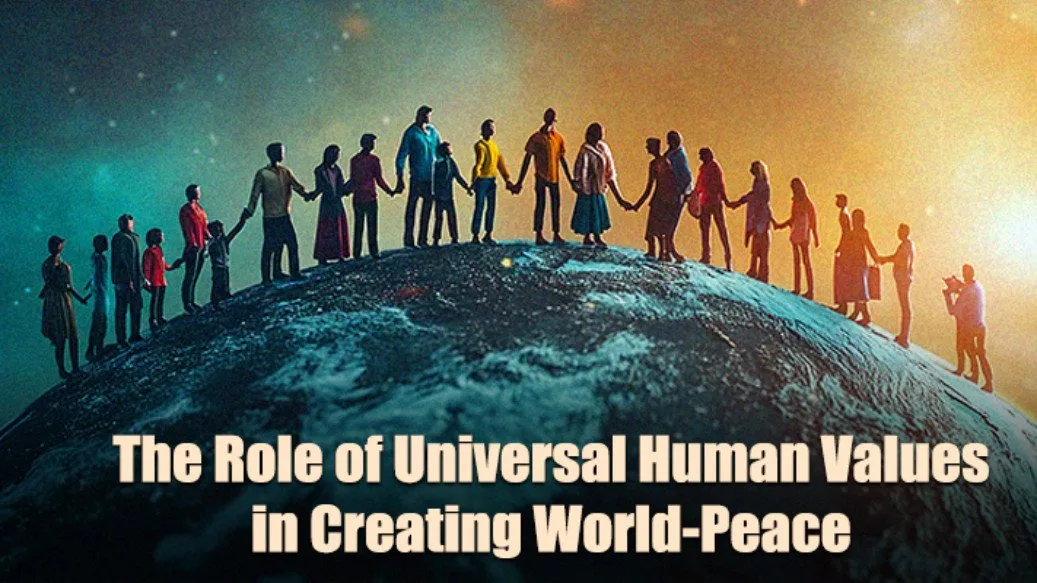
Though cultures are different, some values are respected everywhere in the world.
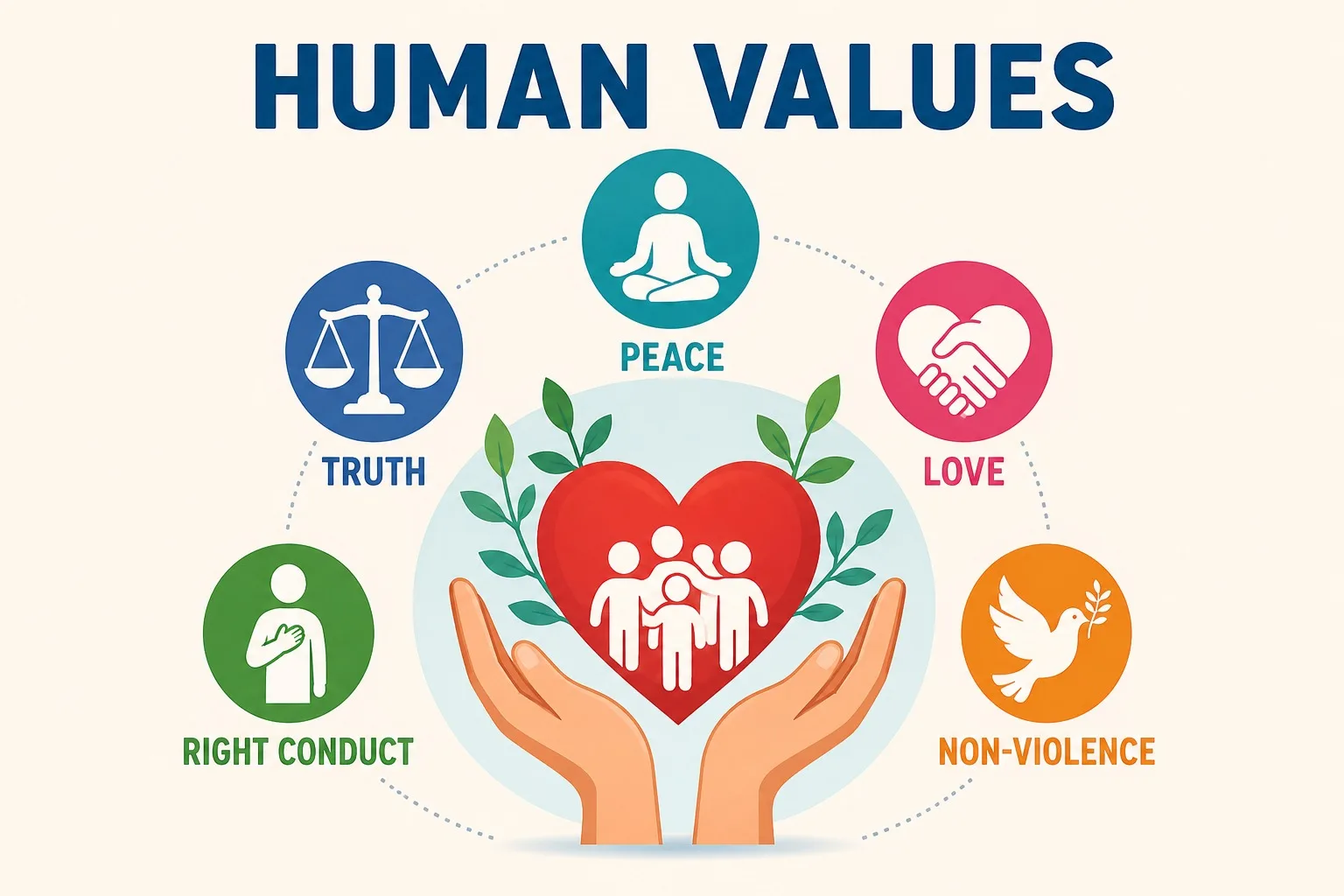
1. Truth (Satya)
Truth means being honest and accepting reality.
Important qualities:
- Honesty
- Integrity
- Fairness
- Trustworthiness
A truthful person gains respect and trust.
2. Right Conduct (Dharma)
Right conduct means doing the right thing and fulfilling duties responsibly.
Examples:
- Responsibility
- Discipline
- Self-care
- Good behavior
It is often called truth in action.
3. Peace (Shanti)
Peace means inner calm and mental balance. It is not only the absence of fighting.
Peace includes:
- Patience
- Self-control
- Concentration
- Emotional balance
A peaceful mind helps us make better decisions.
4. Love (Prema)
Love is a selfless feeling of care and kindness toward others.
Love includes:
- Compassion
- Friendship
- Forgiveness
- Kindness
Love strengthens relationships and builds unity.
5. Non-Violence (Ahimsa)
Non-violence means not harming others by thoughts, words, or actions.
It includes:
- Respect for life
- Tolerance
- Kindness
- Harmlessness
This value promotes peace in society.
Types of Human Values
Human values can be divided into different categories.
Personal Values
These values guide our personal life and character.
Examples:
- Self-respect – Respecting yourself
- Honesty – Speaking truth
- Discipline – Controlling bad habits
- Courage – Facing challenges bravely
Personal values build strong character.
Social Values
Social values help us live peacefully with others.
Examples:
- Empathy – Understanding others’ feelings
- Tolerance – Accepting differences
- Cooperation – Working together
- Justice – Treating everyone fairly
These values strengthen communities.
Moral and Ethical Values
These values help us decide between right and wrong.
Examples:
- Integrity
- Gratitude
- Righteousness
- Non-violence
They guide responsible behavior.
Spiritual Values
Spiritual values focus on inner growth and deeper meaning of life.
Examples:
- Compassion
- Purity of mind
- Detachment
- Peace
These values help a person stay calm even during problems.
Terminal and Instrumental Values
Values can also be divided by purpose.
| Type | Meaning | Examples |
|---|---|---|
| Terminal Values | Final goals in life | Happiness, Security, Wisdom |
| Instrumental Values | Behaviors to reach goals | Honesty, Discipline, Logic |
For example, happiness may be your goal, while honesty helps you achieve it.
Difference Between Values, Morals, and Ethics
Many people think values, morals, and ethics are the same, but they are slightly different.
| Feature | Values | Morals | Ethics |
| Meaning | Personal beliefs | Social rules of right and wrong | Formal professional rules |
| Source | Family, culture, self | Society, religion | Law, profession |
| Nature | Personal | Social | Logical and universal |
Example:
- Value: “I value punctuality.”
- Moral: “Stealing is wrong.”
- Ethics: Doctors must keep patient information private.
Importance of Human Values in Decision-Making
Human values help people make better decisions in life and work.
Better Judgment
Values act like a filter. They help us choose the right action.
For example, an honest officer will avoid corruption.
Solving Ethical Problems
Sometimes two good choices conflict.
Example:
Should an officer focus on speed or follow every rule during a flood emergency?
Values like fairness and transparency help balance both.
Building Good Leadership
Leaders with strong values create healthy workplaces.
If a leader is humble and respectful, team members often behave the same way.
Helping the Poor
Values like compassion and empathy ensure resources reach needy people.
A value-based decision focuses not only on numbers but also on human needs.
Modern Challenges to Human Values
Today, human values face many challenges.
Materialism
Many people focus more on wealth than character.
Success is often measured by money instead of good behavior.
Technology and AI
Modern technology brings ethical problems.
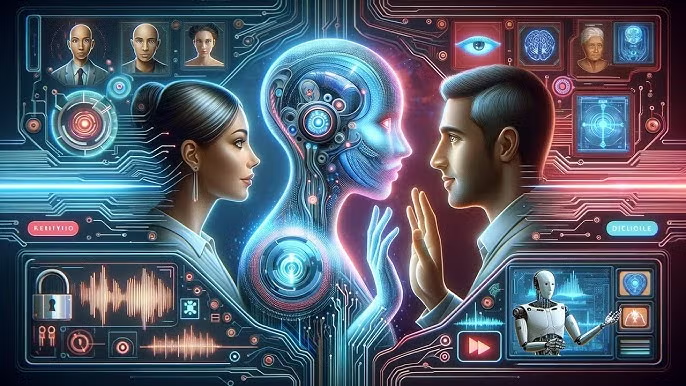
Examples:
- Privacy issues
- Fake news
- Deepfakes
- AI bias
These challenge truth and fairness.
Environmental Problems
Human actions are harming nature.
Pollution, climate change, and deforestation show the need for environmental responsibility.
We must move from human-centered thinking to planet-centered thinking.
Process of Learning Values
Values do not develop overnight. They grow step by step.
Value Awareness
First, we learn about a value.
Example: Learning why honesty matters.
Value Acceptance
Next, we understand its importance.
Value Internalization
Finally, the value becomes part of our character.
At this stage, a person acts honestly even when nobody is watching.
Lessons from Indian Philosophy
Indian traditions teach many important human values.
Nishkama Karma
Do your duty without worrying too much about results.
This reduces stress and improves focus.
Rajdharma
Leaders should always work for public welfare.
Personal interest should never come before public service.
Vasudhaiva Kutumbakam
This means “The world is one family.”
It teaches unity and global cooperation.
Respect for Nature
Nature is sacred and must be protected.
Environmental destruction is harmful for all.
Human Values from Great Personalities
Many great leaders showed strong human values.
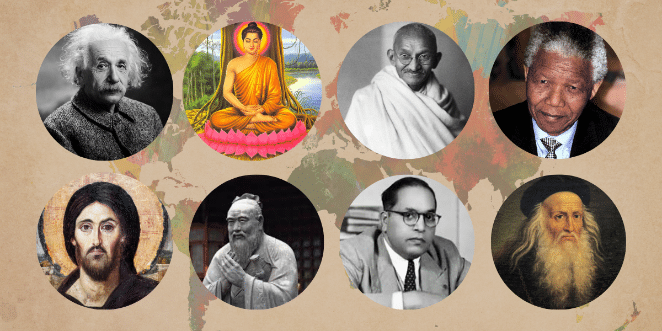
Mahatma Gandhi
Gandhi taught truth and non-violence. His life showed that peace can bring powerful change.
Mother Teresa
She dedicated her life to serving poor and sick people. She symbolized compassion and selfless service.
Albert Einstein
Einstein showed the importance of curiosity and knowledge. He inspired scientific thinking.
Nelson Mandela
Mandela taught forgiveness and resilience. He united a divided nation.
Abraham Lincoln
Lincoln stood for justice, freedom, and equality during difficult times.
Rosa Parks
Her courage against injustice inspired social change.
Martin Luther King Jr.
He fought for equality through peaceful protest.
Malala Yousafzai
Malala represents courage and the right to education for all.
Final Thoughts
Human values are the foundation of a good life and a healthy society. They shape our behavior, decisions, and relationships. In today’s fast-changing world, values like honesty, peace, love, and compassion are more important than ever.
If we practice human values daily, we can build a better, fairer, and more peaceful world for everyone.
FAQs
1. What are human values?
Human values are principles that guide behavior and help people choose right from wrong.
2. What are the five universal human values?
Truth, Right Conduct, Peace, Love, and Non-Violence.
3. Why are human values important?
They improve character, relationships, and decision-making.
4. What is the difference between morals and ethics?
Morals are social rules of right and wrong, while ethics are formal professional standards.
5. How do human values help society?
They create peace, fairness, cooperation, and mutual respect.