




Land Reforms in India: History, Importance and Major Changes

Land Reforms in India played a major role in changing the agricultural system of independent India. These reforms were introduced to reduce inequality in land ownership and improve the condition of farmers. Land is one of the most important resources in India because a large part of the population depends on agriculture for livelihood. Land reforms aimed to ensure fair distribution of land, protect farmers, and increase agricultural productivity.
Thank you for reading this post, don't forget to subscribe!Land System Before Independence
Before India became independent, the land system was largely controlled by the British government. During the British rule, farmers usually did not own the land they cultivated. Instead, powerful landlords such as Zamindars and Jagirdars controlled large areas of land.
The British introduced systems where landlords collected taxes from farmers and paid a portion to the government. This created several problems:
- Land was concentrated in the hands of a few rich landlords.
- Farmers had little or no ownership rights.
- Tenants were heavily exploited.
- High rents made farming difficult.
- Land records were poorly maintained.
- Agricultural land became fragmented into very small pieces.
Because of this, farming remained inefficient. Small and scattered land plots increased disputes and reduced productivity. Farmers often struggled with poverty and debt.
Land Reforms After Independence
After independence in 1947, the Indian government understood that agriculture could not improve without land reforms. A committee led by J. C. Kumarappa (Joseph Cornelius Kumarappa) studied the land problem and suggested major agrarian reforms.
The government introduced land reforms in four major areas:
- Abolition of intermediaries
- Tenancy reforms
- Ceiling on landholdings
- Consolidation of landholdings
These reforms were introduced in different phases to gain public and political support.
1. Abolition of Intermediaries
The first major reform was the abolition of the Zamindari system. This system removed intermediaries like Zamindars who stood between farmers and the government.
Earlier, farmers had to pay taxes and rents through landlords. After the reform, cultivators came into direct contact with the government.
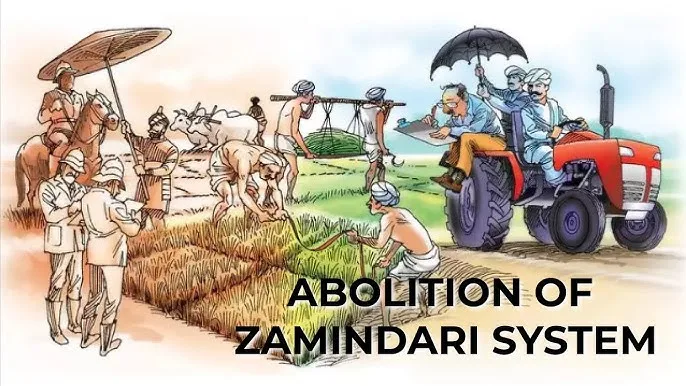
Benefits of Abolishing Intermediaries
- Around 2 crore tenants became landowners.
- The power of landlords reduced.
- More land came under government control.
- Landless farmers got opportunities to receive land.
- Waste land and private forests were taken over by the state.
This reform strengthened actual cultivators and gave them better rights.
Problems in Implementation
Even though the reform helped many farmers, it had limitations.
- Landlordism did not completely disappear.
- Sharecropping continued in many areas.
- Large landlords found legal loopholes.
- Many tenants were evicted.
In some states, landlords were allowed to keep large areas under personal cultivation. Because of this, complete land equality was not achieved.
2. Tenancy Reforms
After removing Zamindars, the next challenge was tenancy regulation.
Before independence, tenants paid extremely high rent often between 35% to 75% of total agricultural produce. This left very little income for farmers.
Tenancy reforms aimed to:
- Regulate rent
- Provide security to tenants
- Give ownership rights to cultivators
Most states fixed fair rent between 20% to 25% of total produce.
Advantages of Tenancy Reforms
These reforms reduced exploitation and improved tenant security.
Major benefits included:
- Reduced rent burden
- Protection from unfair eviction
- Better legal rights for tenants
- Ownership transfer in some states
States like West Bengal and Kerala successfully implemented strong tenancy reforms.
Challenges
However, implementation remained weak in many states.
Common issues included:
- Poor enforcement of laws
- Hidden tenancy arrangements
- Limited ownership transfer
- Weak administrative support
As a result, only a small percentage of tenants became landowners.
3. Ceiling on Landholdings
The third major reform involved fixing a maximum limit on land ownership.
This is called the Land Ceiling Act.
The purpose was simple: no individual or family should hold land beyond a fixed limit. Extra land above that limit would be taken by the government and redistributed to landless families.
The Kumarappa Committee recommended limits on land ownership.
By 1961–62, most states passed land ceiling laws. Later, national guidelines were introduced in 1972.
Ceiling limits depended on:
- Land quality
- Productivity
- Region
- Irrigation availability
The ceiling ranged approximately from:
- 10–18 acres for highly fertile land
- 18–27 acres for medium land
- 27–54 acres for less productive land
Benefits of Land Ceiling
The policy aimed to:
- Reduce land concentration
- Support landless farmers
- Improve social justice
- Help SC and ST families receive land
Major Problems
In reality, many landowners avoided the law.
They used methods such as:
- Dividing land among relatives
- Benami transfers
- Fake ownership records
Some wealthy farmers even legally separated family ownership to avoid land ceiling rules.
Because of loopholes, surplus land distribution remained limited.
4. Consolidation of Landholdings
Another major issue in Indian agriculture was land fragmentation.
Over generations, land was divided among family members. This created many small scattered plots.
For example, a farmer might own 4–5 tiny plots in different locations.
This caused several problems:
- Difficult irrigation
- Increased labour cost
- More travel time
- Boundary disputes
- Poor supervision
To solve this, the government introduced consolidation of landholdings.
This means combining small scattered plots into one large plot.
Benefits of Consolidation
Consolidation helped farmers in many ways:
- Reduced fragmentation
- Saved time and labour
- Lowered farming costs
- Improved irrigation management
- Reduced legal disputes
States like Punjab, Haryana, and western Uttar Pradesh achieved significant success.
Problems
In many other states, progress was slow due to:
- Lack of political support
- Administrative weakness
- Population pressure
- Continued inheritance division
The average farm size in India has reduced sharply over time.
In 1970–71, average holding size was 2.28 hectares. By 2015–16, it fell to 1.08 hectares.
Small landholdings remain a serious challenge for Indian agriculture.
Bhoodan and Gramdan Movements
Apart from government reforms, social movements also tried to solve land inequality.
One important leader was Vinoba Bhave, a disciple of Mahatma Gandhi.
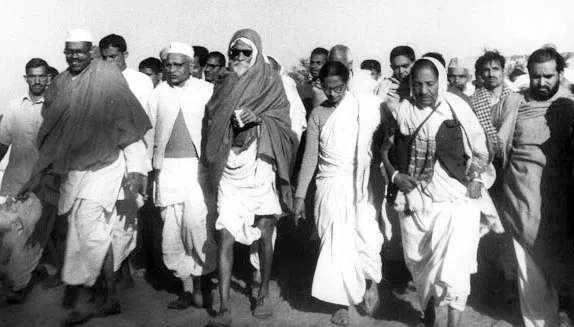
He saw the struggles of landless poor families in Pochampally.
This inspired him to start the Bhoodan Movement in 1951.
Bhoodan Movement
“Bhoodan” means land donation.
Vinoba Bhave requested rich landlords to voluntarily donate a portion of their land to landless farmers.
Many landowners donated land after his appeal.
Success of Bhoodan
The movement:
- Promoted peaceful social change
- Created moral pressure on landlords
- Increased awareness among farmers
- Encouraged rural reform
This became one of the first major social reform movements after independence.
Drawbacks of Bhoodan
Despite good intentions, the movement faced problems.
Most donated land was:
- Unfertile
- Disputed
- Under litigation
As a result, much of the collected land could not be properly distributed.
Gramdan Movement
In 1952, Bhoodan expanded into the Gramdan Movement.
Under Gramdan, villagers voluntarily gave land rights to the village community.
The land would then be redistributed equally and cultivated jointly.
A village was declared Gramdan when:
- 75% of residents agreed
- 51% of village land was included
The first Gramdan village was Mangroth.
Success and Failure
Gramdan worked better in tribal or socially equal villages.
However, it struggled in areas where large inequality already existed.
By 1969, both Bhoodan and Gramdan reached peak popularity.
Later, their impact declined because:
- Public participation reduced
- Government control increased
- Movement lost voluntary spirit
After Vinoba Bhave stepped back in 1967, the movement weakened further.
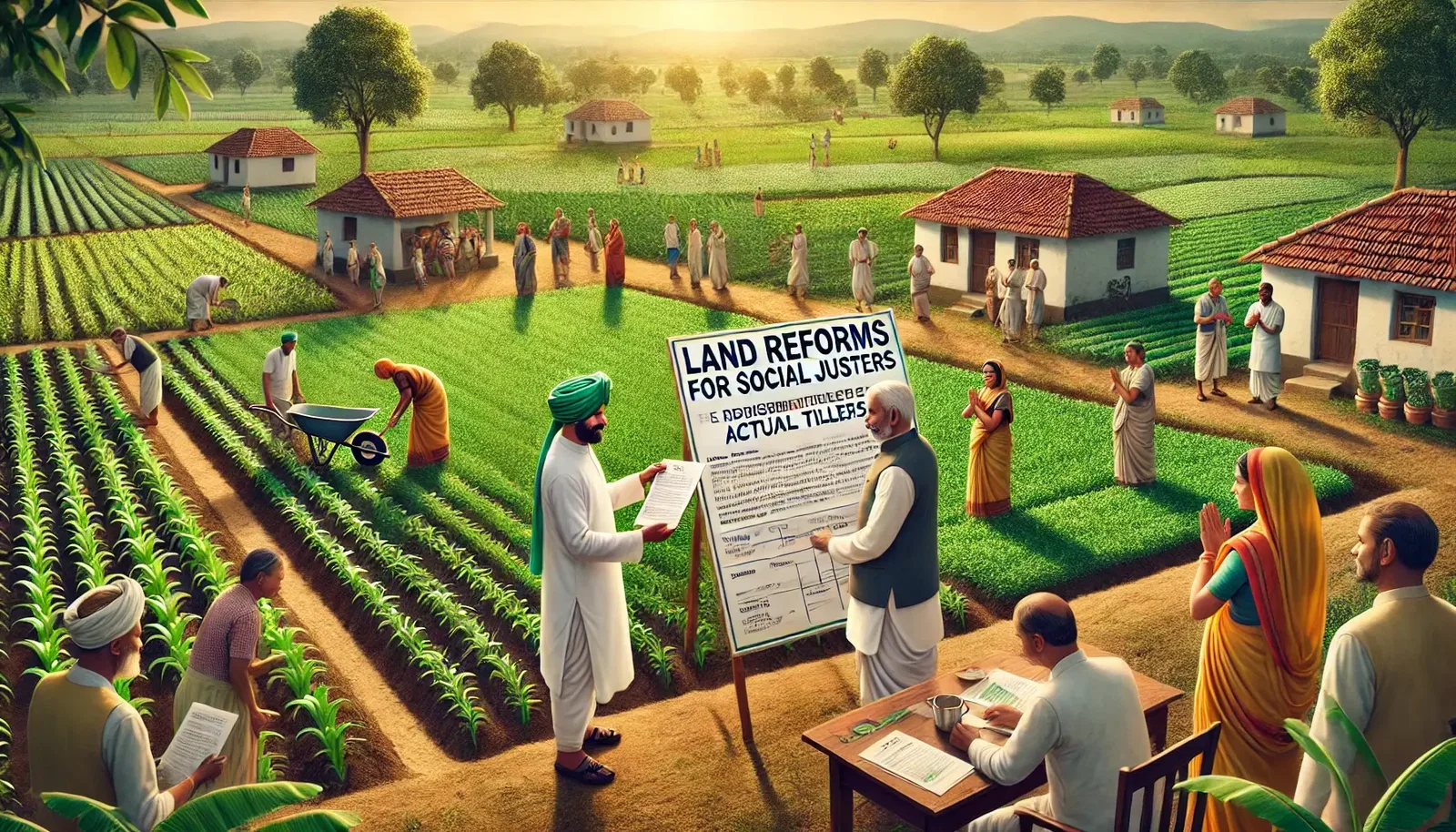
Importance of Land Reforms in Modern India
Even today, land reforms remain important in India.
Modern agriculture faces new challenges:
- Small farm sizes
- Land disputes
- Poor land records
- Low farmer income
- Rural unemployment
Organizations such as NITI Aayog have suggested modern solutions.
These include:
Land Leasing Reform
Small farmers can lease land to larger cultivators or companies for better productivity.
Digitisation of Land Records
Digital records can reduce fraud and land disputes.
Re-Consolidation
Fragmented land should again be merged where possible.
Better Legal Framework
Stronger implementation is needed to make reforms effective.
Final Thoughts
Land reforms have played a major role in shaping rural India. Although implementation has been slow and uneven, these reforms helped reduce inequality and improved the lives of many farmers.
A large part of India still depends on agriculture, so fair land distribution remains important. Future reforms must focus on technology, proper land records, and better policy implementation to improve farmer income and reduce rural poverty.
FAQs
1. What are land reforms in India?
Land reforms are government measures to improve land ownership, reduce inequality, and protect farmers.
2. What are the four major land reforms in India?
The four major reforms are:
- Abolition of intermediaries
- Tenancy reforms
- Ceiling on landholdings
- Consolidation of landholdings
3. What was the Bhoodan Movement?
It was a movement started by Vinoba Bhave in 1951 to encourage voluntary land donation to landless farmers.
4. Why are land reforms important?
They help reduce poverty, improve agricultural productivity, and promote social justice.
5. What is consolidation of land?
It means combining small scattered land plots into one larger plot for easier farming.