



Regional Parties in India: Growth and Impact

The Rise of Regional Parties is one of the most important developments in Indian politics after independence. India is a diverse country with different languages, cultures, religions, and regional identities. Because of this diversity, people in different states often have different political needs and aspirations. Regional parties emerged to represent these local interests and gradually became powerful players in Indian democracy.
Thank you for reading this post, don't forget to subscribe!Today, regional parties influence not only state politics but also national politics. They have played a major role in strengthening federalism, promoting regional development, and shaping coalition governments at the Centre. Understanding the rise of regional parties helps us understand how Indian democracy has evolved over time.
Political Parties in India
Political parties are an essential part of a democratic system. They act as a bridge between the people and the government. Political parties collect public opinions, present demands to the government, contest elections, and form governments.
In India, every political party must register with the Election Commission of India (ECI). Based on their electoral performance, parties are recognized as either national parties or state parties.
National Parties
A political party is recognized as a national party if it secures at least 6% of the total votes in Lok Sabha or Assembly elections in four states and wins at least four seats in the Lok Sabha.
State Parties
A political party is recognized as a state party if it secures at least 6% of the votes in a state assembly election and wins at least two seats.
Recognized parties receive special benefits such as a reserved election symbol that can only be used by their official candidates.
India follows a multi-party system. Along with national parties, there are many regional parties that have become important political forces.
What Are Regional Parties?
Regional parties are political parties whose main influence is limited to one or a few states. They focus on regional issues and represent the interests of specific communities, languages, cultures, or regions.
Although these parties are often called regional parties, their outlook may not always be regional. Some parties have national-level ideas but are successful only in certain states.
The rise of regional parties is closely linked to India’s social diversity. Different regions have unique identities, and people often feel that local issues can be addressed better by local parties.
Reasons Behind the Rise of Regional Parties
Several factors contributed to the growth of regional parties in India.
Cultural Diversity
India is home to many languages, traditions, and cultural groups. People often prefer parties that understand and represent their local culture and identity.
Linguistic Identity
Language has played a major role in regional politics. Many regional parties emerged to protect and promote regional languages and cultural heritage.
Regional Development Issues
Different regions face different development challenges. Regional parties often promise to focus on local development and solve state-specific problems.
Demand for Greater Autonomy
Some regional parties demand more powers for state governments. They believe that states should have greater control over their resources and policies.
Statehood Movements
Certain regional parties were formed to demand separate states. These parties gained public support by advocating for statehood and regional rights.
Political Representation
People sometimes feel neglected by national parties. Regional parties provide a platform for local leaders and communities to express their concerns.
Types of Regional Party Movements
Regional parties in India have generally emerged around four major themes.
Identity-Based Politics
These parties focus on protecting the cultural, linguistic, religious, or ethnic identity of a particular group.
For example, parties like the Shiv Sena emphasized regional identity and local interests.
Autonomy-Based Politics
Some parties demand greater autonomy and more powers for their states within the Indian Union.
The National Conference in Jammu and Kashmir is often cited as an example of a party seeking greater state autonomy.
Statehood Movements
Some parties are formed to demand the creation of separate states.
The Telangana Rashtra Samithi (TRS), now known as Bharat Rashtra Samithi (BRS), successfully led the movement for the creation of Telangana state.
Development-Oriented Politics
Many regional parties claim that they can deliver better development than national parties because they understand local needs more effectively.
Evolution of Regional Parties in India
The growth of regional parties can be understood through different phases of India’s political history.
Phase 1: 1952-1964 – Congress Dominance
After independence, the Indian National Congress dominated Indian politics.
This period is often called the “Congress System” because Congress enjoyed overwhelming support across the country.
Although other political parties existed, they were relatively weak and acted mainly as pressure groups.
Congress functioned like a broad umbrella that included people from different communities, ideologies, and regions.
As a result, regional parties had little influence during this period.
Phase 2: 1964-1977 – Beginning of Political Change
The death of Prime Minister Jawaharlal Nehru marked the beginning of political changes.
The 1967 elections weakened Congress dominance. The party lost power in several states and its majority in Parliament was reduced.
This created opportunities for regional parties to grow.
Many states witnessed the rise of local political movements that challenged Congress rule.
Internal conflicts within Congress also weakened the party.
During this period, regional aspirations became stronger, and regional parties began to gain political space.
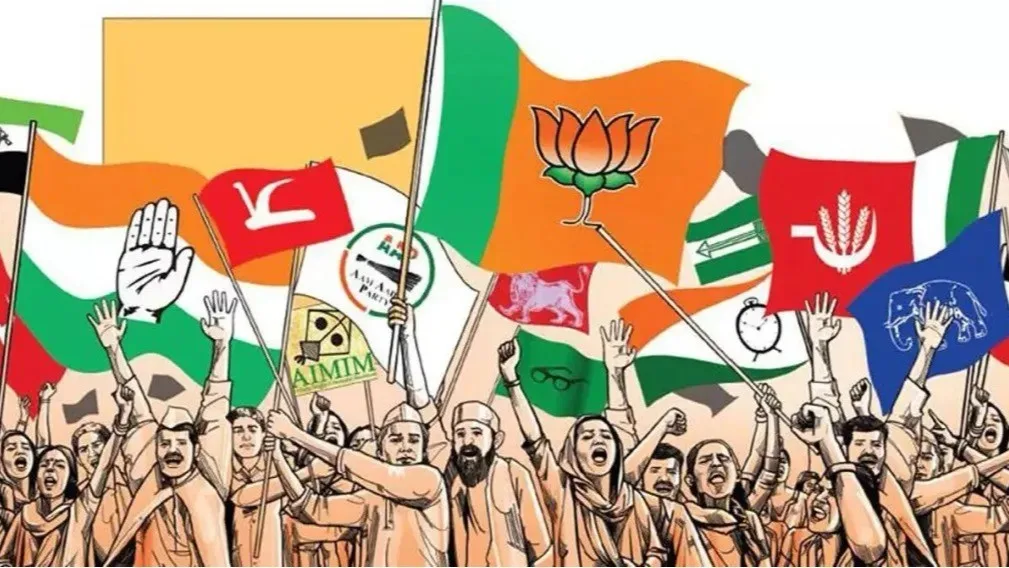
Phase 3: 1977-1980 – Emergence of Multi-Party Politics
The Emergency imposed in 1975 led to widespread dissatisfaction.
In 1977, several opposition parties came together to form the Janata Party and defeated Congress.
This marked the beginning of true multi-party competition in India.
Although the Janata Party government eventually collapsed due to internal differences, it demonstrated that Congress was no longer unbeatable.
Regional parties continued to gain strength during this period.
Phase 4: 1980-1989 – Strengthening of Regional Parties
During the 1980s, regional parties became more influential.
Several state-level parties emerged as powerful political forces.
An important milestone came in the 1984 Lok Sabha elections when the Telugu Desam Party became the main opposition party in Parliament.
This showed that regional parties could play a significant role at the national level.
The relationship between the Centre and states also became an important political issue.
Regional parties increasingly demanded greater respect for federal principles.
Phase 5: 1989-2014 – Coalition Era
The period between 1989 and 2014 is often called the era of coalition politics.
No single national party could secure a majority in Parliament on its own.
As a result, national parties had to form alliances with regional parties to create governments.
Regional parties became kingmakers in national politics.
Their support became essential for forming and sustaining coalition governments.
Many regional leaders gained national prominence during this period.
Advantages of Coalition Politics
The coalition era brought several positive developments:
- Regional voices received national attention.
- Federalism became stronger.
- Smaller states gained representation in national decision-making.
- Minority communities found better political representation.
- Regional development concerns became part of national discussions.
Challenges of Coalition Politics
Coalition governments also faced several difficulties:
- Decision-making often became slow.
- Governments depended on the support of multiple parties.
- Political instability increased.
- Frequent elections increased public expenditure.
- Policy implementation sometimes suffered due to conflicting interests.
Between 1996 and 1999, India witnessed three general elections, highlighting the instability of coalition politics.
Despite these challenges, coalition governments strengthened India’s federal structure by giving states a greater voice.
Phase 6: 2014 Onwards – Return of Majority Government
The 2014 and 2019 Lok Sabha elections saw the Bharatiya Janata Party secure a majority on its own.
This ended nearly 25 years of coalition dependence at the national level.
However, regional parties did not disappear.
They continue to dominate politics in many states and remain influential in national decision-making.
Many regional parties have shifted from confrontation to cooperation with the central government.
Today, issues such as financial relations between the Centre and states, resource sharing, and regional development have become major areas of discussion.
Contribution of Regional Parties to Indian Democracy
The rise of regional parties has had a significant impact on Indian democracy.
Strengthening Federalism
Regional parties have strengthened India’s federal structure by ensuring that state interests are represented at the national level.
Better Representation
They provide political representation to diverse linguistic, cultural, and ethnic groups.
Promoting Regional Development
Regional parties often focus on state-specific issues such as infrastructure, employment, education, and agriculture.
Encouraging Political Participation
They encourage greater participation in the democratic process by giving local communities a political voice.
Protecting Regional Identity
Regional parties help preserve local languages, traditions, and cultural heritage.
Criticism of Regional Parties
Despite their contributions, regional parties face criticism.
Some critics argue that:
- They sometimes prioritize regional interests over national interests.
- Identity-based politics can create divisions.
- Some parties focus too much on vote-bank politics.
- Coalition pressures may slow down governance.
However, supporters argue that these parties are necessary in a diverse country like India because they ensure that local voices are heard.
Challenges Facing Regional Parties Today
Regional parties face several modern challenges:
- Growing competition from national parties.
- Changing voter expectations.
- Need for stronger organizational structures.
- Pressure to deliver development and good governance.
- Adapting to digital campaigning and social media politics.
To remain relevant, regional parties must address these challenges while continuing to represent regional aspirations.
Conclusion
The Rise of Regional Parties has transformed Indian politics over the past several decades. From being minor players in the early years of independence, regional parties have become powerful forces in both state and national politics. They have strengthened federalism, improved representation, and ensured that local issues receive national attention.
While regional parties sometimes face criticism for promoting narrow interests, their contribution to Indian democracy cannot be ignored. They reflect the diversity of India and give political voice to millions of people across different regions.
As India continues to evolve, regional parties will remain an important part of the democratic system. Their growth demonstrates the strength of Indian democracy and its ability to accommodate diverse identities, aspirations, and interests within a united nation.
FAQs on Regional Parties
- What are regional parties in India?
Regional parties are political parties that mainly operate in one state or a specific region of India. - Why did regional parties emerge in India?
They emerged to represent local interests, cultures, languages, and regional development issues. - How are regional parties different from national parties?
National parties have a wider presence across multiple states, while regional parties focus on specific states or regions. - What role do regional parties play in Indian democracy?
They represent regional aspirations and help strengthen democratic participation. - Which are some major regional parties in India?
Examples include DMK, AIADMK, Shiv Sena, TDP, BJD, TRS (BRS), and AAP. - How have regional parties influenced coalition politics?
They often support or join coalition governments at the Centre, influencing national policies. - What is the relationship between regional parties and federalism?
Regional parties strengthen federalism by giving states a stronger voice in national decision-making. - What are the advantages of regional parties?
They promote local development, protect regional identities, and improve representation. - What are the challenges associated with regional parties?
They may encourage regionalism, identity-based politics, and political instability in coalition governments. - How have regional parties changed Indian politics?
They have transformed India from a one-party dominant system to a more diverse and representative political system.