



Judicial Doctrines in Indian Constitution

Judicial Doctrines are important legal principles developed by courts while interpreting the Constitution and laws. These doctrines help judges solve constitutional issues, protect the rights of citizens, and maintain the balance of power between different organs of the government.
Thank you for reading this post, don't forget to subscribe!The Constitution of India does not mention all these doctrines directly. Most of them have been developed through important Supreme Court judgments over the years. They guide the judiciary in interpreting laws fairly and consistently.
Understanding Judicial Doctrines is essential because they protect democracy, uphold the rule of law, and ensure that no authority misuses its constitutional powers.
What Are Judicial Doctrines?
A judicial doctrine is a legal principle created by courts through their decisions. These principles become important guidelines for future cases and help judges interpret constitutional provisions correctly.
Some of the most important Judicial Doctrines in India include:
| Judicial Doctrine | Main Purpose |
|---|---|
| Doctrine of Basic Structure | Protects the core features of the Constitution |
| Doctrine of Separation of Powers | Maintains balance among Legislature, Executive, and Judiciary |
| Doctrine of Pith and Substance | Determines the true nature of a law |
| Doctrine of Incidental or Ancillary Powers | Gives authority to make supporting laws |
| Doctrine of Severability | Removes only unconstitutional parts of a law |
| Doctrine of Eclipse | Makes unconstitutional pre-Constitution laws inactive |
| Doctrine of Territorial Nexus | Allows states to make laws with sufficient connection |
| Doctrine of Colourable Legislation | Prevents indirect misuse of legislative powers |
| Doctrine of Pleasure | Governs appointment and removal of government servants |
| Doctrine of Harmonious Construction | Removes conflicts between legal provisions |
Doctrine of Basic Structure
The Doctrine of Basic Structure is one of the most important Judicial Doctrines in India. It says that Parliament can amend the Constitution but cannot destroy or change its basic features.

Although the Constitution does not define these basic features, the Supreme Court has identified several important elements over time.
Some basic features include:
- Democracy
- Rule of Law
- Judicial Review
- Federalism
- Secularism
- Fundamental Rights
- Separation of Powers
- Independence of Judiciary
Origin
The idea came from constitutional developments in Germany after World War II. It was later adopted by the Indian Supreme Court.
Important Cases
- Kesavananda Bharati v. State of Kerala (1973): Parliament can amend the Constitution but cannot damage its basic structure.
- Indira Nehru Gandhi v. Raj Narain (1975): Reaffirmed the doctrine.
- Minerva Mills Case (1980): Strengthened the protection of the Constitution’s basic features.
- Waman Rao Case (1981): Continued the application of the doctrine.
Doctrine of Separation of Powers
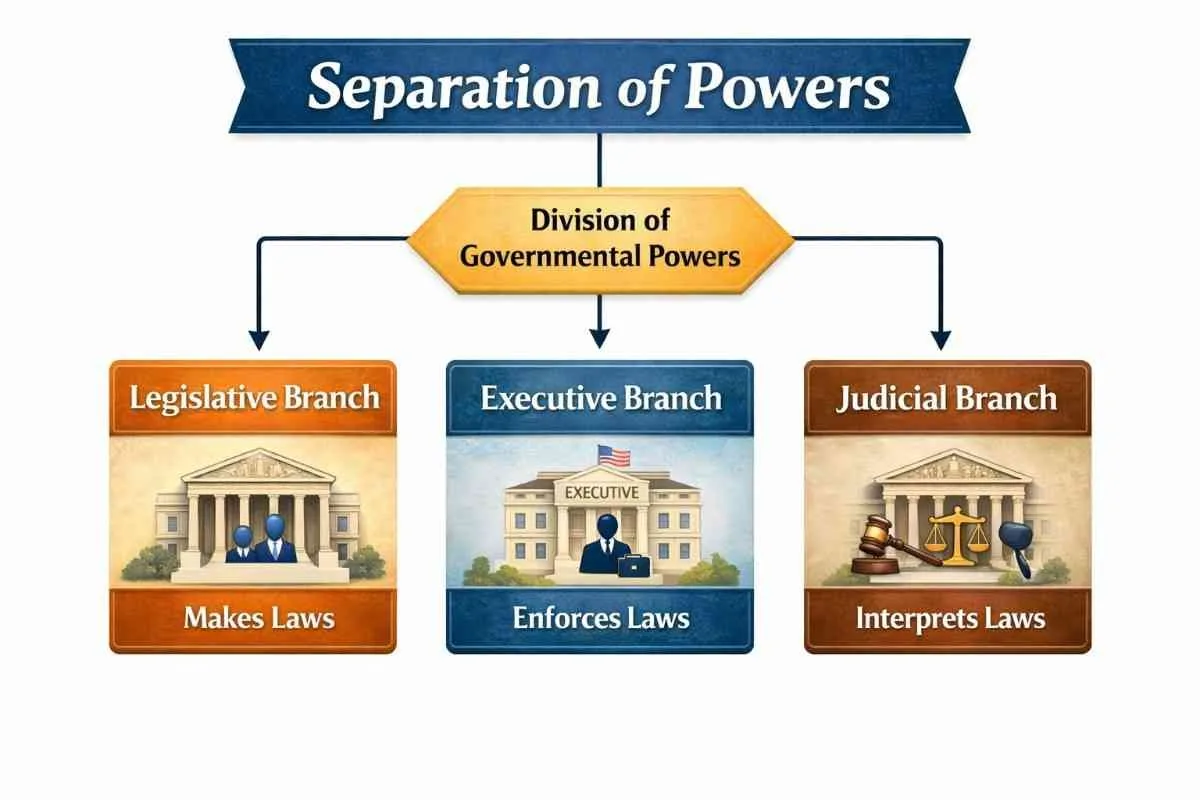
This doctrine divides government powers among three organs:
- Legislature makes laws.
- Executive implements laws.
- Judiciary interprets laws.
Its main purpose is to prevent the concentration of power in one authority.
Main Principles
| Principle | Meaning |
| Separate Functions | Every organ has different duties |
| No Overlapping | One organ should not perform another’s role |
| Mutual Respect | Each organ works independently while respecting others |
Constitutional Provision
Article 50 of the Constitution directs the State to separate the judiciary from the executive.
Important Cases
- Ram Jawaya v. State of Punjab (1955)
- Indira Nehru Gandhi v. Raj Narain (1975)
These judgments confirmed that separation of powers forms part of the Constitution’s basic structure.
Doctrine of Pith and Substance
The words Pith means true nature, while Substance means the essential part.
Sometimes a law appears to belong to one legislative list but actually relates to another. This doctrine helps the court determine the real purpose of the law.
It is mainly used in matters related to:
- Union List
- State List
- Concurrent List
Constitutional Basis
- Article 246
- Article 254
Important Case
Prafulla Kumar Mukherjee v. Bank of Commerce (1946)
The court held that a law dealing mainly with money lending remained valid even though it incidentally affected promissory notes.
Doctrine of Incidental or Ancillary Powers
This doctrine supports the Doctrine of Pith and Substance.
If Parliament or a State Legislature has the power to make a law on a subject, it also has the authority to make related laws necessary for implementing it.
Constitutional Provisions
- Article 4
- Article 169
Important Case
State of Rajasthan v. G. Chawla (1958)
The Supreme Court stated that legislative power includes authority over related matters necessary for effective lawmaking.
Doctrine of Severability
The Doctrine of Severability protects Fundamental Rights.
If only certain sections of a law violate Fundamental Rights, only those sections become invalid while the remaining provisions continue to operate.
However, if the invalid and valid parts cannot be separated, the entire law becomes invalid.
Constitutional Provision
Article 13
Important Cases
- A.K. Gopalan v. State of Madras (1950)
- State of Bombay v. F.N. Balsara (1951)
These cases established that courts should save as much of a law as possible.
Doctrine of Eclipse
The Doctrine of Eclipse applies mainly to laws that existed before the Constitution came into force.
If such a law violates Fundamental Rights, it does not become permanently void. Instead, it remains inactive or “eclipsed.”
If the constitutional restriction is later removed, the law may become active again.
Constitutional Basis
Article 13(1)
Important Case
Bhikaji Narain Dhakras v. State of Madhya Pradesh (1955)
The Supreme Court explained that unconstitutional pre-Constitution laws remain dormant rather than completely invalid.
Doctrine of Territorial Nexus
Normally, State laws apply only within the state’s geographical boundaries.
However, if there is a sufficient connection between the State and the subject matter, the State Legislature may make laws that affect persons or property outside its territory.

Constitutional Provision
Article 245
Important Cases
- A.H. Wadia v. Income Tax Commissioner (1948)
- State of Bombay v. RMDC (1952)
The courts held that sufficient territorial connection is necessary for such laws.
Doctrine of Colourable Legislation
This doctrine is often described as Fraud on the Constitution.
It prevents a legislature from doing indirectly what it cannot do directly.
If a legislature lacks power over a subject, it cannot hide its real intention by giving the law a different appearance.
Constitutional Basis
Article 246
Important Case
R.S. Joshi v. Ajit Mills (1977)
The Supreme Court explained that the doctrine checks misuse of legislative authority.
Doctrine of Pleasure
The Doctrine of Pleasure came from English law.
According to this principle, certain government officials hold office during the pleasure of the President or the Governor.
Constitutional Provisions
| Article | Purpose |
| Article 155 | Appointment of Governors |
| Article 310 | Pleasure of President or Governor |
| Article 311 | Protection against arbitrary dismissal |
Article 311 provides important safeguards for civil servants.
Important Cases
- State of Bihar v. Abdul Majid (1954)
- Union of India v. Tulsiram Patel (1985)
These judgments clarified that public policy supports the doctrine but constitutional protections must also be respected.
Doctrine of Harmonious Construction
Sometimes two provisions of the same law appear to conflict.
The Doctrine of Harmonious Construction requires courts to interpret them so that both provisions remain effective.
The objective is to avoid making any legal provision meaningless.

Main Principles
- Read the law as a whole.
- Avoid unnecessary conflict.
- Give effect to every provision.
- Do not make any section redundant.
- Maintain harmony between different provisions.
Important Cases
- Re Kerala Education Bill (1957)
- East India Hotels Ltd. v. Union of India (2001)
- CIT v. Hindustan Bulk Carriers (2003)
These judgments established the rules for harmonious interpretation.
Importance of Judicial Doctrines
Judicial Doctrines play a vital role in strengthening India’s constitutional system.
Their importance includes:
- Protect constitutional values.
- Safeguard Fundamental Rights.
- Maintain balance among government organs.
- Prevent misuse of legislative powers.
- Ensure fair interpretation of laws.
- Strengthen democracy.
- Promote constitutional governance.
- Protect judicial independence.
FAQs
What are Judicial Doctrines?
Judicial Doctrines are legal principles developed by courts to interpret the Constitution and laws in a fair and consistent manner.
Which is the most important Judicial Doctrine?
The Doctrine of Basic Structure is considered the most important because it protects the core features of the Indian Constitution.
Which Article is related to the Doctrine of Severability?
The Doctrine of Severability is based on Article 13 of the Indian Constitution.
What is the purpose of the Doctrine of Separation of Powers?
It ensures that the Legislature, Executive, and Judiciary perform separate functions and prevent the misuse of power.
What does the Doctrine of Eclipse explain?
It explains that pre-Constitution laws violating Fundamental Rights become inactive rather than permanently void.
Which doctrine is known as Fraud on the Constitution?
The Doctrine of Colourable Legislation is known as Fraud on the Constitution because it prevents indirect misuse of legislative powers.
Why are Judicial Doctrines important?
Judicial Doctrines protect constitutional values, Fundamental Rights, democracy, and ensure proper interpretation of laws by the courts.