



Directive Principles of State Policy: Meaning, Articles, Features and Importance

Directive Principles of State Policy (DPSP) are one of the most important parts of the Indian Constitution. They guide the government in making laws and policies that improve the lives of people. Although these principles cannot be enforced in a court of law, they help create a fair, equal, and welfare-oriented society.
Thank you for reading this post, don't forget to subscribe!The main aim of the Directive Principles of State Policy is to establish social and economic justice in India. They encourage the government to reduce poverty, improve education, protect workers, promote public health, and ensure equal opportunities for every citizen.
What are Directive Principles of State Policy?
The Directive Principles of State Policy (DPSP) are guidelines given to the Central and State Governments for governing the country. These principles are mentioned in Part IV of the Indian Constitution, covering Articles 36 to 51.
The Constitution expects every government to keep these principles in mind while making laws and policies.
Unlike Fundamental Rights, citizens cannot approach a court if these principles are not followed. However, they play a major role in building a welfare state.
Origin of Directive Principles of State Policy
The idea of Directive Principles of State Policy did not begin in India.
- The concept first came from the Spanish Constitution.
- Later, it became part of the Irish Constitution under Article 45.
- The makers of the Indian Constitution adopted this idea while drafting the Constitution.
The purpose was to ensure that governments always work for the welfare of the people.
Constitutional Provisions of DPSP
| Provision | Details |
|---|---|
| Part of Constitution | Part IV |
| Articles Covered | Articles 36 to 51 |
| Nature | Non-justiciable |
| Main Purpose | Establish a welfare state |
| Applicable To | Central and State Governments |
Article 37 clearly states that although these principles are not enforceable by courts, they are fundamental in the governance of the country. Governments should apply them while making laws.
Objectives of Directive Principles of State Policy
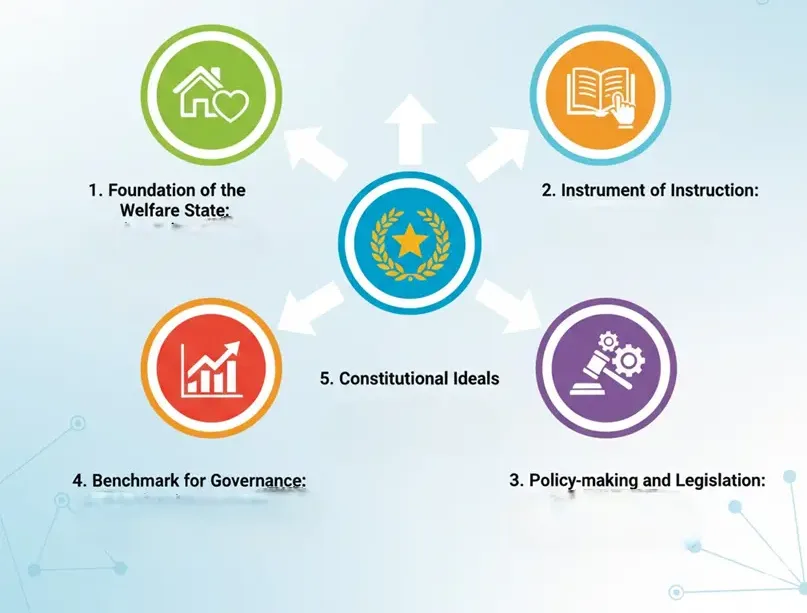
The main objectives of DPSP are:
- Build a welfare state.
- Reduce poverty and inequality.
- Promote social and economic justice.
- Improve education and healthcare.
- Protect workers and weaker sections.
- Encourage rural development.
- Improve environmental protection.
- Promote international peace.
These objectives help India move towards balanced and inclusive development.
Difference Between Fundamental Rights and DPSP
| Fundamental Rights | Directive Principles of State Policy |
|---|---|
| Enforceable by courts | Not enforceable by courts |
| Protect individual rights | Guide the government in making policies |
| Negative in nature because they restrict government action | Positive in nature because they direct government action |
| Mainly protect citizens | Focus on overall welfare of society |
| Found in Part III | Found in Part IV |
Even though they are different, both Fundamental Rights and DPSP work together to strengthen Indian democracy.
Classification of Directive Principles of State Policy
The Directive Principles are divided into three main categories.
1. Socialist Principles
These principles aim to reduce inequality and improve living conditions.
| Article | Provision |
|---|---|
| Article 38 | Promote social, economic and political justice |
| Article 39 | Equal livelihood, equal pay, fair distribution of resources |
| Article 41 | Right to work, education and public assistance |
| Article 42 | Humane working conditions and maternity relief |
| Article 43 | Living wage and decent standard of life |
| Article 43A | Workers’ participation in management |
| Article 47 | Improve nutrition, public health and standard of living |
Importance
These principles help improve the lives of workers, farmers, women and poor families.
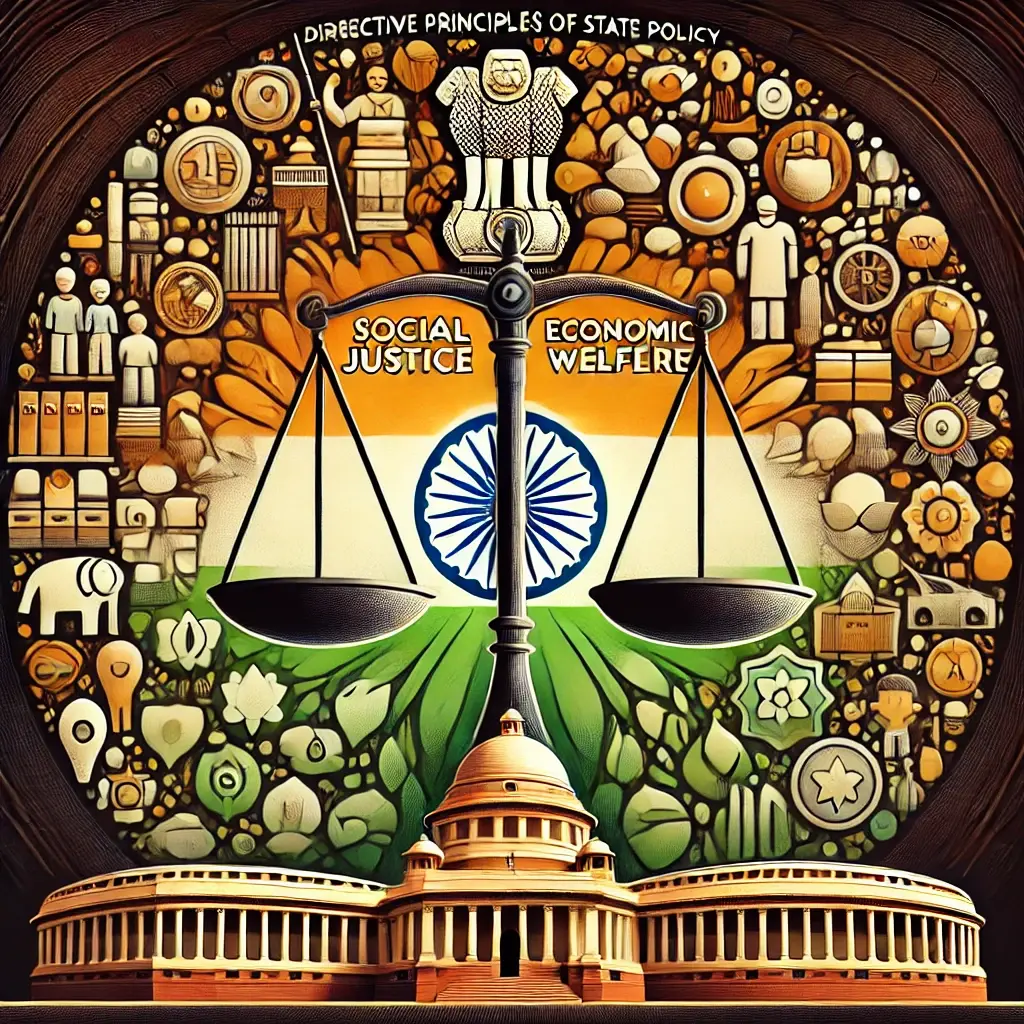
2. Gandhian Principles
These principles are inspired by the ideas of Mahatma Gandhi.
| Article | Provision |
|---|---|
| Article 40 | Organize Village Panchayats |
| Article 43 | Promote cottage industries |
| Article 43B | Strengthen cooperative societies |
| Article 46 | Promote education and economic interests of weaker sections |
| Article 47 | Improve public health and discourage harmful intoxicants |
| Article 48 | Protect cows and improve animal breeds |
Importance
These principles encourage self-reliant villages, rural industries and social justice.
3. Liberal and Intellectual Principles
These principles focus on modern governance, education, environment and international peace.
| Article | Provision |
|---|---|
| Article 44 | Uniform Civil Code |
| Article 45 | Early childhood care and education |
| Article 48 | Scientific agriculture and animal husbandry |
| Article 48A | Environmental protection |
| Article 49 | Protection of monuments |
| Article 50 | Separation of judiciary from executive |
| Article 51 | International peace and friendly relations |
Importance
These principles help India become a modern, democratic and environmentally responsible nation.
Important Constitutional Amendments Related to DPSP
Several constitutional amendments have strengthened the Directive Principles.
42nd Constitutional Amendment (1976)
This amendment added important provisions such as:
- Article 39A for free legal aid to poor people.
- Article 43A for workers’ participation in industries.
- Article 48A for environmental protection.
44th Constitutional Amendment (1978)
This amendment strengthened Article 38 by asking the State to reduce economic inequalities.
It also removed the Right to Property from the list of Fundamental Rights.
86th Constitutional Amendment (2002)
This amendment changed Article 45 and made education a Fundamental Right through Article 21A.
Children between 6 and 14 years now have the right to free and compulsory education.
Landmark Supreme Court Cases
Several Supreme Court judgments have shaped the relationship between Fundamental Rights and DPSP.
| Case | Importance |
|---|---|
| Champakam Dorairajan (1951) | Fundamental Rights prevail over DPSP in case of conflict |
| Golaknath Case (1967) | Parliament cannot amend Fundamental Rights for DPSP implementation |
| Kesavananda Bharati Case (1973) | Parliament can amend the Constitution but cannot change its Basic Structure |
| Minerva Mills Case (1980) | Balance between Fundamental Rights and DPSP is part of the Basic Structure |
These judgments helped maintain harmony between citizens’ rights and government responsibilities.
Implementation of Directive Principles of State Policy
Many government laws and schemes have been introduced to fulfill the Directive Principles.
Land Reforms
The government introduced land reforms to improve agriculture and reduce inequality.
Major steps included:
- Abolition of Zamindari system
- Land ceiling laws
- Distribution of surplus land
- Tenancy reforms
- Cooperative farming
Labour Welfare Laws
Several labour laws protect workers.
Some important laws include:
| Law | Purpose |
|---|---|
| Minimum Wages Act, 1948 | Minimum wages for workers |
| Code on Wages, 2020 | Uniform wage rules |
| Contract Labour Act, 1970 | Protection of contract workers |
| Child Labour Act | Prevent child labour |
| Bonded Labour System Abolition Act, 1976 | End bonded labour |
| Maternity Benefit Act, 1961 | Benefits for women workers |
| Equal Remuneration Act, 1976 | Equal pay for men and women |
Panchayati Raj System
The 73rd Constitutional Amendment Act, 1992 strengthened village self-government.
Today, Panchayati Raj works at three levels:
- Village
- Block
- District
This fulfills the objective of Article 40.
Promotion of Cottage Industries
To support rural employment, the government promotes cottage and village industries through organizations such as:
- Khadi and Village Industries Commission (KVIC)
- Silk Board
- Coir Board
- Handicrafts Boards
These organizations provide financial and marketing support.
Right to Education
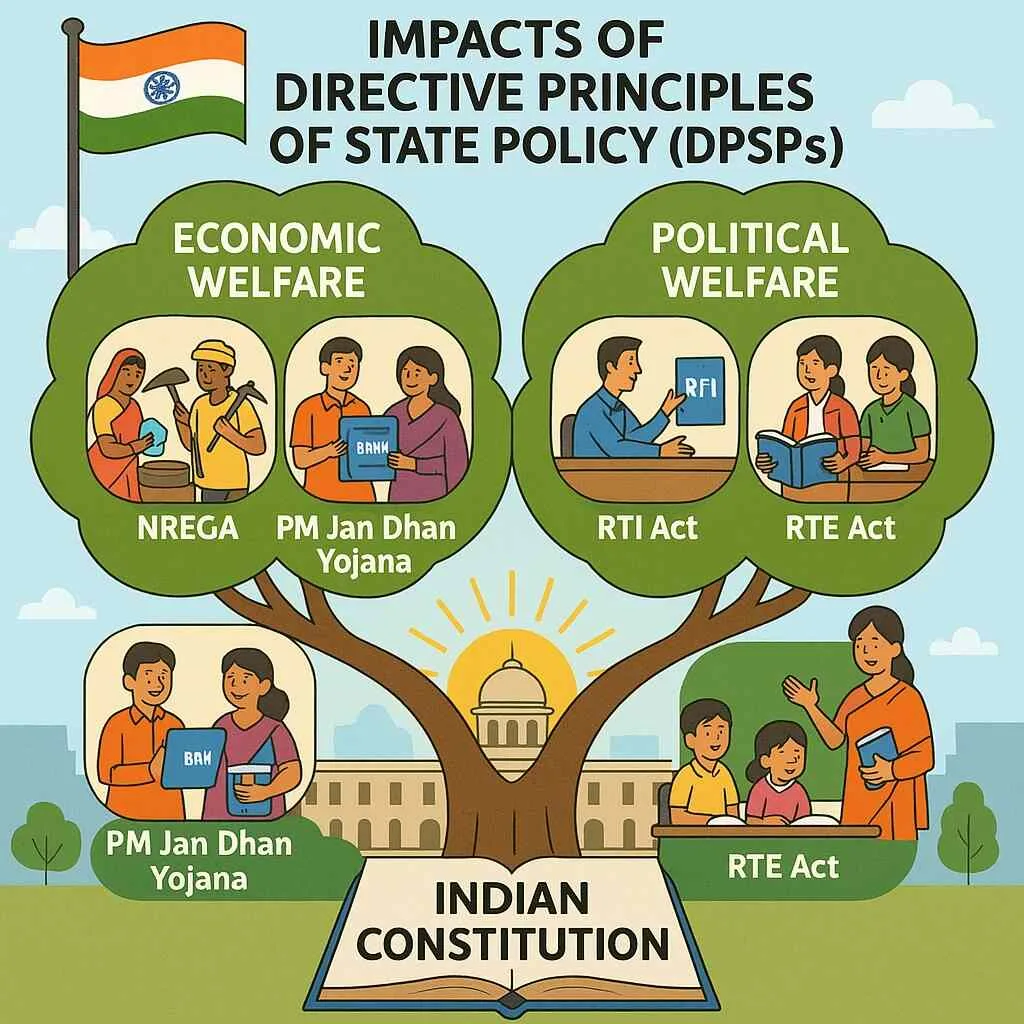
Following the 86th Constitutional Amendment, the Right to Education Act, 2009 made free education available to children between 6 and 14 years.
This fulfills the goal of Article 45.
Rural Development
Several programmes have improved village life.
Some important schemes include:
- Community Development Programme
- Integrated Rural Development Programme
- Mahatma Gandhi National Rural Employment Guarantee Act (MGNREGA)
These programmes improve employment, income and living standards.
Public Health
The government has launched many health programmes to improve healthcare services.
These include:
- National Rural Health Mission (NRHM)
- Pradhan Mantri health initiatives
- Nutrition improvement programmes
- Maternal and child healthcare schemes
These efforts support Article 47.
Environmental Protection
The government has enacted several laws to protect nature.
Important environmental laws include:
- Wildlife Protection Act, 1972
- Forest Conservation Act, 1980
- Environment Protection Act, 1986
- Water Pollution Control Act
- Air Pollution Control Act
These laws help conserve forests, wildlife and clean air.
Protection of Heritage
India protects historical monuments through the Ancient Monuments and Archaeological Sites and Remains Act, 1958.
This fulfills the objective of Article 49.
Importance of Directive Principles of State Policy
The Directive Principles continue to guide governments in making people-friendly policies.
Their importance includes:
- Promote equality and justice.
- Reduce poverty.
- Improve education.
- Strengthen healthcare.
- Protect workers.
- Encourage village development.
- Protect the environment.
- Support women and weaker sections.
- Promote peace and international cooperation.
- Build a welfare state.
Even though courts cannot enforce these principles, they have inspired many important laws and government programmes.
FAQs
What are Directive Principles of State Policy?
Directive Principles of State Policy are guidelines given in Part IV of the Indian Constitution that help governments make laws for the welfare of society.
Which Articles contain the Directive Principles of State Policy?
They are mentioned in Articles 36 to 51 of the Indian Constitution.
Are Directive Principles legally enforceable?
No. They are non-justiciable, which means citizens cannot approach courts to enforce them.
What is the main aim of DPSP?
The main aim is to establish a welfare state by promoting social, economic and political justice.
How many categories of DPSP are there?
They are divided into three categories:
- Socialist Principles
- Gandhian Principles
- Liberal and Intellectual Principles
Which amendment added environmental protection to DPSP?
The 42nd Constitutional Amendment Act, 1976 added Article 48A, which focuses on protecting the environment.
Why are Directive Principles important?
They guide governments in making policies that improve education, healthcare, employment, rural development, environmental protection and social justice.