

Skill Development and Entrepreneurship in India

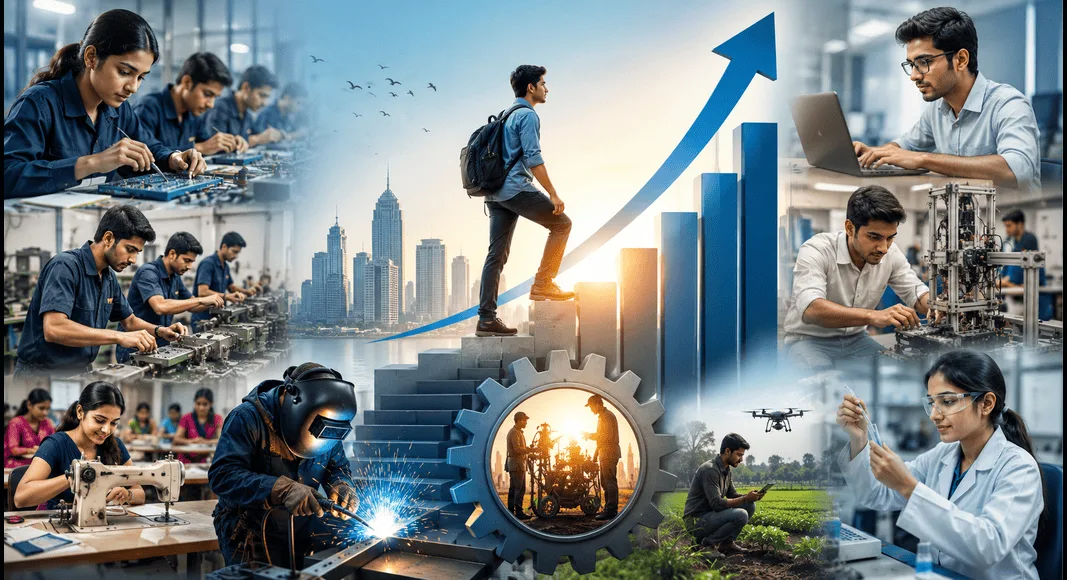
Skill Development and Entrepreneurship plays a very important role in creating employment opportunities, improving the quality of the workforce, and encouraging entrepreneurship in India. As industries continue to change with new technologies, young people need modern skills to compete in the job market. The Ministry of Skill Development and Entrepreneurship (MSDE) has been working to bridge the gap between education and employment by providing skill training, improving training centers, and supporting entrepreneurship across the country.
Thank you for reading this post, don't forget to subscribe!In 2019, the Ministry focused on four major goals:
- Convergence of different skill development programs
- Increasing the scale of skill training
- Meeting the aspirations of young people
- Improving the quality of skill education
What is the Ministry of Skill Development and Entrepreneurship?
The Ministry of Skill Development and Entrepreneurship (MSDE) is responsible for promoting skill development and entrepreneurship across India. It works to provide vocational training, improve employment opportunities, encourage innovation, and help people become job creators instead of only job seekers.
The ministry works with state governments, industries, educational institutions, and international organizations to improve the country’s skill ecosystem.
Major Focus Areas in 2019
During 2019, the ministry concentrated on four important areas:
- Better coordination among different skill development programs
- Expanding training opportunities
- Encouraging youth to choose skill education
- Improving the quality of training and apprenticeships
Each of these areas included several important schemes and reforms.
Initiatives for Better Convergence
One of the biggest challenges in skill development is the lack of coordination between different departments and organizations. To solve this issue, the ministry introduced several initiatives.
National Skill Development Mission (NSDM)
The National Skill Development Mission (NSDM) was launched to bring all skill development activities under one coordinated system.
Its main objectives are:
- Improve coordination between different ministries and states.
- Speed up decision-making.
- Increase the number of skilled workers.
- Maintain common standards for skill training across India.
This mission helps avoid duplication of efforts and ensures better planning.
Skill India Portal
The Skill India Portal is a digital platform that collects skill development data from different sources.
The portal brings together information from:
- Central Ministries
- State Governments
- Private Training Institutes
- Corporate Training Providers
This single platform helps in monitoring skill programs, tracking trainees, and improving transparency.
Initiatives to Increase the Scale of Skill Training
To provide skill education to more people, the ministry expanded existing schemes and introduced new ones.
Industrial Training Institutes (ITIs)
Industrial Training Institutes (ITIs) are among India’s oldest vocational training institutions.
In 2019, the ministry worked on:
- Modernizing ITIs
- Upgrading equipment
- Improving infrastructure
- Introducing new technology-based courses
These improvements help students gain industry-relevant skills.
Pradhan Mantri Kaushal Vikas Yojana (PMKVY)
The Pradhan Mantri Kaushal Vikas Yojana (PMKVY) is India’s flagship skill development scheme.
Its main objectives include:
- Providing free skill training
- Improving employability
- Offering industry-recognized certification
- Helping youth secure jobs
The scheme mainly targets unemployed youth and school or college dropouts.
Pradhan Mantri Kaushal Kendra (PMKK)
The Pradhan Mantri Kaushal Kendra (PMKK) is a network of modern training centers across India.
These centers provide:
- High-quality infrastructure
- Practical training
- Industry-standard equipment
- Competency-based learning
The aim is to create model skill training institutions that inspire confidence among students.
Recognition of Prior Learning (RPL)
Many people already possess valuable skills through work experience but lack formal certificates.
The Recognition of Prior Learning (RPL) program assesses these existing skills.
After evaluation, individuals receive certification according to the National Skills Qualification Framework (NSQF).
Benefits include:
- Recognition of existing skills
- Better employment opportunities
- Improved wages
- Increased confidence
RPL is an important component of PMKVY.
Skill Management and Accreditation of Training Centres (SMART)
The SMART system is an online platform that manages skill training centers.
Its functions include:
- Accreditation
- Affiliation
- Grading
- Continuous monitoring
This ensures that training centers maintain quality standards.
SANKALP
SANKALP stands for Skills Acquisition and Knowledge Awareness for Livelihood Promotion.
It is a Centrally Sponsored Scheme supported by the World Bank.
The scheme focuses on:
- District-level planning
- Better coordination
- Stronger partnerships
- Improved implementation of the National Skill Development Mission
SANKALP helps strengthen the overall skill ecosystem.
STRIVE
Skills Strengthening for Industrial Value Enhancement (STRIVE) is another World Bank-supported project.
Its main goal is to improve:
- Performance of ITIs
- Apprenticeship training
- Industry partnerships
- Quality of vocational education
The scheme makes skill training more relevant to industrial needs.
Pradhan Mantri YUVA Yojana
The Pradhan Mantri YUVA Yojana (Yuva Udyamita Vikas Abhiyan) encourages entrepreneurship among young Indians.
Its objectives include:
- Entrepreneurship education
- Business training
- Easy access to mentoring
- Promotion of social enterprises
- Inclusive economic growth
The scheme motivates youth to become successful entrepreneurs.
Initiatives to Meet Youth Aspirations
The ministry introduced several programs to motivate students and professionals toward skill development.
Kaushalyacharya Awards
The Kaushalyacharya Awards recognize outstanding skill trainers.
These awards aim to:
- Appreciate excellent trainers
- Encourage quality teaching
- Motivate more professionals to become trainers
Good trainers are essential for building a skilled workforce.
National Entrepreneurship Awards 2019
The National Entrepreneurship Awards honor individuals and organizations that make exceptional contributions to entrepreneurship.
These awards encourage innovation, startup culture, and job creation.
The ministry hopes to create more job providers instead of job seekers.
Skill Saathi Counseling Program
Many young people are unaware of available skill development opportunities.
To address this issue, the ministry launched the Skill Saathi Counseling Program.
The program helps youth:
- Understand career options
- Learn about Skill India programs
- Choose suitable training courses
- Build confidence
It increases awareness about vocational education.
Vocational Courses in Schools
The ministry worked closely with CBSE to introduce vocational education in schools.
Special Hubs of Excellence in Skills are being developed to provide:
- Technology-based learning
- Practical skill training
- Career-oriented education
This allows students to develop employable skills while still in school.
SHREYAS Program
The ministry collaborated with the Ministry of Human Resource Development to launch the SHREYAS Program.
This program integrates apprenticeships with higher education courses such as:
- BA (Professional)
- BSc (Professional)
- BCom (Professional)
Initially, apprenticeship-based degree programs were introduced in sectors like:
- Retail
- Media
- Logistics
Students gain practical industry experience while completing their degrees.
Indian Institute of Skills (IIS)
To improve the quality of skill education, the ministry announced the establishment of the Indian Institute of Skills (IIS) in Mumbai.
The institute aims to become a world-class skill training institution comparable to India’s leading educational institutes.
Its focus includes:
- Advanced technology training
- Industry partnerships
- International standards
- High-quality vocational education
Improving the Quality of Skill Development
Along with expanding training programs, the ministry also focused on improving quality.
Reforms to the Apprenticeship Act, 1961
The government introduced major reforms to make apprenticeships more attractive for industries and students.
Important reforms included:
- Increasing the upper limit of apprentices from 10% to 15%.
- Reducing the minimum establishment size required to hire apprentices from 40 workers to 30 workers.
- Fixing the first-year stipend instead of linking it to minimum wages.
- Increasing stipends for second- and third-year apprentices by 10% to 15%.
- Allowing apprenticeship duration for optional trades to range from 6 months to 36 months.
These reforms encourage industries to provide more apprenticeship opportunities.
Dual System of Training (DST)
The Dual System of Training (DST) combines classroom education with practical industry training.
Inspired by Germany’s vocational education model, the system allows students to:
- Learn technical concepts in ITIs.
- Gain real industrial experience.
- Improve practical skills.
- Increase job readiness.
The ministry planned to expand DST to at least 1,000 ITIs across India.
Introduction of New-Age Courses
To prepare youth for future jobs, MSDE introduced several modern skill courses.
These include:
- Internet of Things (IoT) – Smart Healthcare
- Internet of Things (IoT) – Smart Cities
- 3D Printing
- Drone Pilot Training
- Solar Technician
- Geo Informatics
These courses prepare students for emerging industries and future technologies.
Formation of District Skill Committees (DSCs)
The ministry established District Skill Committees (DSCs) in every district under the Aspirational Skilling Abhiyaan of the SANKALP program.
The committees help by:
- Identifying local skill needs
- Planning district-level training
- Coordinating with industries
- Monitoring implementation
This ensures that skill development programs meet local employment demands.
Mahatma Gandhi National Fellowship (MNGF)
The Mahatma Gandhi National Fellowship (MNGF) was introduced in 75 districts across six states.
The fellowship supports district administrations by placing skilled professionals who help:
- Improve skill development planning
- Strengthen local implementation
- Build better coordination among stakeholders
The program connects academic knowledge with practical governance.
Indian Skill Development Services (ISDS)
To strengthen the country’s skill development system, the government created a new administrative service called the Indian Skill Development Services (ISDS).
The officers under ISDS work to:
- Improve policy implementation
- Strengthen training institutions
- Enhance monitoring
- Promote skill development nationwide
This dedicated service highlights the government’s commitment to skill development.
Business Sakhis (Biz-Sakhis)
Women’s entrepreneurship received special attention through the introduction of Business Sakhis (Biz-Sakhis).
This initiative was developed by NIESBUD in collaboration with UNDP, NIRDPR, and TISS.
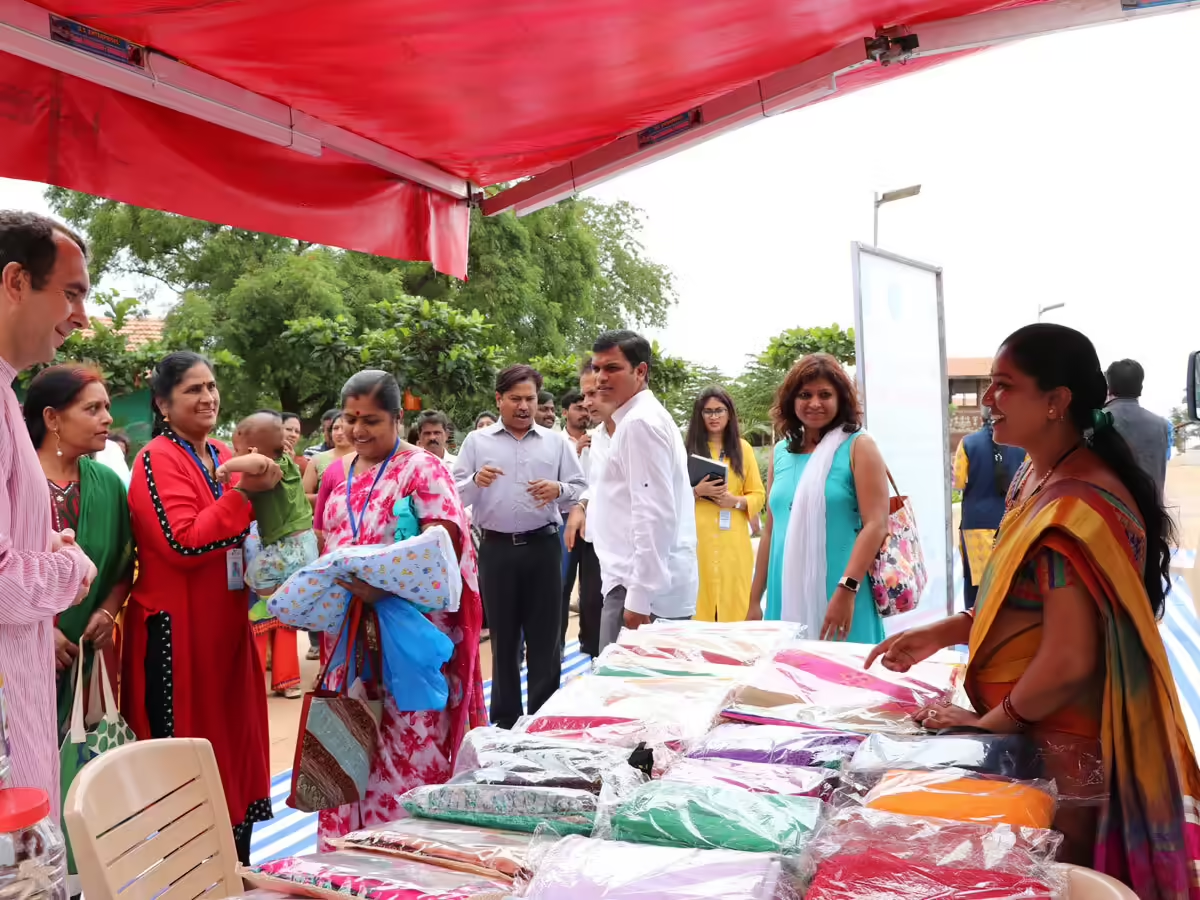
Business Sakhis are community mentors who provide:
- Business guidance
- Emotional support
- Mentorship
- Help in starting enterprises
- Assistance in solving business challenges
The initiative encourages women to become successful entrepreneurs and financially independent.
Importance of Skill Development in India
Skill development is essential for India’s economic growth. It helps young people become employable, supports industries with skilled workers, and promotes entrepreneurship. As technology continues to evolve, continuous learning and vocational training have become more important than ever.
Programs launched by the Ministry of Skill Development and Entrepreneurship not only improve employment opportunities but also encourage innovation, self-employment, and inclusive development. They also reduce the gap between education and industry requirements.
Conclusion
Skill Development and Entrepreneurship remained one of the Government of India’s top priorities in 2019. Through initiatives like PMKVY, SANKALP, STRIVE, PMKK, SHREYAS, MNGF, and the establishment of the Indian Institute of Skills, the Ministry worked to create a stronger and more efficient skill development ecosystem.
The focus on better coordination, wider access to training, improved quality, and modern technology-based courses has helped prepare India’s youth for future employment opportunities. By promoting vocational education, apprenticeships, entrepreneurship, and industry partnerships, these initiatives aim to build a skilled workforce capable of supporting India’s long-term economic growth and making the country more competitive in the global economy.
FAQs on Skill Development and Entrepreneurship in India
1. What is skill development?
Skill development is the process of teaching people practical and technical skills that help them get jobs or start their own businesses.
2. What is the purpose of the Ministry of Skill Development and Entrepreneurship?
The ministry aims to improve employability, promote vocational education, and encourage entrepreneurship across India.
3. What is Pradhan Mantri Kaushal Vikas Yojana (PMKVY)?
PMKVY is a government scheme that provides free skill training and certification to Indian youth to improve their employment opportunities.
4. What is the National Skill Development Mission (NSDM)?
NSDM is a mission that coordinates skill development programs across different ministries and states to improve training quality and efficiency.
5. What is Recognition of Prior Learning (RPL)?
RPL is a program that assesses and certifies the existing skills of experienced workers, even if they have not received formal training.
6. What is the objective of the SANKALP scheme?
SANKALP aims to strengthen the skill development system at the district level through better planning, coordination, and quality improvement.
7. What is the STRIVE scheme?
STRIVE is a World Bank-supported scheme that improves the performance of Industrial Training Institutes (ITIs) and apprenticeship programs.
8. What are Pradhan Mantri Kaushal Kendras (PMKKs)?
PMKKs are modern training centers that provide high-quality, industry-focused skill development courses.
9. Why are apprenticeships important?
Apprenticeships provide hands-on industry experience, helping students develop practical skills and improve their chances of getting a job.
10. How does skill development help India’s economy?
Skill development creates a skilled workforce, increases employment, supports industries, promotes entrepreneurship, and contributes to economic growth.