


Maritime Security: Importance, Challenges and India’s Strategy

Maritime Security has become one of the most important aspects of national and global security in the 21st century. Oceans connect countries through trade, energy supply, communication, and transportation. More than 80% of global trade by volume is carried through sea routes, making safe and secure oceans essential for economic growth.
Thank you for reading this post, don't forget to subscribe!For India, maritime security is even more important because the country has a coastline of more than 7,500 km, an Exclusive Economic Zone (EEZ) of over 2 million square kilometres, and a strategic location in the Indian Ocean Region (IOR). India depends heavily on sea routes for international trade, energy imports, fisheries, and maritime commerce.
Apart from traditional threats like piracy and smuggling, modern maritime security also includes cyber threats, illegal fishing, environmental disasters, maritime terrorism, and geopolitical competition among major powers. As global trade continues to expand, protecting India’s maritime interests has become a top national priority.
What is Maritime Security?
Maritime Security refers to protecting the seas, oceans, coastal areas, ports, ships, and maritime resources from various threats.
Although there is no single international definition, maritime security generally includes:
- National security
- Safe international trade
- Protection of marine resources
- Environmental conservation
- Human security
- Prevention of illegal activities at sea
It covers not only oceans but also territorial waters, rivers, ports, harbours, and regional seas.
Why is Maritime Security Important?
Maritime security affects every country because oceans support global trade, communication, food supply, and energy transportation.
1. Protection from Piracy
Piracy remains a major challenge in many sea regions.
Pirates attack merchant ships, kidnap crew members, steal cargo, and demand ransom. Areas such as the Gulf of Aden and parts of the western Indian Ocean have witnessed piracy incidents in the past.
Continuous naval patrols help reduce these threats.
2. Preventing Maritime Terrorism
Terrorist groups may use sea routes to transport weapons, explosives, or infiltrate countries.
India became more aware of this threat after the 2008 Mumbai terrorist attacks, where terrorists entered through the sea route.
Strong coastal surveillance helps prevent similar attacks.
3. Controlling Smuggling and Illegal Activities
Criminal groups often use sea routes for:
- Drug trafficking
- Arms smuggling
- Human trafficking
- Illegal immigration
- Wildlife smuggling
Strong maritime security agencies help stop these illegal activities.
4. Protecting the Marine Environment
The oceans face several environmental threats such as:
- Oil spills
- Marine pollution
- Plastic waste
- Illegal dumping
- Damage to coral reefs
Maritime security agencies also respond to environmental emergencies and protect marine ecosystems.
5. Supporting Global Trade
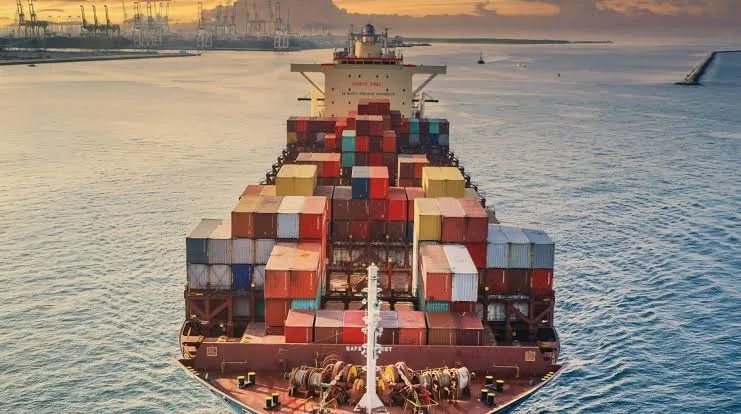
Nearly all major economies depend on sea transport.
If shipping routes become unsafe, international trade slows down, affecting businesses and consumers across the world.
Safe oceans ensure uninterrupted movement of goods.
Importance of Maritime Security for India
India’s geographical position makes maritime security extremely important.
Long Coastline
India has a coastline of over 7,500 km, covering nine coastal states and four Union Territories.
Protecting such a long coastline requires continuous monitoring.
Trade and Economy
Around 95% of India’s trade by volume and nearly 70% by value moves through sea routes.
Major exports and imports travel across the Indian Ocean.
Therefore, secure sea lanes are essential for India’s economy.
Energy Security
India imports a large share of its crude oil and natural gas through the sea.
Any disruption in maritime trade routes can directly affect fuel supplies and increase energy prices.
Blue Economy
India’s Blue Economy includes:
- Fisheries
- Shipping
- Tourism
- Offshore energy
- Marine biotechnology
- Port development
A secure maritime environment supports sustainable economic growth.
Strategic Location
India is located at the centre of the Indian Ocean Region.
Several important international shipping routes pass close to India’s coastline.
This strategic location increases India’s responsibility in maintaining regional security.
Sea Lanes of Communication (SLOCs)
Sea Lanes of Communication (SLOCs) are major international shipping routes used for transporting goods, oil, and commercial cargo.
These sea routes are extremely important because:
- They support international trade.
- They transport energy supplies.
- They connect Asia, Europe, Africa, and the Middle East.
Protecting these sea lanes is one of India’s major security priorities.
India’s Maritime Security System
India follows a three-layer coastal security system.
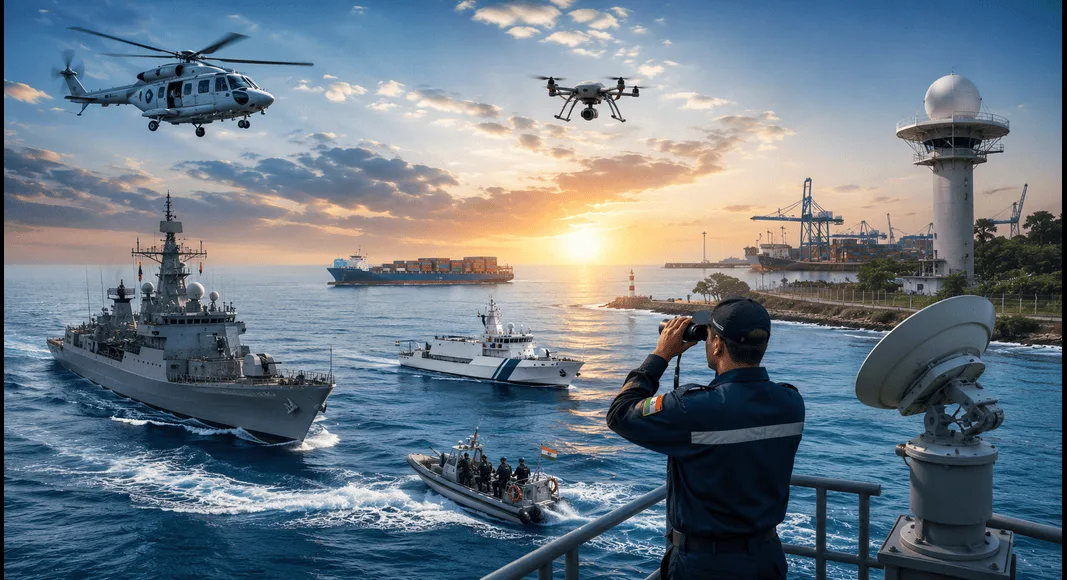
Indian Navy
The Indian Navy protects India’s overall maritime interests.
Its responsibilities include:
- Defending the country’s maritime borders
- Conducting anti-piracy operations
- Protecting international shipping
- Responding during war and emergencies
Indian Coast Guard
The Indian Coast Guard performs:
- Coastal surveillance
- Search and rescue operations
- Anti-smuggling operations
- Marine pollution control
- Protection of the Exclusive Economic Zone (EEZ)
The Coast Guard patrols up to 200 nautical miles.
State Marine Police
State Coastal Police patrol shallow coastal waters.
Their responsibilities include:
- Coastal patrolling
- Local intelligence gathering
- Preventing illegal fishing
- Checking suspicious boats
They generally operate up to 12 nautical miles from the coast.
India’s Major Maritime Security Initiatives
SAGAR Policy
One of India’s most important maritime initiatives is SAGAR, which stands for:
Security and Growth for All in the Region.
It was announced in 2015.
Its main objectives include:
- Peaceful Indian Ocean
- Regional cooperation
- Maritime capacity building
- Disaster response
- Economic development
- Safe navigation
SAGAR promotes India’s role as a responsible maritime partner.
Respect for International Law
India supports the United Nations Convention on the Law of the Sea (UNCLOS), 1982.
UNCLOS provides international rules regarding:
- Territorial waters
- Exclusive Economic Zone (EEZ)
- High Seas
- Navigation rights
- Marine resources
India believes maritime disputes should be solved peacefully through international law.
Information Fusion Centre – Indian Ocean Region (IFC-IOR)
India established the Information Fusion Centre-Indian Ocean Region (IFC-IOR) in Gurugram in 2018.
It is jointly managed by:
- Indian Navy
- Indian Coast Guard
Its objectives are:
- Maritime Domain Awareness
- Sharing information among partner countries
- Monitoring suspicious activities
- Improving regional cooperation
It helps identify threats before they become serious.
Anti-Piracy Operations
Since piracy increased near Somalia, the Indian Navy has actively protected merchant ships in the western Indian Ocean.
India has:
- Escorted commercial vessels
- Rescued hijacked ships
- Participated in international anti-piracy missions
- Cooperated with several countries under United Nations-supported initiatives
Indian naval operations have earned international appreciation.
Coastal Security Strengthening
After the 2008 Mumbai attacks, India significantly strengthened coastal security by:
- Installing coastal radar stations
- Registering fishing boats
- Improving intelligence sharing
- Increasing naval patrols
- Expanding Coast Guard infrastructure
These measures have improved coastal surveillance considerably.
Emerging Maritime Security Challenges
Although India has made significant progress, several challenges remain.
Infrastructure Gaps
India still requires:
- Modern shipbuilding facilities
- Better ship repair infrastructure
- Stronger port connectivity
- Improved coastal logistics
Modern maritime infrastructure is essential for national security.
Limited International Liaison Officers
India plans to post Naval Liaison Officers in friendly countries for better intelligence sharing.
However, delays in these appointments reduce operational coordination.
Better international representation can improve maritime awareness.
China’s Expanding Maritime Presence
China has increased its naval activities in the Indo-Pacific and the Indian Ocean.
Its growing influence through ports, naval bases, and maritime infrastructure creates strategic concerns for India.
Protecting India’s maritime interests requires continuous monitoring and cooperation with friendly countries.
Maritime Cyber Threats
Modern ships and ports depend heavily on digital technology.
Cyber attacks can target:
- Navigation systems
- Port operations
- Cargo management
- Communication networks
Cybersecurity has become an important part of maritime security.
Illegal Fishing
Illegal, Unreported and Unregulated (IUU) fishing causes:
- Loss of marine biodiversity
- Economic losses for fishermen
- Depletion of fish stocks
International cooperation is needed to control illegal fishing activities.
Climate Change
Climate change creates new maritime challenges such as:
- Rising sea levels
- Coastal erosion
- Strong cyclones
- Marine pollution
- Coral reef destruction
These issues affect both security and livelihoods.
Recent Developments (2023-2025)
India has continued to strengthen its maritime security in recent years.
Some important developments include:
- Expansion of maritime surveillance using satellites, drones, and advanced radar systems.
- Greater naval cooperation through exercises like Malabar, involving India, the United States, Japan, and Australia.
- Increased focus on the Indo-Pacific Oceans Initiative (IPOI) for regional cooperation.
- Continued deployment of Indian naval ships to protect commercial vessels in the Red Sea and Gulf of Aden during regional security tensions.
- Greater emphasis on the Blue Economy, sustainable fisheries, and marine resource management.
- Enhanced cooperation with countries such as France, Australia, Indonesia, Sri Lanka, Mauritius, and the Maldives for maritime safety and disaster response.
These developments have strengthened India’s role as a leading maritime power in the Indian Ocean Region.
The Way Forward
India can further strengthen maritime security by taking several important steps.
Improve Maritime Infrastructure
Modern ports, shipyards, logistics networks, and repair facilities should be expanded.
Strengthen Naval Capacity
Continuous modernization of the Navy, Coast Guard, and Marine Police is necessary.
Enhance International Cooperation
India should increase intelligence sharing, joint naval exercises, and coordination with friendly countries.
Promote Rule-Based Maritime Order
All countries should resolve disputes peacefully according to international law, especially UNCLOS.
Secure Sea Lanes
Protecting Sea Lanes of Communication (SLOCs) should remain a top priority to ensure uninterrupted global trade.
Encourage Private Sector Participation
Private companies can contribute to:
- Shipping
- Port development
- Blue Economy
- Maritime technology
- Undersea communication cables
Protect Marine Environment
Greater efforts are needed to reduce pollution, conserve marine biodiversity, and promote sustainable use of ocean resources.
Conclusion
Maritime Security is no longer limited to protecting coastlines. It now includes national security, economic growth, environmental protection, international trade, cybersecurity, and regional cooperation. For a country like India, whose economy and strategic interests are closely linked with the Indian Ocean, maintaining secure and open seas is essential.
Government initiatives such as SAGAR, the Information Fusion Centre–Indian Ocean Region, coastal security reforms, and active participation in international maritime cooperation have significantly improved India’s maritime capabilities. At the same time, challenges such as piracy, maritime terrorism, cyber threats, illegal fishing, climate change, and geopolitical competition require constant attention.
As India moves towards becoming a major global economic and maritime power, strengthening maritime security through technology, international partnerships, sustainable development, and rule-based cooperation will play a key role in ensuring peace, prosperity, and national security for the future.
FAQs
1. What is Maritime Security?
Maritime Security means protecting oceans, seas, ports, ships, and coastal areas from threats like piracy, terrorism, smuggling, pollution, and illegal activities.
2. Why is Maritime Security important for India?
It is important because India has a coastline of over 7,500 km, depends heavily on sea trade, and must protect its national security and marine resources.
3. What are the major maritime threats?
Major threats include piracy, maritime terrorism, illegal fishing, arms and drug smuggling, cyber threats, environmental disasters, and geopolitical conflicts.
4. What is the SAGAR policy?
SAGAR (Security and Growth for All in the Region) is India’s vision to ensure peace, security, and sustainable development in the Indian Ocean Region.
5. What is UNCLOS?
UNCLOS (United Nations Convention on the Law of the Sea) is an international agreement that defines the rights and responsibilities of countries over the world’s oceans.
6. Which organizations protect India’s maritime borders?
The Indian Navy, Indian Coast Guard, and State Coastal Police work together to protect India’s maritime boundaries.
7. What is the Information Fusion Centre–Indian Ocean Region (IFC-IOR)?
It is a centre in Gurugram that shares maritime information with partner countries to improve security and maritime domain awareness.
8. What are Sea Lanes of Communication (SLOCs)?
SLOCs are important sea routes used by ships to transport goods, oil, and other essential resources across the world.
9. What challenges does India face in maritime security?
India faces challenges such as China’s growing naval presence, piracy, infrastructure gaps, illegal activities, cyber threats, and climate-related disasters.
10. How can India strengthen Maritime Security?
India can strengthen maritime security by improving naval infrastructure, increasing international cooperation, using advanced technology, securing sea routes, and promoting the Blue Economy.