



Major Constitutional Amendments in India – Part 2

Major Constitutional Amendments have played a significant role in strengthening and improving the Constitution of India. Since the Constitution came into force on 26 January 1950, Parliament has passed several amendments to meet the changing political, social, economic, and administrative needs of the country.
Thank you for reading this post, don't forget to subscribe!Some amendments were introduced to improve governance, while others were passed in response to important Supreme Court judgments, political developments, or national emergencies. A few amendments expanded citizens’ rights, whereas others changed the relationship between the Union and the States. Many amendments also focused on improving democracy, protecting weaker sections of society, and making government administration more efficient.
The period between 1975 and 1992 witnessed some of the most important Constitutional Amendments in India’s history. During these years, the country experienced the National Emergency, restoration of democratic institutions, anti-defection reforms, expansion of voting rights, and recognition of more Indian languages.
Why are Constitutional Amendments Important?
The Constitution is a living document. It must change with time so that it continues to meet the needs of the people.
Constitutional Amendments help to:
- Improve governance.
- Protect democracy.
- Strengthen citizens’ rights.
- Maintain political stability.
- Respond to judicial decisions.
- Introduce administrative reforms.
- Meet changing national requirements.
However, every amendment must respect the Basic Structure Doctrine, which was established by the Supreme Court in the Kesavananda Bharati Case (1973).
Thirty-Ninth Constitutional Amendment Act, 1975
The Thirty-Ninth Amendment was passed during the Emergency period.
Why was it introduced?
The Allahabad High Court declared the election of Prime Minister Indira Gandhi to the Lok Sabha invalid after a petition filed by Raj Narain.
To deal with this situation, Parliament introduced the Thirty-Ninth Amendment.
Major Changes
Election Disputes
The amendment removed disputes related to the election of the following offices from the jurisdiction of the courts:
- President
- Vice-President
- Prime Minister
- Speaker of the Lok Sabha
Instead, Parliament was given the power to decide how such disputes would be handled.
Ninth Schedule
Some Central Acts were also added to the Ninth Schedule to protect them from judicial review.
This amendment became highly controversial because it reduced judicial oversight over important constitutional offices.
Forty-Second Constitutional Amendment Act, 1976
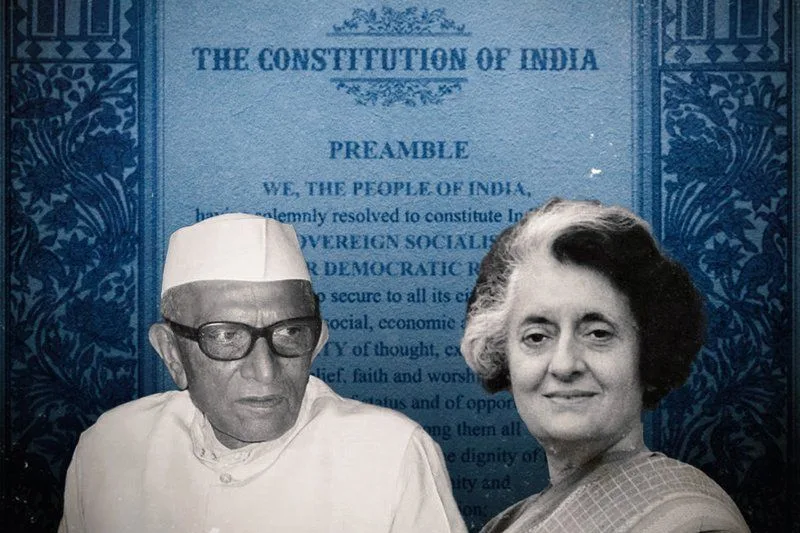
The Forty-Second Amendment is often called the “Mini Constitution” because it made a very large number of changes to the Constitution.
It is one of the most extensive Constitutional Amendments in Indian history.
Major Changes
Changes to the Preamble
Three new words were added:
- Socialist
- Secular
- Integrity
These words strengthened India’s commitment to social justice, religious equality, and national unity.
Fundamental Duties
A new Part IV-A was inserted.
It introduced Fundamental Duties, making it the responsibility of every citizen to respect the Constitution, protect national unity, preserve the environment, and perform other civic duties.
President Bound by Cabinet Advice
The President was made legally bound to act according to the advice of the Council of Ministers.
Administrative Tribunals
A new Part XIV-A provided for the establishment of Administrative Tribunals to handle service-related disputes.
Freeze on Parliamentary Seats
The number of Lok Sabha and State Assembly seats was frozen based on the 1971 Census until 2001.
The objective was to encourage population control.
Judicial Review Curtailed
The amendment attempted to reduce the powers of the Supreme Court and High Courts regarding judicial review.
Constitutional Amendments Beyond Judicial Review
It declared that Constitutional Amendments could not be challenged in courts.
However, this provision was later struck down by the Supreme Court.
Longer Tenure of Legislatures
The term of the Lok Sabha and State Legislative Assemblies was increased from five years to six years.
Directive Principles Strengthened
Laws made to implement certain Directive Principles received greater protection even if they affected some Fundamental Rights.
Anti-National Activities
Parliament received powers to make laws against anti-national activities.
New Directive Principles
Three new Directive Principles were added:
- Equal justice and free legal aid
- Participation of workers in industrial management
- Protection of forests, wildlife, and the environment
Emergency Provisions
The amendment made it easier to declare Emergency in only a part of India.
President’s Rule
The maximum duration of one proclamation of President’s Rule was increased from six months to one year.
Centre’s Powers Increased
The Central Government was allowed to deploy armed forces in any state during serious law and order situations.
Subjects Shifted to Concurrent List
Five important subjects were transferred from the State List to the Concurrent List:
- Education
- Forests
- Protection of Wild Animals and Birds
- Weights and Measures
- Administration of Justice (except Supreme Court and High Courts)
Other Changes
The amendment also:
- Removed the requirement of quorum in legislatures.
- Allowed Parliament to determine members’ privileges.
- Proposed the creation of an All India Judicial Service.
- Simplified disciplinary procedures against civil servants.
The Forty-Second Amendment greatly strengthened the powers of the Central Government.
Forty-Third Constitutional Amendment Act, 1977
After the Emergency ended, the new government sought to restore democratic institutions.
Major Changes
- Restored the powers of the Supreme Court and High Courts regarding judicial review.
- Restored the power to issue writs.
- Removed Parliament’s special powers to make laws against anti-national activities.
This amendment reversed several controversial provisions of the Forty-Second Amendment.
Forty-Fourth Constitutional Amendment Act, 1978
The Forty-Fourth Amendment is considered one of the most important democratic reforms in Indian constitutional history.
It restored many constitutional safeguards that had been weakened during the Emergency.
Major Changes
Legislature Tenure Restored
The term of the Lok Sabha and State Legislative Assemblies was reduced from six years back to five years.
Quorum Restored
The requirement of quorum in Parliament and State Legislatures was restored.
Parliamentary Privileges
The reference to the British House of Commons regarding parliamentary privileges was removed.
Protection for Newspaper Reports
True reports of parliamentary proceedings published in newspapers received constitutional protection.
President’s Power
The President was allowed to return the advice of the Cabinet once for reconsideration.
However, if the Cabinet sends the advice again, the President must accept it.
Ordinances
The amendment removed provisions making the satisfaction of the President or Governor final regarding ordinances.
Judicial Powers
Several powers of the Supreme Court and High Courts were restored.
National Emergency
The phrase “Internal Disturbance” was replaced with “Armed Rebellion.”
This made it much harder to declare a National Emergency.
Written Recommendation
A National Emergency can now be declared only after receiving the written recommendation of the Cabinet.
Right to Property
The Right to Property was removed from the list of Fundamental Rights.
It became a legal right under Article 300A.
Protection of Articles 20 and 21
Rights relating to protection in criminal cases and protection of life and personal liberty cannot be suspended even during a National Emergency.
Election Disputes
The courts regained the authority to hear election disputes relating to the President, Vice-President, Prime Minister, and Speaker.
The Forty-Fourth Amendment restored democratic balance between the Executive, Legislature, and Judiciary.
Fiftieth Constitutional Amendment Act, 1984
The Fiftieth Amendment focused on national security.
Major Change
Parliament received the power to restrict certain Fundamental Rights of employees working in:
- Intelligence organizations
- Armed Forces communication systems
- National security organizations
This was done to protect confidential information and maintain national security.
Fifty-Second Constitutional Amendment Act, 1985
The Fifty-Second Amendment introduced one of India’s most important political reforms.

Why was it needed?
Frequent defections by elected representatives led to political instability.
This practice became popularly known as “Aaya Ram, Gaya Ram.”
Major Changes
Anti-Defection Law
The amendment added the Tenth Schedule to the Constitution.
It provides for the disqualification of Members of Parliament and State Legislatures who change political parties after being elected.
This law promotes political stability and discourages unethical defections.
Fifty-Eighth Constitutional Amendment Act, 1987
India’s Constitution was originally written in English.
The Fifty-Eighth Amendment provided an authoritative Hindi version of the Constitution.
Both English and Hindi texts were given equal legal validity.
This promoted the use of Hindi in constitutional matters.
Sixty-First Constitutional Amendment Act, 1989
The Sixty-First Amendment expanded democratic participation.
Major Change
The voting age for Lok Sabha and State Legislative Assembly elections was reduced:
- From 21 years
- To 18 years
This allowed millions of young Indians to participate in elections.
Today, every Indian citizen aged 18 years or above has the right to vote if otherwise eligible.
Sixty-Fifth Constitutional Amendment Act, 1990
This amendment strengthened constitutional protection for Scheduled Castes and Scheduled Tribes.
Major Change
It replaced the earlier Special Officer with a multi-member National Commission for Scheduled Castes and Scheduled Tribes.
The Commission was given greater authority to protect the rights and welfare of SCs and STs.
Sixty-Ninth Constitutional Amendment Act, 1991
The Sixty-Ninth Amendment granted a special constitutional status to Delhi.
Major Changes
- Delhi became the National Capital Territory (NCT) of Delhi.
- A 70-member Legislative Assembly was created.
- A Council of Ministers was established to assist in governance.
This amendment provided limited state-like powers while keeping Delhi as a Union Territory.
Seventy-First Constitutional Amendment Act, 1992
India is home to hundreds of languages.
The Seventy-First Amendment recognized three more languages.
Major Changes
The following languages were added to the Eighth Schedule:
- Konkani
- Manipuri
- Nepali
After this amendment, the total number of Scheduled Languages increased to 18.
The amendment promoted India’s rich linguistic and cultural diversity.
Importance of These Constitutional Amendments
The Constitutional Amendments discussed above had a lasting impact on India’s political and legal system.
They helped to:
- Strengthen democracy.
- Protect constitutional institutions.
- Improve election laws.
- Promote political stability.
- Increase youth participation in elections.
- Protect Scheduled Castes and Scheduled Tribes.
- Recognize India’s linguistic diversity.
- Balance the powers of Parliament, Judiciary, and Executive.
- Improve governance at both the national and state levels.
Several of these amendments continue to influence India’s constitutional framework today.
Conclusion
Major Constitutional Amendments from 1975 to 1992 represent one of the most important phases in the evolution of the Indian Constitution. During this period, Parliament introduced major changes affecting the Preamble, Fundamental Duties, Fundamental Rights, judicial review, elections, emergency provisions, voting rights, anti-defection laws, and language recognition.
While some amendments, such as the Forty-Second Amendment, significantly expanded the powers of the government, later amendments like the Forty-Third and Forty-Fourth restored democratic safeguards and strengthened judicial independence. Other amendments promoted political stability, improved governance, expanded voting rights to young citizens, and protected the interests of Scheduled Castes, Scheduled Tribes, and linguistic minorities.
Together, these amendments demonstrate how the Constitution of India continues to evolve while preserving its core democratic values and the Basic Structure established by the Supreme Court. They remain essential topics for students, competitive examinations, and anyone interested in understanding India’s constitutional development.
FAQs
1. What is the Forty-Second Constitutional Amendment known as?
The Forty-Second Constitutional Amendment Act, 1976 is known as the “Mini Constitution” because it introduced a large number of changes to the Indian Constitution.
2. Which words were added to the Preamble by the Forty-Second Amendment?
The words Socialist, Secular, and Integrity were added to the Preamble through the Forty-Second Constitutional Amendment Act, 1976.
3. What are Fundamental Duties?
Fundamental Duties are the moral responsibilities of Indian citizens listed in Part IV-A of the Constitution. They were added by the Forty-Second Constitutional Amendment.
4. What was the main purpose of the Forty-Fourth Constitutional Amendment?
The Forty-Fourth Constitutional Amendment restored several democratic safeguards, reduced the Lok Sabha’s tenure back to five years, strengthened judicial powers, and protected Fundamental Rights during a National Emergency.
5. What is the Anti-Defection Law?
The Anti-Defection Law was introduced by the Fifty-Second Constitutional Amendment Act, 1985 through the Tenth Schedule. It disqualifies legislators who switch political parties after being elected.
6. Which Constitutional Amendment reduced the voting age to 18 years?
The Sixty-First Constitutional Amendment Act, 1989 reduced the voting age for Lok Sabha and State Legislative Assembly elections from 21 years to 18 years.
7. Which Constitutional Amendment gave special status to Delhi?
The Sixty-Ninth Constitutional Amendment Act, 1991 granted Delhi the status of the National Capital Territory (NCT) and created a Legislative Assembly and Council of Ministers.
8. Which languages were added to the Eighth Schedule by the Seventy-First Amendment?
The Seventy-First Constitutional Amendment Act, 1992 added Konkani, Manipuri, and Nepali to the Eighth Schedule, increasing the number of Scheduled Languages to 18.
9. What is the significance of the Forty-Third Constitutional Amendment?
The Forty-Third Constitutional Amendment restored the powers of the Supreme Court and High Courts regarding judicial review and removed certain Emergency-era provisions.
10. Why are the Major Constitutional Amendments important?
Major Constitutional Amendments help the Constitution adapt to changing national needs, strengthen democracy, improve governance, protect citizens’ rights, and maintain the balance between Parliament, the Judiciary, and the Executive.