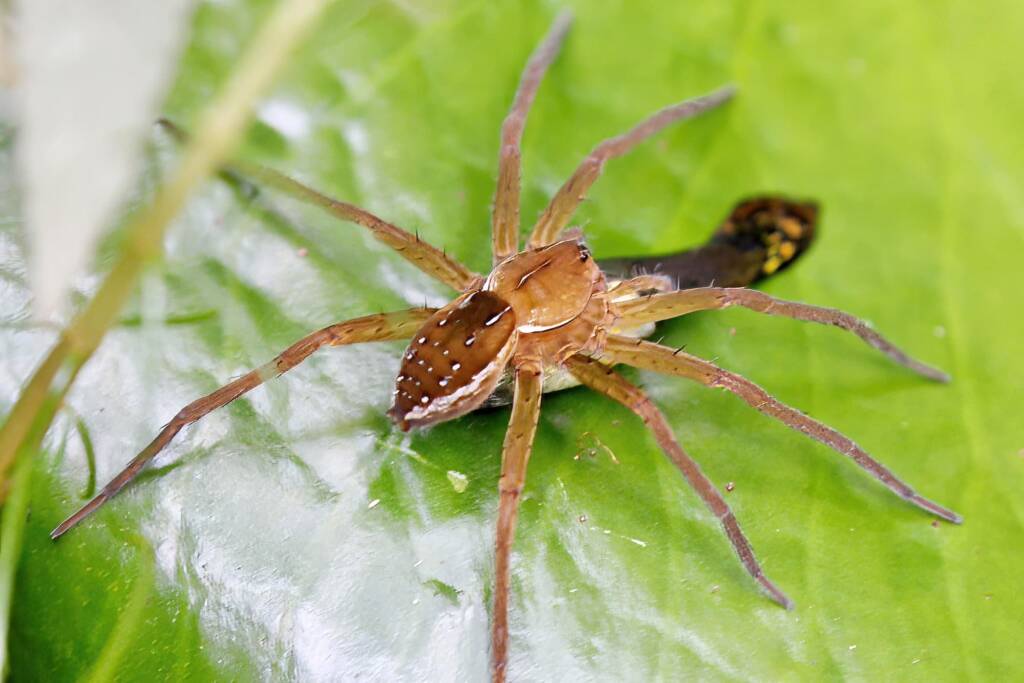
Kerala Researchers Identify Dolomedes indicus in Wayanad Streams

A research team in Kerala has identified a new semi-aquatic spider species named Dolomedes indicus. This marks the first confirmed discovery of a fishing spider from the Dolomedes genus in India. The finding from the rainforests of Wayanad highlights the rich natural life of the Western Ghats and shows how important it is to continue studying biodiversity.
Thank you for reading this post, don't forget to subscribe!Discovery in the Streams of Wayanad
Scientists from the Kerala Forest Research Institute found the species in the forest areas of Lakkidi and Periya in Wayanad. Unlike spiders that build webs, Dolomedes indicus is a hunter that searches for food on water.
The spider can sense small vibrations on the water’s surface caused by insects or tiny fish. It quickly moves across the water to catch its prey. Researchers also noticed an impressive ability to dive—one female spider stayed underwater for almost 90 minutes by trapping a layer of air using special water-repelling hairs.
Scientific Confirmation and Unique Features

The research team confirmed the species through detailed physical study and DNA testing. Although there were earlier unverified reports of fishing spiders, this is the first time solid genetic and structural proof has been presented.
Male Dolomedes indicus spiders have a clear snow-white stripe from the face to the middle of the back. Females are bigger, greenish-brown, and blend easily into moss-covered stream edges. Specimens have been safely stored in the KFRI Insect Collection for further research.
Ecology, Behaviour and Habitat Sensitivity
This species lives in cool, fast-moving forest streams and stays away from dirty or stagnant waters. Its behaviours—such as gliding on water, diving for long periods, swimming and surface hunting—show how well it has adapted to a semi-aquatic lifestyle.
The spider is very sensitive to changes in its habitat. Because of this, it can act as a useful species for checking the health of freshwater systems in the Western Ghats.
Key Points
- Dolomedes indicus is the first confirmed species of the Dolomedes genus recorded from India.
- Found in the Lakkidi and Periya forest regions of Wayanad, Kerala.
- Shows semi-aquatic hunting behaviour using water surface tension.
- Identified through DNA studies and physical traits, including a snow-white stripe in males.
Conservation Importance of the Western Ghats
Since these spiders depend on freshwater environments, they may help scientists understand the health of stream ecosystems. The discovery draws attention to the fragile nature of stream habitats in the Western Ghats, which face threats from climate change and land-use changes. Protecting clean, natural forest streams is important to support species like Dolomedes indicus that are closely tied to such environments.