The Meches Tribe of Assam: Culture and Heritage

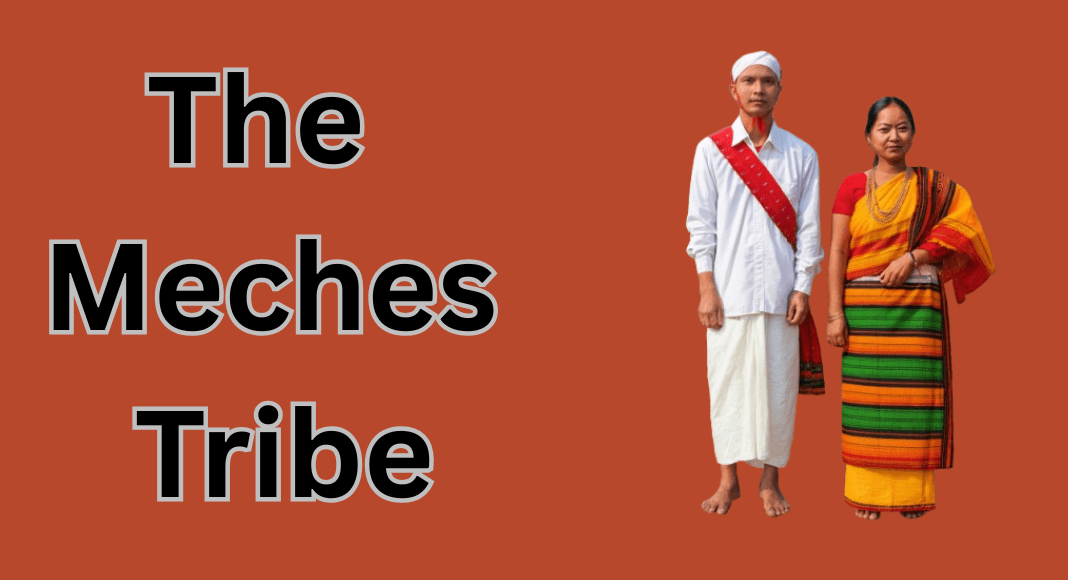
The Meches tribe of Assam is one of the lesser-known yet culturally rich Scheduled Tribes of the plains districts of the state. Though they are a numerically small tribe, their unique history, customs, traditions, and deep connection with the greater Bodo-Kachari group make them an important part of Assam’s ethnic mosaic.
Thank you for reading this post, don't forget to subscribe!The main concentration of the Meches is found in the Mechpara area of South Salmara subdivision in Goalpara district, but over the years, they have migrated and settled in small pockets across Dibrugarh (Khowang area), Karbi Anglong (Parakhowa area), Sonitpur district, and even near the border areas of Nagaland in Golaghat district.
Some Mech families of Dibrugarh migrated from Goalpara during pre-independence days, while others moved into the Dayang Reserved Forest area of Golaghat in search of better livelihood opportunities. Even though their numbers are small, their cultural identity has survived through centuries.
The Meches Tribe of Assam: Origin and Racial Affinity
The question of origin has always been important for understanding the identity of the Meches. Several scholars have presented different theories:
Tibeto-Burman Roots
Dr. Suniti Kumar Chatterjee stated that the Meches are of Tibeto-Burman origin and belong to the larger Bodo section of the Indo-Mongoloid group. Over time, they came in close cultural contact with Bengali and Assamese-speaking Hindus, leading to gradual acculturation.
Dalton’s View of Common Ancestry
Dalton believed that the Meches and Kacharis share the same ancestral stock. Even if they are not completely identical, it is clear that they had a common origin. The wide presence of Meches in Goalpara and the Terai region of the Himalayas indicates their ancient migration routes.
He also mentioned that the old Mechpara Zamindari got its name from its Mech inhabitants, although ironically, the Zamindar family itself was Rajbongshi, not Mech.
Guha’s Historical View
According to historian Guha, Mechpara Zamindari was created by dividing the Bijni Zamindari, and the first Zamindar was Bhagadatta Das Choudhury, a Rajbongshi-Kshatriya. This again shows that the Meches lived in the area even if the ruling family was not Mech.
The Term ‘Mech’ and Its Possible Origins
Some scholars argued that “Mech” originated from the word “Mleccha”. Others like Grierson felt that Bodos living in the Jalpaiguri and Terai areas called themselves Mech because they lived near the river Mechi.
However, evidence does not strongly support the claim that “Mech” is a corruption of “Mleccha”, because then all Kirata groups of ancient Assam would have been called by the same name.
Legends of Migration
Risley (Tribes and Castes of Bengal) recorded a Limbu legend where three brothers ancestors of the Meches, Koch, and Dhimals fell from heaven in Varanasi and migrated toward Khachar, where the youngest brother settled. The Meches are also believed to have interacted with Nepalese people during migrations.
Conclusion About Their Origin
After analysing all views, scholars agree that:
- The Meches are not descendants of Nepalese.
- They are Indo-Mongoloids belonging to the Bodo-Kachari branch.
- Their migration likely followed the Brahmaputra valley westward and then towards Jalpaiguri and Terai.
- The Meches and Bodo-Kacharis are essentially the same ethnic stock, though historically studied separately.
The Meches Tribe of Assam: Demographic Characteristics
The Meches are a numerically small tribal group.
During the 1971 Census, their population in Assam was 2,570, which was:
- 0.02% of Assam’s total population
- 0.16% of total tribal population of Assam
- 0.19% of plains tribal population
Many Meches prefer calling themselves Kachari, especially in Dibrugarh, where they identify as Mech-Kachari.
Literacy
Surprisingly, the Meches had the highest literacy rate among all plains tribes in 1971:
- Overall literacy: 30.58%
- Male literacy: 39.66%
- Female literacy: 21.64%
This was higher than the state’s average at that time.
The Meches Tribe of Assam: Social Life
The social life of the Meches is deeply rooted in clan identity, marriage customs, family structure, and community values.
The Meches Tribe of Assam: Clans
A clan among the Meches is called Ari. They have five major clans and four occupational clans.
Five Principal Clans
- Sampramari / Campramari
Origin story: Their ancestors fled suddenly during cooking, leaving behind a dish called Sampram, hence the name.
This is a priestly clan, considered the highest. - Narzinari / Narzenari
Derived from Narzin/Narzen, a type of tree. Members are believed to have originated from a tree. - Basumatari
Believed to have originated from Mother Earth (Basu-mata). - Mochari / Moshari
Derived from Mocha/Mosha, meaning tiger. They trace origin from a tiger. - Hajoari
They originated from a hill (Hajo).
Four Other Occupational Clans
(a) Bargao-ari – Village leaders or Mandals
(b) Doi-ma-ari – Riverine people
(c) Goya-ari – Betel nut growers
(d) Khatlou-ari – Growers of a sweet root crop
These clan names closely match Bodo clan names, again proving their cultural closeness.
The Meches Tribe of Assam: Marriage
Marriage among the Meches was traditionally simple but has undergone changes with time.
Exogamy and Tribe Endogamy
- Clans are exogamous marriage within the same clan was prohibited (now somewhat relaxed).
- They usually marry within their tribe or with Bodo-Kacharis.
- In some areas (like Dibrugarh), marriages with OBC communities also occur.
Old Marriage Practices
- Marriages were arranged by mothers and elderly women.
- A bride price (Jan) was paid based on the girl’s qualities.
- Rituals were simple: exchange of betel nuts and leaves marked the union.
- The bride went to the groom’s house for the final ceremony.
- A feast was organized at the groom’s home.
Modern Changes
- Bride price is no longer encouraged; sometimes only a symbolic amount is given.
- Both men and women now arrange marriages.
- Weddings follow more elaborate religious rituals.
- The groom now goes to the bride’s house, following mainstream customs.
Widow Marriage
- Allowed.
- An unmarried younger brother can marry his elder brother’s widow, but not the other way around.
Divorce
- Allowed but uncommon.
- Divorce was done by tearing a betel leaf in presence of village leaders.
Belief About Conjugal Fidelity
Risley recorded a custom involving the Sij plant, considered sacred.
If its leaves withered, it was believed that a woman in the household was unfaithful.
A rice-chewing ritual determined guilt. Such beliefs have disappeared today.
The Meches Tribe of Assam: Birth Customs
- Tuesdays and Saturdays are considered inauspicious for pregnant women to go out.
- After childbirth, a piece of iron or knife is kept under the bed to ward off evil spirits.
- No professional midwives; elderly women assist in delivery.
- The umbilical cord is cut using a green bamboo strip:
- 5 strokes for a boy
- 7 strokes for a girl
- If a child is still-born, they believe it was taken by an evil spirit called Gotha-Modai.
The Meches Tribe of Assam: Family Structure
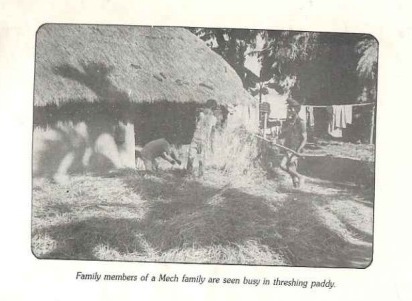
The Mech family structure is patrilineal, similar to the Bodo-Kacharis.
Joint Family System
- Traditionally, they lived as a joint/extended family.
- Married sons stayed in the same household.
- Daughters moved to their husband’s family.
Today, due to education and modern lifestyle, nuclear families are becoming common.
The Meches Tribe of Assam: Inheritance
- Only sons inherit property.
- Daughters, even if unmarried, get no share.
- In absence of sons, property goes to the nearest male relative.
- Sons must take care of widowed mother and unmarried sisters.
The Meches Tribe of Assam: Traditional Houses
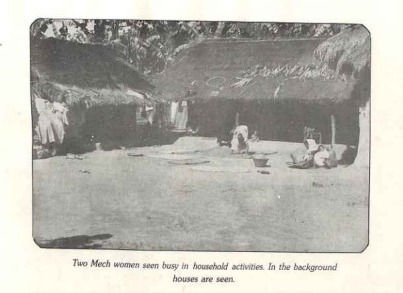
Mech houses resemble typical Bodo-Kachari homes.
Housing Pattern
- Houses are built around a courtyard with four structures.
- The northern house is the largest and is considered sacred.
- This is where the goddess of wealth, Mainou, resides.
Materials
- Bamboo
- Timber
- Thatch
- Mud
Today, many families use tin roofs and modern materials.
The Sacred Siju Plant
Non-Christian Meches keep a Siju (Euphorbia Indica) plant in the northeast corner of the courtyard, enclosed by bamboo.
It is the home of their Great God Bathou (Siva).
The Meches Tribe of Assam: Food Habits
Their food habits are similar to other plains tribes of Assam.
Daily Meals
- Breakfast: leftover rice (poita bhat), salt, chillies, roasted fish.
- Lunch & dinner: rice, vegetables, fish, dried fish, chillies.
- They eat pork, fowl, duck, and occasionally buffalo meat (earlier).
Drinks
- Tea, often without sugar or milk.
- They drink milk and tea with milk, unlike some tribes.
- Favourite drink: rice beer (Jou), brewed at home.
- It is important for festivals and hospitality.
- However, rice beer is never offered to God Bathou.
Other Habits
- Tobacco (smoking), betel nut and leaf chewing.
- No addiction to opium or hemp traditionally.
The Meches Tribe of Assam: Death and Funeral Practices
Both cremation and burial are practiced.
Cremation or Burial?
- Wealthy families prefer cremation.
- Poor families bury the dead, keeping the body face up with the head towards the south.
- Food and drink are burned at the grave for the soul.
Beliefs About Death
- Death is a natural event; excessive mourning is discouraged.
- During death, the body’s feet are placed northward, symbolizing the journey to Kailash, where Bathou lives.
Inauspicious Deaths
Certain deaths are considered inauspicious:
- Suicide
- Death by tiger
- Death by elephant
Such bodies are never cremated, only buried.
Clan Responsibility
Only members of the deceased’s clan may carry the body to the funeral ground.
Death Ceremony
Performed on the 8th or 12th day, depending on decisions by the village headman and elders.
A feast is arranged, where villagers contribute rice, fowls, rice beer, and labour.
The Meches Tribe of Assam: Culture, Beliefs, and Traditions
Although your provided material focused on origin and social structure, summarizing these aspects helps complete the article.
Religion
Traditionally, the Meches follow Bathouism, worshipping Bathou (Siva).
The Siju plant represents divine presence.
Festivals
Meches celebrate festivals similar to Bodos:
- Kherai
- Bwisagu
- Harvest festivals
- Ancestor worship ceremonies
Rice beer plays an important role in festivities.
Language
Their language belongs to the Bodo group of Tibeto-Burman languages.
However, many Meches have shifted to Assamese, Bengali, or Rajbongshi dialects over time.
Music and Dance
Traditional dance forms are celebrated during seasonal festivals.
They use bamboo instruments and drums similar to other Bodo-Kachari groups.
Economy
Traditionally:
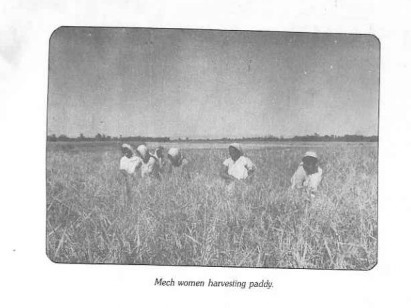
- They were farmers, growing rice and vegetables.
- Some practiced shifting cultivation in earlier times.
- Many were riverine people and engaged in fishing, reflecting their clan names (Doi-ma-ari).
The Meches Tribe of Assam: Present Social and Cultural Status
Today, the Meches are undergoing significant changes:
- Increasing education
- Adoption of modern professions
- Shift to nuclear families
- Inter-community marriages
- Migration to urban areas
Despite this, many traditional elements clan identity, worship of Bathou, the Siju plant, and rice beer continue to be strong symbols of their heritage.
Conclusion
The Meches tribe of Assam may be small in number, but their cultural and historical legacy is rich and significant. Their connection with the Bodo-Kachari group, unique clan system, traditions around marriage and death, and belief structures highlight the deep cultural layers woven into Assam’s social fabric.
Though modern influences have reshaped parts of their life, their identity survives through rituals, language memories, and their deep relationship with nature and spirituality. The Meches continue to be a vital part of the ethnic heritage of Assam and the larger northeastern region.