




India Natural Gas Futures Launched on NSE

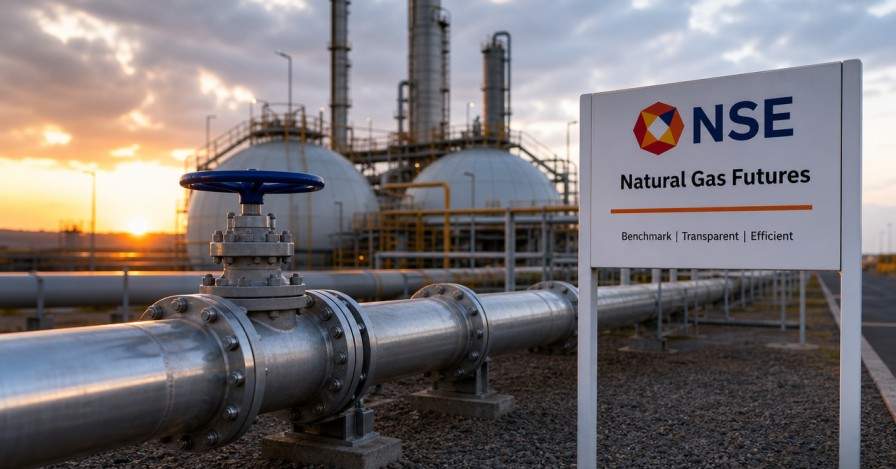
Natural Gas Futures officially launched in India on 27 July 2026, marking an important development in the country’s energy and financial markets. The National Stock Exchange (NSE) introduced India’s first domestic benchmark-based natural gas futures contract after receiving approval from the Securities and Exchange Board of India (SEBI). The contract is listed under the trading symbol NATGASIND and is expected to improve price transparency, support better risk management, and strengthen India’s growing natural gas market.
The launch comes at a time when India is increasing the use of cleaner energy sources and expanding its natural gas infrastructure to meet rising industrial and household demand.

What Are Natural Gas Futures?
Natural gas futures are financial contracts that allow buyers and sellers to agree on the future price of natural gas without exchanging the fuel immediately.
Instead of buying or selling physical gas on the same day, market participants trade contracts based on the expected future price of natural gas.
These contracts help businesses protect themselves from sudden price changes and make financial planning more predictable.
Natural gas futures are already traded in several international markets, and India has now introduced its own domestic benchmark-based contract.
India’s First Domestic Benchmark-Based Contract
The newly launched contract is the first in India to be linked to a domestic natural gas price benchmark.
Its pricing is based on the Indian Gas Exchange (IGX) at the Gujarat (Dahej) Hub, one of the country’s major natural gas trading locations.
The contract is quoted in Indian Rupees per mmBtu, a standard unit used around the world to measure natural gas prices.
Using a domestic benchmark allows the contract to reflect conditions in India’s own energy market instead of depending only on international price movements.
How the Contract Works
The new natural gas futures contract follows a cash-settlement system.
This means that when the contract expires, traders settle the difference in price through financial payments instead of delivering physical natural gas.
Some important features include:
- Trading symbol: NATGASIND
- Trading unit: 250 mmBtu
- Cash-settled contract
- Priced in Indian Rupees
- Based on the IGX Gujarat (Dahej) Hub benchmark
This design makes trading easier while reducing the need for storage and transportation of natural gas.
Role of NSE and SEBI
The National Stock Exchange (NSE) is one of India’s largest stock exchanges and offers trading in equities, derivatives, debt securities, and other financial products.
Before launching the contract, the exchange received approval from SEBI, India’s securities market regulator.
SEBI oversees financial markets to ensure fair trading practices, investor protection, and market transparency.
The approval reflects the regulator’s support for developing new financial products that strengthen India’s commodity and energy markets.
Settlement Process
The settlement of the contract will be managed by NSE Clearing, which is responsible for ensuring smooth and secure transactions.
NSE Clearing will handle:
- Daily mark-to-market adjustments.
- Initial margin collection.
- Clearing of trades.
- Final settlement of contracts.
The final settlement price will be calculated using the monthly weighted average price of natural gas delivered at the Indian Gas Exchange’s Gujarat (Dahej) Hub during the contract period.
However, trades carried out under government-mandated ceiling prices will not be included in the settlement calculation. This helps ensure that the benchmark reflects regular market activity.
Why This Launch Matters
The introduction of a domestic natural gas futures contract is expected to provide several benefits for India’s energy sector.
It can help:
- Improve price transparency.
- Reduce uncertainty caused by price fluctuations.
- Support better financial planning.
- Strengthen India’s commodity market.
- Encourage efficient price discovery.
Energy companies, industrial consumers, traders, and financial institutions can use the contract to manage price risks more effectively.
As India continues to expand natural gas usage in manufacturing, transportation, power generation, and city gas distribution, financial tools like futures contracts are becoming increasingly important.
Growing Focus on India’s Energy Market
India is working to increase the share of natural gas in its overall energy mix as part of its broader clean energy strategy.
The country is investing in new gas pipelines, LNG terminals, city gas distribution networks, and domestic trading platforms to improve energy availability and reduce dependence on more polluting fuels.
The launch of Natural Gas Futures supports these efforts by creating a transparent market-based pricing system linked to domestic demand and supply conditions.
With growing participation from producers, consumers, and traders, this new financial product is expected to strengthen India’s energy ecosystem while contributing to the development of a more modern and competitive commodity market.