

Battle of Saraighat: The Historic Victory That Protected Assam

Battle of Saraighat is one of the greatest battles in Indian history. It was fought in March 1671 on the Brahmaputra River near Saraighat, present-day Guwahati in Assam. This famous naval battle took place between the Ahom Kingdom, led by the brave general Lachit Borphukan, and the Mughal Empire, led by Raja Ram Singh I of Amber. The battle ended with a remarkable victory for the Ahoms and stopped the Mughal Empire from expanding further into Assam.
The Battle of Saraighat is remembered not only because the Ahoms won against a much larger army but also because they used smart planning, local knowledge, courage, and teamwork instead of depending only on military strength. The battle became a symbol of bravery, leadership, and the determination to protect one’s homeland. Even today, the story of Lachit Borphukan inspires millions of people across India, especially in Assam.

The Ahom Kingdom Before the Battle
The Ahom Kingdom was founded in 1228 by Sukaphaa, a Tai prince who entered Assam through the Patkai Hills. Over the centuries, the Ahoms built one of the strongest kingdoms in northeastern India. They ruled Assam for nearly six hundred years and successfully defended their land against many foreign invasions.
The kingdom was known for its well-organized administration, strong military system, skilled boatmen, and efficient farming methods. The Brahmaputra River played a central role in the kingdom’s economy, transportation, and defense.
Although the Ahoms had fought many battles before, the Mughal Empire remained their biggest challenge.
Ahom-Mughal Conflicts Before Saraighat
The Mughal Empire wanted to capture Assam because it was rich in natural resources and had an important strategic location in eastern India. Control over Assam would also allow the Mughals to expand further into the northeast.
For many years, the Ahoms and Mughals fought several battles. Sometimes the Mughals captured parts of western Assam, while the Ahoms fought back to regain their territories.
A major turning point came in 1662, when Mughal general Mir Jumla invaded Assam under the orders of Emperor Aurangzeb.
Mir Jumla’s campaign caused heavy destruction across the Ahom Kingdom. Many villages were destroyed, crops were damaged, forts were captured, and thousands of people suffered. The Ahom capital, Garhgaon, also fell into Mughal control.
Treaty of Ghilajharighat
After suffering heavy losses, Ahom king Jayadhwaj Singha had no option but to sign the Treaty of Ghilajharighat in 1663.
According to the treaty:
- The Ahoms had to hand over large parts of western Assam.
- The Mughals gained control over Guwahati and nearby areas.
- The Ahoms had to pay a heavy war compensation.
- The kingdom suffered political and economic losses.
- The treaty reduced the prestige of the Ahom Kingdom.
Although the treaty ended the fighting for a short time, it deeply hurt the pride of the Ahom rulers and people.
The Determination to Recover Assam
King Jayadhwaj Singha was deeply saddened by the defeat. Before his death, he reportedly asked his successor to remove the humiliation suffered by the kingdom.
His cousin Chakradhwaj Singha became the new Ahom king and immediately started preparing for another struggle against the Mughals.
Unlike the previous king, Chakradhwaj Singha believed that Assam should never remain under Mughal control. His main goal was to recover Guwahati and protect the independence of the Ahom Kingdom.
For this important mission, he selected one of the greatest military leaders in Assamese history Lachit Borphukan.
Who Was Lachit Borphukan?
Lachit Borphukan was one of the highest-ranking commanders of the Ahom Kingdom. He belonged to a respected Ahom family and had received military as well as administrative training from a young age.
He was known for his:
- Courage
- Discipline
- Honesty
- Strategic thinking
- Leadership skills
- Deep love for Assam
Instead of depending only on physical strength, Lachit carefully studied the enemy, the land, and the river before making military decisions.
His leadership would later become the biggest reason behind the Ahom victory.
Rebuilding the Ahom Kingdom
After becoming commander, Lachit Borphukan began rebuilding the kingdom’s military strength.
The Ahom administration worked hard to prepare for another war.
Several important steps were taken.
Rehabilitation of People
Many families had left their homes during Mir Jumla’s invasion. The government helped people return to their villages and continue farming.
Stronger Food Production
More attention was given to agriculture so that enough food would be available for soldiers and civilians during the war.
Building New Forts
The Ahoms repaired damaged forts and built new defensive positions around important locations, especially near Guwahati.
Better Military Training
Soldiers received regular training in land battles, river warfare, archery, sword fighting, and the use of traditional weapons.
More Boats
Since rivers were very important in Assam, the Ahoms built many strong war boats that could move quickly across the Brahmaputra.
Alliances with Neighboring Kingdoms
The Ahom rulers understood that strong friendships with neighboring kingdoms would increase their strength.
They renewed alliances with:
- Jaintia Kingdom
- Dimasa (Kachari) Kingdom
These friendly kingdoms supported the Ahoms during the conflict and helped strengthen regional resistance against the Mughal Empire.
Recapturing Guwahati
By 1667, the Ahoms were fully prepared.
Under Lachit Borphukan’s leadership, the Ahom army marched toward Guwahati.
The campaign was carefully planned.
Instead of attacking blindly, the Ahoms captured one fort after another.
They successfully regained:
- Kajali
- Sonapur
- Panikhaiti
- Pandu
- Several military posts around Guwahati
Finally, after a long siege, the Ahoms captured the important Itakhuli Fort, forcing the Mughal forces to retreat.
This was one of the biggest victories before the Battle of Saraighat.
The Ahoms once again established control over Guwahati and pushed the Mughal forces back toward the Manas River.
Aurangzeb’s Response
The defeat at Guwahati shocked Mughal Emperor Aurangzeb.
He wanted to recover the lost territory immediately.
Therefore, he appointed Raja Ram Singh I of Amber, one of the experienced Rajput commanders, to lead a massive campaign against the Ahoms.
Ram Singh left Delhi with a powerful army.
As he moved east, more soldiers joined his force.
The Mughal army included:
- Thousands of infantry soldiers
- Around 18,000 cavalry
- Rajput warriors
- Koch soldiers
- Archers
- Shield bearers
- Around 40 warships
- Experienced military officers
The Mughal army was much larger than the Ahom force.
When Lachit Borphukan learned about its size, he realized that fighting in open land would be extremely dangerous.
Why Was Saraighat Chosen?
Choosing the battlefield was one of Lachit Borphukan’s greatest military decisions.
Saraighat, located near present-day Guwahati, had several natural advantages.
Narrow River
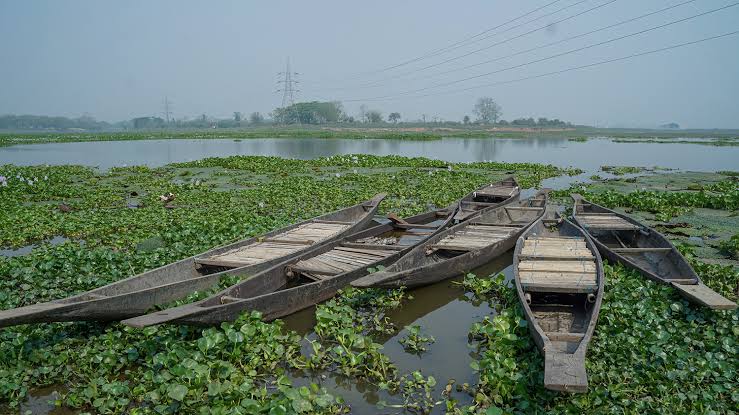
The Brahmaputra becomes comparatively narrow near Saraighat.
Large Mughal warships could not move freely in this section of the river.
Hills on Both Sides
The surrounding hills reduced the movement of Mughal cavalry.
This prevented the Mughals from using one of their greatest strengths.
Strong Defensive Position
The Ahoms built mud embankments and defensive walls around Guwahati.
These made it difficult for enemy forces to attack from land.
Familiar Geography
Ahom soldiers knew every part of the river, nearby forests, hills, and waterways.
This local knowledge gave them a huge advantage during military operations.
The Stage Was Set
By the end of 1669, both kingdoms had completed their preparations.
The Mughal Empire believed its massive army would easily defeat the Ahoms.
The Ahoms knew they were smaller in number, but they trusted their planning, courage, and leadership.
The Brahmaputra River, the hills of Guwahati, and the determination of the Assamese people were about to witness one of the greatest battles in Indian history.
The final confrontation at Saraighat would soon decide the future of Assam and determine whether the Mughal Empire could expand further into the northeast.
Ahoms Strengthen Their Hold on Guwahati
After recapturing Guwahati in 1667, the Ahom Kingdom knew that the Mughal Empire would soon try to take it back. Lachit Borphukan did not waste any time. He ordered his soldiers to strengthen the city’s defenses.
New mud embankments were built around Guwahati. Forts were repaired, and soldiers were placed at important locations on both sides of the Brahmaputra River. Watch posts were set up to observe enemy movements, and supply routes were secured to ensure food and weapons reached the army when needed.
Lachit also increased the number of war boats because he believed the final battle would be fought on the river.
Raja Ram Singh Begins His Campaign
When Emperor Aurangzeb learned that Guwahati had been recaptured by the Ahoms, he became determined to regain control.
He appointed Raja Ram Singh I of Amber, a respected Rajput commander and the son of the famous general Mirza Raja Jai Singh, to lead a fresh campaign against Assam.
Ram Singh left Delhi in late 1667 and reached eastern India after a long journey. Along the way, Aurangzeb strengthened his army by sending thousands of additional soldiers.
His army included:
- Large numbers of infantry
- Around 18,000 cavalry
- Rajput warriors
- Koch soldiers
- Archers and shield bearers
- Heavy artillery
- Around 40 warships
- Experienced Mughal officers
The Mughal army was one of the strongest military forces of its time.
Strategic Retreat to Guwahati
As Ram Singh’s army advanced, some Ahom forces fought delaying battles near the Manas River.
However, Lachit knew that fighting such a huge army in open land would be a mistake.
Instead of risking a major defeat, he ordered a planned retreat toward Guwahati.
This was not a sign of fear. It was a carefully planned military strategy.
The retreat forced the Mughal army to move deeper into the narrow river region where the Ahoms had already prepared strong defenses.
Delaying the Enemy Through Diplomacy
Lachit understood that every extra day would make the Ahom defenses stronger.
Therefore, he started diplomatic talks with Raja Ram Singh through captured Mughal officer Firuz Khan.
Letters were exchanged between the two sides.
While these discussions continued, Ahom soldiers quietly completed forts, repaired embankments, gathered supplies, and prepared their war boats.
Ram Singh believed negotiations might succeed, but Lachit was mainly using diplomacy to gain valuable time.
This clever planning became one of the reasons for the Ahom victory.
Continuous Small Battles
For many months, fighting continued around Guwahati.
Instead of one large battle, there were several smaller clashes.
Ahom soldiers attacked Mughal camps at unexpected times.
Small groups crossed rivers at night.
Some attacked supply lines.
Others destroyed enemy positions before disappearing into nearby forests and hills.
These surprise attacks made it difficult for the Mughal army to move freely.
The Mughals won some battles, while the Ahoms won others.
Neither side could gain complete control.
The Battle of Alaboi
One of the most important events before the Battle of Saraighat was the Battle of Alaboi, fought in 1669.
Raja Ram Singh became frustrated by the Ahoms’ repeated surprise attacks and defensive strategy.
He wanted a direct battle.
According to historical accounts, Ram Singh even challenged the Ahom king to settle the conflict through a duel.
The proposal was rejected because the Ahom king believed it was not suitable for a ruler to fight a military commander directly.
Soon after, a large battle took place near the Alaboi Hills.
During this battle, the Mughal cavalry proved very powerful in the open plains.
Thousands of Ahom soldiers lost their lives.
Many historians believe that nearly 10,000 Ahom soldiers were killed.
This was one of the biggest losses suffered by the Ahom Kingdom during the conflict.
Mughal Pressure Increases
After their success at Alaboi, the Mughal commanders became more confident.
Aurangzeb sent additional support to Ram Singh and instructed him to capture Guwahati as quickly as possible.
The Mughal army increased pressure from both land and river.
Large warships carrying cannons moved along the Brahmaputra.
Fresh troops reached Assam from Bengal.
Despite this growing pressure, the Ahoms refused to surrender.
Another Round of Negotiations
Realizing that the war was taking a long time, Raja Ram Singh again tried to negotiate.
He offered a settlement in which the Ahoms would give up Guwahati in return for money and peace.
Some Ahom officers felt that accepting the proposal might save lives.
However, senior commander Atan Burhagohain strongly opposed the idea.
He argued that once Guwahati was surrendered, the Mughals would eventually try to capture the rest of Assam.
His advice convinced the Ahom leadership.
The peace proposal was rejected.
The Ahoms decided to continue fighting.
The Final Mughal Attack
By early 1671, both sides knew that a decisive battle could no longer be avoided.
Ram Singh prepared his largest attack.
His forces moved along both banks of the Brahmaputra.
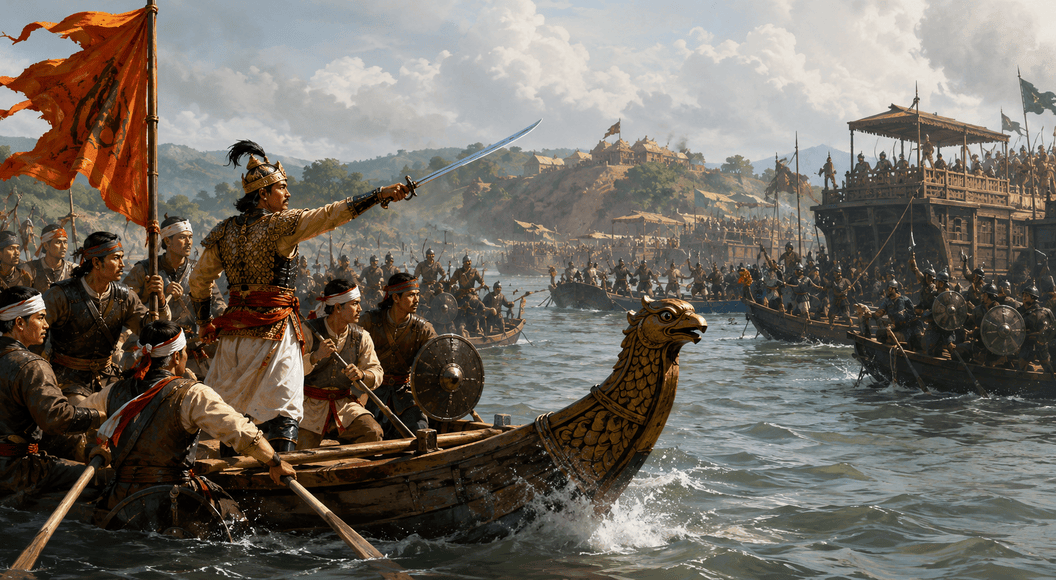
Large Mughal warships carrying cannons advanced through the river.
Their goal was simple to break the Ahom defenses, capture Guwahati, and restore Mughal rule in Assam.
At the same time, the Ahoms prepared for their greatest test.
A Difficult Situation for the Ahoms
Just before the final battle, the Ahoms faced a serious problem.
Lachit Borphukan became seriously ill.
His illness greatly affected the morale of the soldiers.
Many warriors feared that without their commander, defeating the Mughal army would be impossible.
As the Mughal fleet advanced, some Ahom boats even began to withdraw.
The situation became extremely dangerous.
Lachit Borphukan’s Courage
When Lachit learned that some soldiers were retreating, he refused to remain in bed.
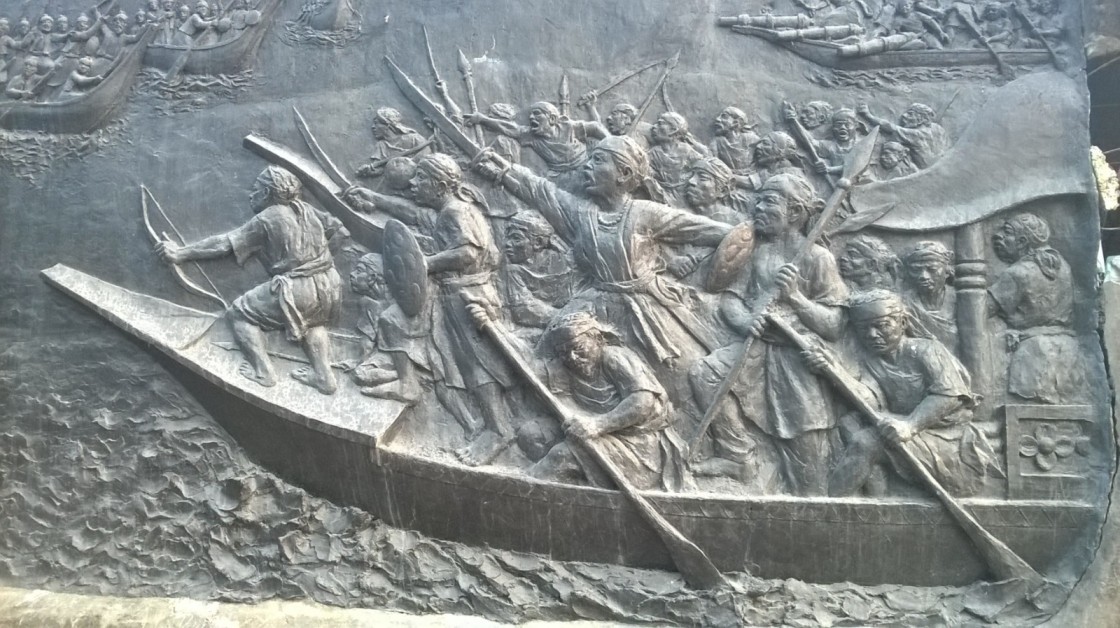
Although weak with illness, he ordered his men to carry him to a war boat.
According to tradition, he declared that the king had trusted him to protect Assam and that he would rather die fighting than return home in defeat.
His words inspired every soldier.
The sight of their commander leading the battle despite serious illness filled the Ahom army with new courage.
Warriors who had started retreating immediately turned back toward the battlefield.
The Naval Battle Begins
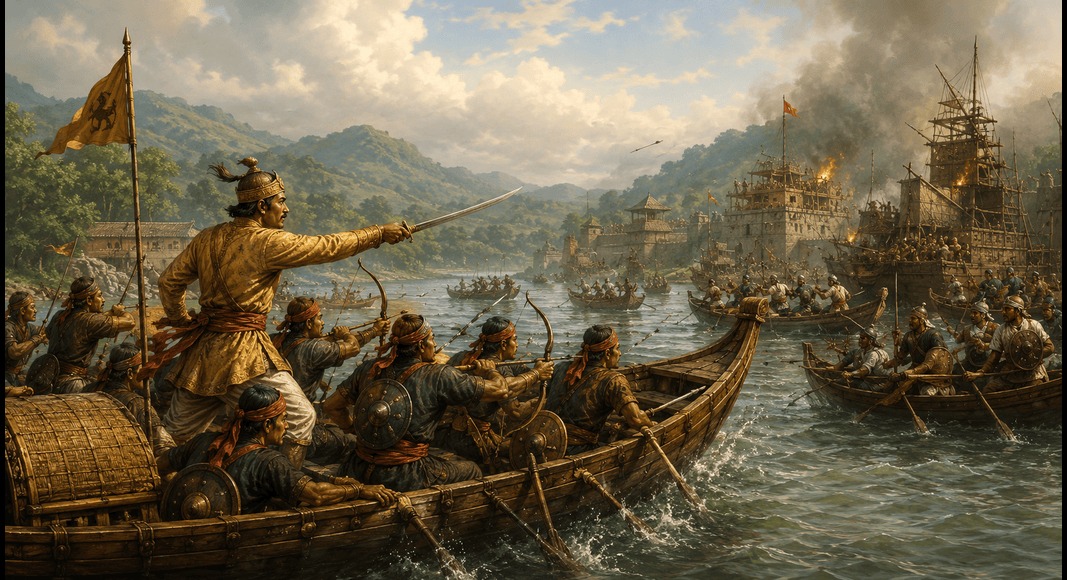
The final Battle of Saraighat was fought on the Brahmaputra River in March 1671.
This battle was very different from ordinary land battles.
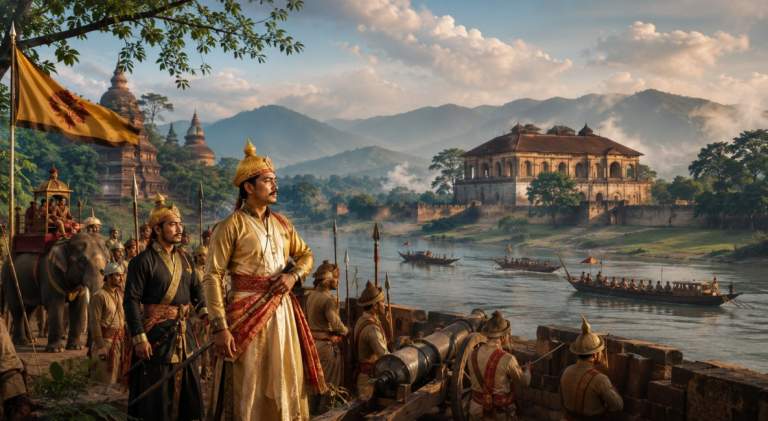
Instead of fighting mainly on open ground, most of the action took place on water.
The Mughal fleet depended on large warships carrying heavy cannons.
The Ahoms used many smaller and faster boats.
Their boats could move quickly through the narrow river channels.
This gave them a major advantage.
Clever Ahom Strategy
Lachit Borphukan did not allow the Mughal navy to fight comfortably.
Instead, the Ahom boats attacked from different directions.
Some attacked from the front.
Others came from the sides.
Several boats moved behind the Mughal fleet.
This created confusion among the Mughal commanders.
The narrow river prevented the larger Mughal ships from turning quickly.
Meanwhile, the smaller Ahom boats moved freely across the water.
The Ahoms also combined attacks from the river with attacks from the nearby hills and riverbanks.
The Mughal forces found themselves under pressure from every direction.
Death of Munnawar Khan
During the intense fighting, Mughal naval commander Munnawar Khan was killed.
His death created confusion inside the Mughal fleet.
Without strong leadership, coordination between the Mughal warships became difficult.
This gave the Ahoms an even greater advantage.
The Mughal attack gradually lost momentum.
Why the Ahoms Won the Battle
Although the Mughal army was much larger, several factors helped the Ahoms win.
Strong Leadership
Lachit Borphukan inspired every soldier through his bravery and determination.
Smart Planning
The Ahoms chose the battlefield carefully and forced the Mughals to fight where their cavalry was less useful.
Better Knowledge of the River
The Ahom navy understood every part of the Brahmaputra and used this knowledge effectively.
Fast War Boats
Smaller boats allowed the Ahoms to attack quickly and surround larger Mughal ships.
Teamwork
The Ahom commanders worked together and followed a common strategy throughout the battle.
High Morale
The determination to protect their homeland gave the Ahom soldiers great courage.
A Historic Victory
The Battle of Saraighat ended with a decisive Ahom victory.
The Mughal Empire failed in its final major attempt to conquer Assam.
The courage of Lachit Borphukan and the determination of the Ahom soldiers became part of Assam’s proud history.
Even today, the battle is remembered as one of the finest examples of leadership, planning, and patriotism in India.
The Battle of Saraighat ended in March 1671 with a major victory for the Ahom Kingdom. The Mughal army was forced to retreat towards the Manas River, which became the western boundary of the Ahom Kingdom once again. The victory protected Assam from Mughal expansion and became one of the greatest achievements in the history of the Ahom Kingdom.
Although the Ahoms celebrated their success, the war had caused heavy losses on both sides. Many brave soldiers lost their lives, villages had suffered damage, and resources had been used during years of fighting. Even after winning the battle, the Ahom rulers remained alert because they knew the Mughal Empire could launch another attack in the future.
Death of Lachit Borphukan
Only about a year after the great victory, Lachit Borphukan passed away in April 1672 at Kaliabor. Historical records suggest that he died due to illness, the same illness that had affected him during the Battle of Saraighat.
His death was a great loss for the Ahom Kingdom. He was not only a skilled military commander but also a wise leader who always placed his kingdom above his personal comfort.
Lachit Borphukan became a symbol of courage, discipline, sacrifice, and patriotism. His famous decision to lead the battle despite being seriously ill remains one of the greatest examples of leadership in Indian history.
Mughal Occupation of Guwahati
Although the Ahoms had won the Battle of Saraighat, the conflict with the Mughals was not completely over.
In 1679, Laluk Sola Borphukan, who succeeded Lachit as the Borphukan, handed over Guwahati to the Mughals. This allowed the Mughal Empire to regain control of the city for a short period.
However, Mughal control did not last long.
Battle of Itakhuli (1682)
In 1682, the Ahom Kingdom launched another military campaign under King Gadadhar Singha.
Ahom forces defeated the Mughal army in the Battle of Itakhuli and successfully recaptured Guwahati.
This victory permanently ended Mughal control over Kamrup and western Assam.
After this defeat, the Mughal Empire never made another major attempt to conquer the Ahom Kingdom.
The Ahoms continued to rule Assam until the early nineteenth century.
Why the Battle of Saraighat Was Important
The Battle of Saraighat was much more than a military victory. It changed the course of Assam’s history.
Protected Assam’s Independence
The battle prevented the Mughal Empire from expanding into the Brahmaputra Valley and protected the independence of the Ahom Kingdom.
Ended Major Mughal Expansion
Saraighat became the last major Mughal attempt to conquer Assam. After their defeat, Mughal influence in the region became weaker.
Proved the Power of Strategy
The battle showed that smart planning, local knowledge, and leadership could defeat a much larger army.
Strengthened Assamese Identity
The victory became a source of pride for the people of Assam and remains an important part of the state’s cultural identity.
Important Leaders of the Battle
Ahom Kingdom
- Lachit Borphukan – Commander of the Ahom army and hero of the battle.
- King Chakradhwaj Singha – Planned the recovery of Guwahati and appointed Lachit as commander.
- King Udayaditya Singha – Continued supporting the war after Chakradhwaj Singha’s death.
- Atan Burhagohain – Senior Ahom commander who opposed surrender and supported continued resistance.
Mughal Empire
- Aurangzeb – Mughal Emperor who ordered the campaign.
- Raja Ram Singh I – Commander of the Mughal army.
- Mir Jumla – Earlier Mughal general whose invasion led to the conflict.
- Munnawar Khan – Mughal naval commander who was killed during the final battle.
Timeline of the Battle of Saraighat
1662 – Mir Jumla invaded the Ahom Kingdom.
1663 – Treaty of Ghilajharighat signed after the Ahom defeat.
1663 – Chakradhwaj Singha became king and started rebuilding the kingdom.
1667 – Lachit Borphukan recaptured Guwahati from the Mughals.
1669 – Battle of Alaboi took place, causing heavy Ahom losses.
1671 – Battle of Saraighat ended with a decisive Ahom victory.
1672 – Lachit Borphukan passed away at Kaliabor.
1679 – Guwahati briefly came under Mughal control again.
1682 – Battle of Itakhuli restored Guwahati permanently to the Ahom Kingdom.
Interesting Facts About the Battle of Saraighat
- The Battle of Saraighat was mainly a naval battle fought on the Brahmaputra River.
- The Ahom army was much smaller than the Mughal army.
- Lachit Borphukan led the final battle despite being seriously ill.
- The Mughal Empire failed in its last major attempt to conquer Assam.
- The Brahmaputra River played a major role in deciding the outcome of the battle.
- The Ahoms used many small, fast boats against larger Mughal warships.
- The victory is considered one of the greatest achievements in Assamese history.
- Lachit Borphukan is remembered as one of India’s finest military leaders.
Legacy of Lachit Borphukan
Lachit Borphukan’s legacy continues to inspire people across India.
Every year, Lachit Divas is celebrated on 24 November, his birth anniversary, especially in Assam. Schools, colleges, government offices, and cultural organizations organize events to remember his bravery and leadership.
The National Defence Academy (NDA) also honors him by awarding the Lachit Borphukan Gold Medal to the best cadet, recognizing qualities such as leadership, courage, and discipline.
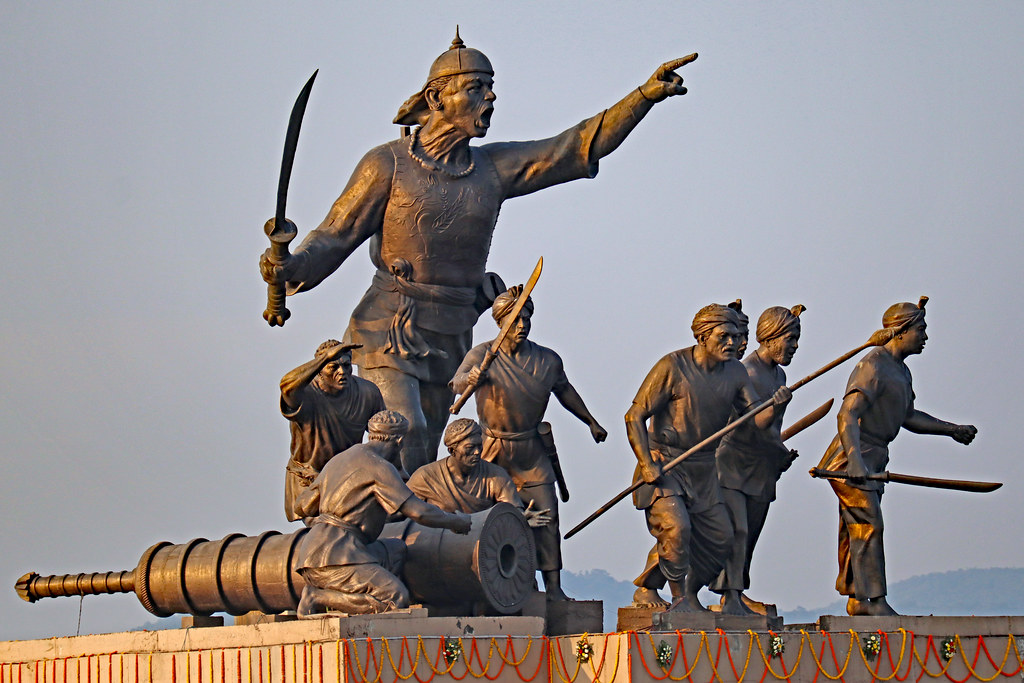
His statue stands proudly in several parts of Assam, and his story is taught to students as an example of dedication and patriotism.
Battle of Saraighat in Modern India
Today, the Battle of Saraighat is remembered as one of India’s greatest military victories.
Historians study the battle because it demonstrates how geography, planning, intelligence, and leadership can be more important than the size of an army.
For the people of Assam, the battle represents courage, unity, and the determination to protect their homeland.
It also reminds future generations that strong leadership and careful planning can overcome even the biggest challenges.
Conclusion
The Battle of Saraighat remains one of the most remarkable victories in Indian history. Fought in 1671 on the Brahmaputra River, it proved that courage, intelligence, and strong leadership can defeat even the most powerful armies. Under the leadership of Lachit Borphukan, the Ahom Kingdom successfully defended Assam against the Mughal Empire and protected its independence.
Although the Ahoms faced many hardships before and after the battle, their determination never faded. The later victory at the Battle of Itakhuli finally ended Mughal control in the region and secured the future of the Ahom Kingdom.
More than three centuries later, the Battle of Saraighat continues to inspire people with its message of bravery, unity, sacrifice, and love for one’s homeland.
FAQs
1. What was the Battle of Saraighat?
The Battle of Saraighat was a naval battle fought in March 1671 between the Ahom Kingdom and the Mughal Empire on the Brahmaputra River near Guwahati.
2. Who led the Ahom army?
The Ahom army was led by the famous commander Lachit Borphukan.
3. Who commanded the Mughal army?
The Mughal army was commanded by Raja Ram Singh I of Amber.
4. Who was the Mughal Emperor during the battle?
The Mughal Emperor was Aurangzeb.
5. Why was the Battle of Saraighat important?
It stopped the Mughal Empire from expanding into Assam and protected the independence of the Ahom Kingdom.
6. Why did the Ahoms win the battle?
The Ahoms won because of excellent leadership, smart military planning, local knowledge, strong naval tactics, and high morale.
7. When did Lachit Borphukan die?
He died in April 1672, about one year after the Battle of Saraighat.
8. What happened after the battle?
The Mughals retreated, but they briefly regained Guwahati in 1679 before the Ahoms permanently recovered it in the Battle of Itakhuli in 1682.
9. Why is Lachit Borphukan remembered today?
He is remembered for his courage, patriotism, leadership, and sacrifice in defending Assam.
10. What is the biggest lesson from the Battle of Saraighat?
The battle teaches that intelligence, planning, and determination can overcome a stronger enemy.