




2026 ED138: New Dwarf Planet Candidate

2026 ED138 is a newly identified icy object located beyond Pluto in the outer Solar System. Scientists using data from the Vera C. Rubin Observatory in Chile have identified it as a possible dwarf planet. The International Astronomical Union’s Minor Planet Center announced the discovery on 27 October 2026. Early estimates suggest that the object may be between 600 and 1,500 kilometres wide. However, researchers need more observations before confirming whether it qualifies as a dwarf planet.
How Was 2026 ED138 Discovered?
Astrophysicist Matthew Holman from the Center for Astrophysics | Harvard & Smithsonian identified 2026 ED138 while examining data collected by the Vera C. Rubin Observatory in 2026. He used computer software designed to find moving objects among billions of detections in the night sky.

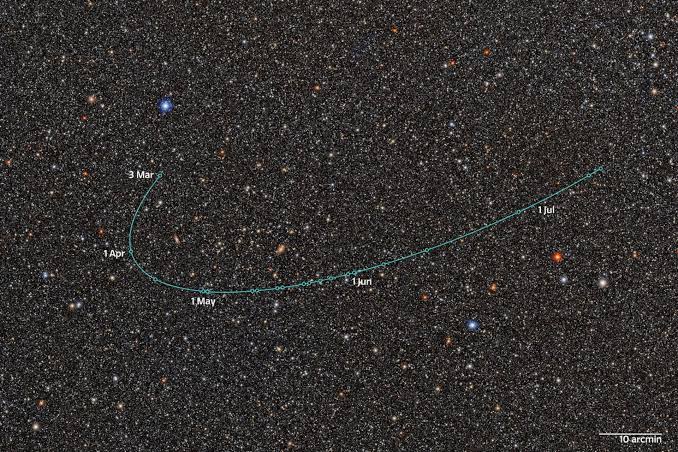
The research team then searched for earlier images of the same object. Scientists found additional observations in the observatory’s records, along with older images captured by other surveys. Some of these images date back to 2016, helping researchers study the object’s movement over more than a decade.
The discovery is notable because 2026 ED138 appeared in a crowded region of the sky near the Milky Way. Millions of stars in this area made the distant object difficult to identify in earlier observations. The Rubin Observatory’s powerful camera and advanced data-processing methods helped scientists detect its movement.
Where Is 2026 ED138 Located?
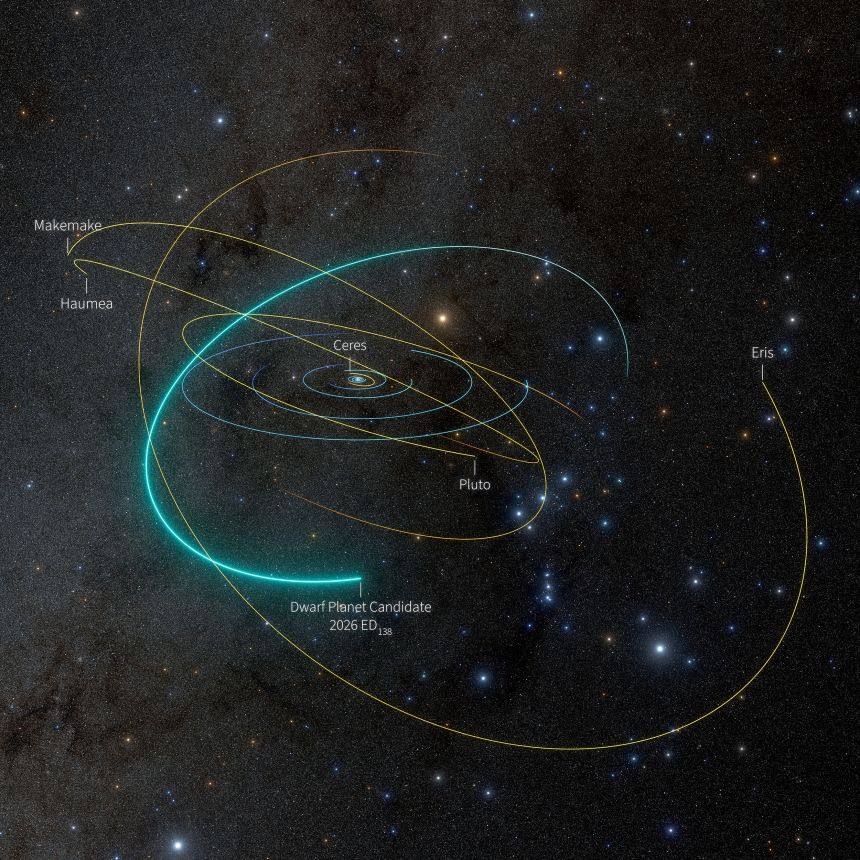
2026 ED138 is found in the outer part of the Solar System, beyond Neptune and Pluto. It is currently about 46 astronomical units (AU) from the Sun. One astronomical unit is the average distance between Earth and the Sun, approximately 150 million kilometres.
For comparison, Pluto orbits the Sun at an average distance of about 39.5 AU. The location of 2026 ED138 places it among objects known as trans-Neptunian objects, which orbit the Sun beyond Neptune.
The object’s orbit is also tilted by about 24 degrees relative to the main plane of the Solar System. Scientists study such orbital features to understand how distant objects formed and how the gravitational influence of planets, including Neptune, may have changed their paths over time.
How Big Is the New Object?
Early estimates place the diameter of 2026 ED138 between 600 and 1,500 kilometres. This wide range reflects uncertainty about how much sunlight its surface reflects. A brighter object can appear large even when it reflects more light, while a darker object may need to be larger to appear equally bright.
Researchers need additional observations, especially at infrared wavelengths, to estimate its actual size more accurately. These observations can help scientists measure the heat emitted by the object and better understand its physical properties.
If the estimates are confirmed, 2026 ED138 could be among the largest known dwarf planet candidates beyond Neptune.
Why Is It Only a Dwarf Planet Candidate?
Finding a large object does not automatically make it a dwarf planet. According to the International Astronomical Union, a dwarf planet must orbit the Sun, have enough mass for its gravity to make it nearly round, have not cleared other objects from its orbital neighbourhood, and not be a moon.
Scientists believe 2026 ED138 may be large enough for its gravity to give it a rounded shape. However, its exact size and physical characteristics are not yet fully known. Further research is needed before its classification can be confirmed.
The name 2026 ED138 is a provisional designation. It identifies the object while astronomers continue to study it; it does not mean that the object has already been officially recognised as a dwarf planet.
Which Dwarf Planets Are Currently Recognised?
The International Astronomical Union recognises five dwarf planets in the Solar System: Ceres, Pluto, Haumea, Makemake and Eris.
Ceres lies in the asteroid belt between Mars and Jupiter. The other four are located in the distant outer Solar System. Pluto was reclassified as a dwarf planet in 2006 after the International Astronomical Union introduced its formal definition of a planet.
If scientists confirm the status of 2026 ED138, it could become the sixth officially recognised dwarf planet.
What Does This Discovery Mean for Space Research?
The discovery shows how modern telescopes and computer technology are improving our understanding of the Solar System. The Vera C. Rubin Observatory is designed to repeatedly survey the southern sky over a period of ten years. Its observations are expected to help researchers identify many more asteroids and distant icy objects.
Studying objects such as 2026 ED138 can provide clues about the early Solar System, the movement of planets and the conditions in which small icy bodies formed. Scientists can also compare its orbit and physical features with those of other trans-Neptunian objects.
Further observations will help determine the object’s size, surface properties and possible dwarf planet status. Until those studies are complete, 2026 ED138 remains a promising candidate rather than a confirmed member of the Solar System’s dwarf planet group.