



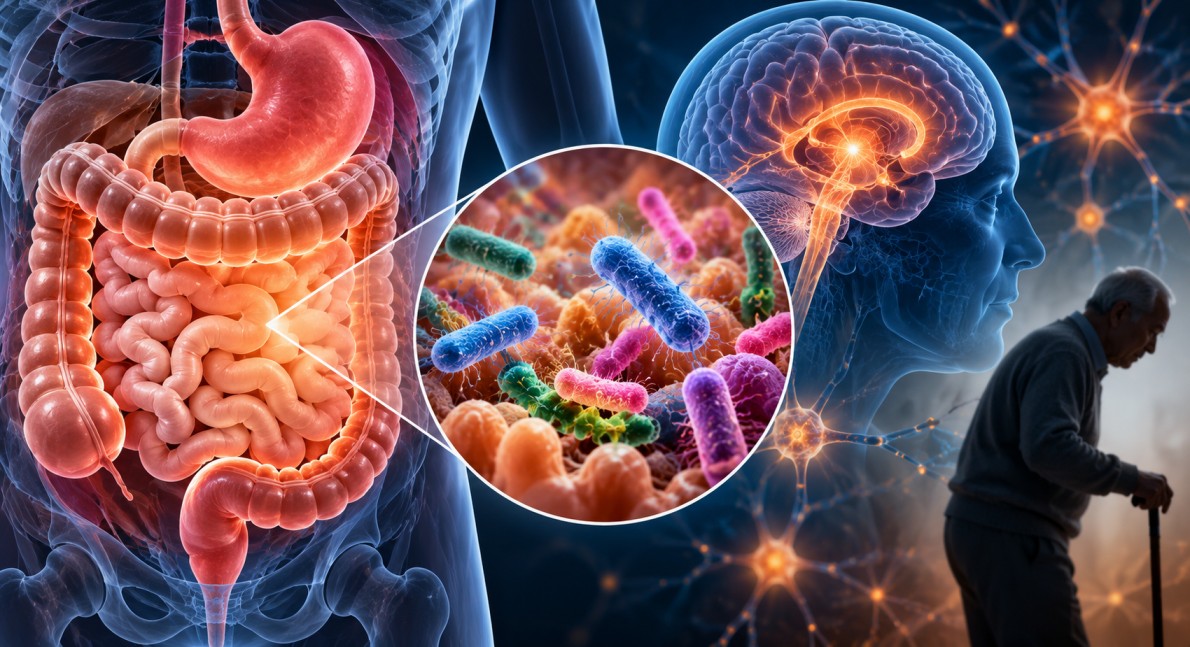
Gut Bacteria: Parkinson’s Study in Kerala

Gut Bacteria may help scientists better understand Parkinson’s disease, according to a new study involving researchers from the Cochin University of Science and Technology (CUSAT) and the Sree Chitra Tirunal Institute for Medical Sciences and Technology (SCTIMST). The research examined people with Parkinson’s disease in Kerala and found differences in their gut bacteria compared with healthy individuals. The findings were published in the scientific journal npj Parkinson’s Disease in October 2026. The study adds to growing research on the possible connection between the digestive system, inflammation and brain health.
What Did the Researchers Find?
The researchers identified differences in the types and amounts of bacteria found in the gut of people with Parkinson’s disease. Some bacterial groups linked to inflammatory processes were more common, while several groups associated with anti-inflammatory activity were less common.

The study reported higher levels of bacteria from groups including Escherichia-Shigella and Collinsella. It also found lower levels of certain bacteria, including Bacteroides, Lachnospira and Agathobacter.
These findings suggest that the gut microbiome may be different in people living with Parkinson’s disease. However, the results do not prove that the bacterial changes cause the condition. Further studies are needed to understand how these differences develop and whether they influence the disease.
What Is the Gut Microbiome?
The gut microbiome is the community of microorganisms living in the digestive system. It includes bacteria and other tiny organisms that interact with food, the gut lining and the body’s immune system.
Many gut bacteria help break down dietary fibre that the human body cannot fully digest on its own. During this process, they produce substances that support different functions in the body.
One important group of substances is short-chain fatty acids. These include acetate, propionate and butyrate. They are produced when gut bacteria ferment certain types of fibre and can help maintain the gut lining and regulate immune activity.
Changes in the gut microbiome may affect these processes. Researchers are studying whether such changes are connected with inflammation and conditions that affect the brain, including Parkinson’s disease.
How Is the Gut Connected to the Brain?
Scientists are investigating the gut-brain connection, a communication network between the digestive system and the nervous system. The gut and brain communicate through several pathways, including nerve signals, immune responses and chemical messengers.
The CUSAT-SCTIMST research also identified differences in predicted microbial functions related to dopamine, glutamate and gamma-aminobutyric acid, commonly known as GABA. These chemical messengers help regulate movement and other brain functions.
Parkinson’s disease is a progressive neurological condition associated with the loss of dopamine-producing nerve cells. Dopamine plays an important role in controlling movement. People with the condition may experience tremors, muscle stiffness, slower movements and difficulties with balance.
The researchers’ findings suggest that gut bacteria and their possible metabolic activities deserve further investigation. However, changes in microbial functions do not establish that gut bacteria directly cause the loss of dopamine-producing cells.
Why Is This Study Important for India?
Gut microbiome research often involves people from different countries and populations. The composition of gut bacteria can vary with diet, age, lifestyle, genetics and other environmental factors. Findings from one population may not always apply in the same way to another.
The study of patients from Kerala provides information about gut bacteria in an Indian population. It also brings together microbiome analysis and the study of possible microbial functions, helping researchers explore how bacterial communities may relate to the condition.
The research received support from the Indian Council of Medical Research (ICMR). Scientists involved in the project include researchers from CUSAT and SCTIMST, which contributed expertise in microbiology, neuroscience and clinical research.
Could Gut Bacteria Help With Future Diagnosis or Treatment?
Researchers hope that understanding gut bacteria may eventually support the development of new ways to study Parkinson’s disease. Certain microbial patterns could be investigated as possible markers of the condition, while future research may examine whether changing the gut microbiome can improve health outcomes.
However, these possibilities remain under investigation. The study does not establish a reliable diagnostic test based on gut bacteria, nor does it show that changing a person’s microbiome can prevent or cure Parkinson’s disease.
More research involving larger and more diverse groups of people will be needed to confirm the findings. Scientists will also need to separate the effects of the disease from other factors, such as diet, medication and lifestyle, that can influence gut bacteria.
The study adds to an expanding field of research exploring how the digestive system and brain may interact. By examining both bacterial composition and predicted microbial functions, the researchers have provided new information that can guide further studies into Parkinson’s disease.