Adi Karmayogi: Transforming Tribal Villages Through Change Leadership

Adi Karmayogi is a pioneering initiative launched in 2025 to create a cadre of 20 lakh change leaders across tribal villages in India. Spearheaded by the Ministry of Tribal Affairs, the programme operates under the Dharti Aba Janjatiya Gram Utkarsh Abhiyaan and is designed to strengthen last-mile delivery of welfare schemes. By combining participatory training, emotional learning, and grassroots-level vision building, Adi Karmayogi represents a bold attempt to reshape governance and empower tribal communities.
Thank you for reading this post, don't forget to subscribe!Background and Purpose
India’s tribal regions have long struggled with developmental gaps. Contrary to popular belief, the challenge is not the absence of schemes but the lack of effective implementation and motivation among officials and community workers. The Adi Karmayogi initiative emerged from a national workshop where experts highlighted this gap. Instead of focusing on shortcomings, the programme encourages optimism, motivation, and solution-driven approaches.
The purpose of this effort is to empower tribal communities to take ownership of their development, while also motivating officials to deliver schemes with sincerity and enthusiasm. It aligns with the government’s broader push to build trust and participatory governance in rural areas.
Training Structure and Coverage
The Adi Karmayogi programme has been designed as a cascade model of training to ensure maximum reach. It plans to train:
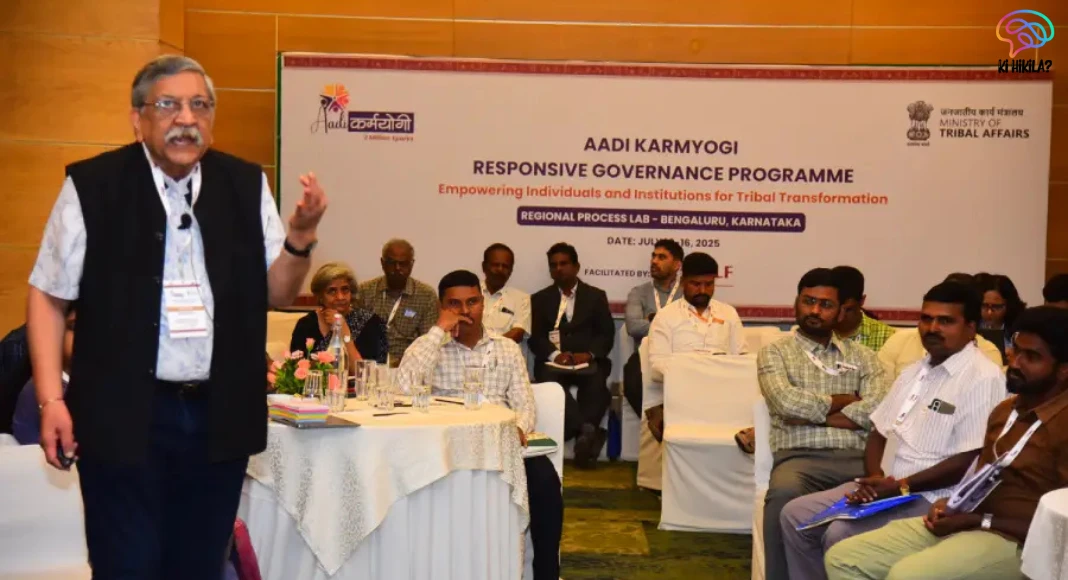
- 240 State-level master trainers
- 2,750 district trainers
- 15,000 block trainers
These trainers will then reach the grassroots, equipping 20 lakh village-level officials, volunteers, and community leaders with leadership and problem-solving skills. Currently, State and district-level training is underway, with village-level training soon to spread across 324 districts.
This hierarchical yet participatory structure ensures not only scalability but also sustainability, as trained individuals will continue to mentor others in their communities.
Participatory Training Activities
The uniqueness of the Adi Karmayogi initiative lies in its interactive and symbolic training methods. Activities are designed to inspire confidence, teamwork, and creativity among participants. Examples include:
- Lighting candles: Symbolising the idea of spreading light instead of cursing darkness.
- Role-plays: Simulating real-life village scenarios, such as solving water scarcity or resolving conflicts.
- Fish bowl exercise: Encouraging open dialogue and mutual understanding.
- Knot-tying and human knot activities: Demonstrating problem-solving, teamwork, and the idea that solutions lie within the group itself.
These exercises not only engage participants but also instill a sense of ownership and optimism about change.
Village Vision and Aspirational Blueprints
One of the most innovative aspects of Adi Karmayogi is the creation of Village Vision 2030 documents. Each of the targeted one lakh villages will prepare its vision for the future, outlining goals in education, healthcare, infrastructure, and livelihood.
To make these visions visible and accessible, they will be displayed as public murals within villages. These aspirational blueprints will not only guide government actions but also empower communities to track progress and hold officials accountable.
This approach ensures that development is not imposed from above but grows out of the aspirations of the people themselves.
Adi Seva Kendras and Scheme Access
To strengthen last-mile delivery, one lakh Adi Seva Kendras will be established. These centres will act as single-window access points for all welfare schemes, from education and health benefits to livelihood support and digital services.
The aim is 100% saturation of scheme delivery, eliminating bureaucratic delays and ensuring that every eligible family in tribal areas receives their rightful benefits. This will improve transparency, reduce corruption, and bring governance closer to the people.
Creating Safe Spaces and Emotional Learning
Another hallmark of Adi Karmayogi is its emphasis on emotional intelligence and safe spaces. The programme encourages the creation of muttram-like spaces within villages—open forums where community members can share thoughts, emotions, and ideas without fear of hierarchy or judgment.
The training recognises different learning styles—activist, reflector, theorist, and pragmatist—to ensure that participants remain engaged and motivated. Additionally, innovative tools like emoji cues are used to help individuals identify and express emotions, thereby fostering empathy and emotional intelligence.
Significance and Long-term Impact
The Adi Karmayogi initiative is much more than a training programme. It represents a paradigm shift in how governance and development are approached in tribal India. By focusing on motivation, emotional learning, and participatory problem-solving, it addresses the root causes of ineffective implementation.
In the long term, the creation of 20 lakh change leaders could transform governance at the grassroots. Villages will no longer wait passively for schemes but will actively shape their own futures, guided by their Vision 2030 blueprints. Officials, too, will approach their work with renewed motivation and accountability.
Conclusion
The launch of Adi Karmayogi in 2025 marks a milestone in India’s efforts to bridge the gap between policy and practice in tribal development. By blending motivation, emotional learning, participatory exercises, and grassroots vision-building, the programme lays the foundation for inclusive and sustainable growth in tribal regions.
As the initiative progresses, its true success will lie not only in improved scheme delivery but also in the empowerment of tribal communities to become architects of their own destiny.