



AIIMS AI Mental Health Programme: A Revolutionary Step Toward Student Well-being

The AIIMS AI Mental Health Programme marks a significant milestone in India’s public health and education sectors. The All India Institute of Medical Sciences (AIIMS), New Delhi, introduced this Artificial Intelligence (AI)-based initiative called “Never Alone” in 2025. The programme was launched on World Suicide Prevention Day to address the rising concern of student suicides and promote mental health awareness nationwide. Through an innovative blend of technology and compassionate care, the initiative offers round-the-clock virtual and offline consultations via a web-based platform accessible on WhatsApp. Its primary goal is to provide affordable, personalised, and secure mental health screening for students across India.
Thank you for reading this post, don't forget to subscribe!AIIMS AI Mental Health Programme: Background and Urgency
India is currently grappling with an escalating mental health crisis. According to the National Crime Records Bureau (NCRB), over 1.7 lakh suicides were reported in 2022, marking the highest in more than five decades. Young adults aged between 18 and 30 years accounted for nearly 35 per cent of these deaths. Suicide has emerged as a major public health issue globally, with the World Health Organization (WHO) reporting one suicide every 45 seconds worldwide. Low- and middle-income countries, including India, bear 73 per cent of the global suicide burden.
In India, mental health challenges are further intensified by stigma, lack of awareness, and limited access to professional help. Studies indicate that 70 to 80 per cent of individuals with mental health issues do not seek treatment due to fear, financial barriers, or societal judgment. The AIIMS AI Mental Health Programme aims to bridge this vast treatment gap by providing students with accessible, stigma-free, and affordable mental health support.
AIIMS AI Mental Health Programme: Features of the “Never Alone” Initiative
The Never Alone programme introduces several cutting-edge features designed to ensure maximum accessibility, affordability, and confidentiality. One of its most notable aspects is its affordable pricing model, costing only 70 paise per student per day for institutions with over 5,000 students. This low-cost approach makes large-scale implementation feasible, even for government and semi-urban institutions.
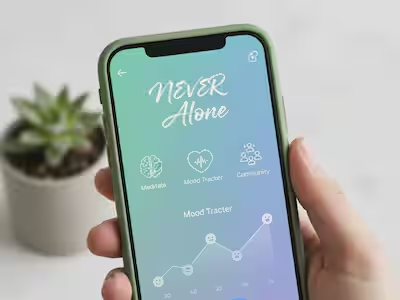
The service is accessible through WhatsApp, allowing students to connect instantly with mental health professionals. The AI-powered system enables personalised screening, early intervention, and post-intervention follow-up, ensuring continuous care and timely support.
The programme also emphasizes security and privacy, which are crucial when dealing with sensitive mental health data. Currently, it is operational at AIIMS Delhi, AIIMS Bhubaneswar, and the Institute of Human Behaviour and Allied Sciences (IHBAS), Shahdara. Plans are underway to expand this service across other AIIMS campuses and universities nationwide.
AIIMS AI Mental Health Programme: Implementation and Institutional Support
Implementation of the AIIMS AI Mental Health Programme involves a collaborative approach between educational institutions and AIIMS Delhi. Schools, colleges, and universities can subscribe to the programme by formally partnering with AIIMS. Once registered, institutions can provide their students with immediate access to Never Alone’s mental health platform.
Notably, all AIIMS institutions across India will receive the programme free of cost through the Global Centre of Integrative Health (GCIH). This non-profit initiative, supported by AIIMS alumnus Dr. Deepak Chopra, focuses on promoting integrative health and holistic well-being. GCIH’s involvement ensures the scalability and long-term sustainability of the project.
The integration of AI-driven assessments with human counseling creates a hybrid model that combines technological precision with emotional empathy an approach that could redefine mental health care delivery in India.
AIIMS AI Mental Health Programme: Tackling Stigma and Treatment Gaps
A major obstacle in India’s mental health care system is stigma the fear of being judged or discriminated against prevents many from seeking help. The AIIMS AI Mental Health Programme directly addresses this by offering anonymous and confidential consultations. The easy accessibility through WhatsApp ensures that students can seek support discreetly, without societal pressure.
The programme’s AI interface also identifies behavioral patterns and potential red flags based on responses and engagement levels. By doing so, it can prompt timely interventions and connect users with mental health professionals before situations worsen.
Moreover, Never Alone works toward normalising mental health discussions within educational settings. By incorporating awareness campaigns and mental health workshops, it fosters a supportive environment where students feel comfortable acknowledging their struggles and reaching out for help.
AIIMS AI Mental Health Programme: A New Public Health Approach
This initiative signifies a shift from the traditional, reactive model of mental health care to a preventive and proactive approach. The AIIMS AI Mental Health Programme aligns with India’s broader public health goals of reducing suicide rates and enhancing psychological well-being among youth.
In addition to offering individual counseling, the programme promotes institutional resilience by training educators and staff to identify early signs of mental distress. This collaborative structure ensures that the entire academic ecosystem becomes more empathetic and responsive to students’ emotional needs.

The initiative also advocates for an increase in the number of trained mental health professionals, which remains disproportionately low in India compared to global standards. By combining technology with human expertise, AIIMS aims to make mental health services more inclusive and far-reaching.
AIIMS AI Mental Health Programme: Impact and Future Prospects
The impact of the AIIMS AI Mental Health Programme is expected to be transformative, especially among students in higher education. The college and university demographic is one of the most vulnerable groups in India when it comes to stress, anxiety, and suicide. By integrating AI tools and real-time human interaction, the programme ensures early detection, quick response, and continuous emotional support.
The affordability of the model makes it a viable solution for both government and private educational institutions. If implemented nationwide, the initiative could revolutionize student mental health infrastructure by creating an ecosystem of care that is proactive, compassionate, and technology-driven.
As AI continues to evolve, future updates to the Never Alone platform could include predictive analytics, chat-based emotional monitoring, and integration with academic support systems. With AIIMS leading this innovation, India stands at the forefront of merging mental health care and artificial intelligence to create a healthier, more resilient youth population.