Amrita CSIR NIScPR MoU Boosts Research Collaboration

Amrita CSIR NIScPR MoU marks an important step in strengthening India’s research and innovation ecosystem. Amrita Vishwa Vidyapeetham has signed a Memorandum of Understanding with the CSIR–National Institute of Science Communication and Policy Research (CSIR–NIScPR) to expand cooperation in research, science communication and science-based policy work. The agreement was formalised during a two-day national workshop supported by NITI Aayog, highlighting the growing role of universities in addressing real-world challenges through research and innovation.
Thank you for reading this post, don't forget to subscribe!The partnership reflects a broader national push to connect academic research with governance, public welfare and development planning. By working together, the two institutions aim to ensure that scientific knowledge reaches policymakers and communities in meaningful ways.
Amrita CSIR NIScPR MoU Focuses on Practical Research Outcomes
A key goal of the Amrita CSIR NIScPR MoU is to promote applied and policy-focused research. Rather than limiting studies to academic discussions, the collaboration seeks to turn research findings into useful tools for decision-makers. Joint research programmes, policy studies and capacity-building initiatives will be developed to support this aim.
The agreement also places strong emphasis on science communication. Making scientific information simple, clear and accessible is essential for public understanding and trust. Through this partnership, both institutions plan to improve how research insights are shared with government bodies, industries and citizens.
Amrita CSIR NIScPR MoU Aligns Research With National Priorities
The MoU aligns closely with India’s development goals. It supports the idea that research should contribute directly to solving social and economic problems. Areas such as public health, sustainability, education, digital development and technology-driven solutions are expected to benefit from this collaboration.
By linking research activities to national priorities, the partnership ensures that scientific efforts remain relevant and impactful. This approach helps bridge the gap between academic knowledge and practical application, benefiting communities across the country.
Amrita CSIR NIScPR MoU Highlighted at NITI Aayog Workshop
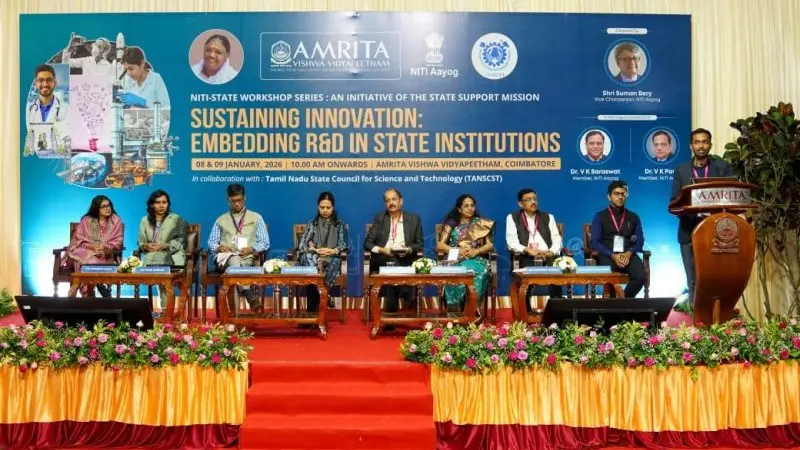
The signing of the MoU took place during a national workshop titled “Sustaining Innovation: Embedding R&D in State Institutions.” The event brought together policymakers, scientists, academic leaders and research professionals from across India.
The workshop focused on building strong innovation systems at the state level. Discussions explored ways to improve institutional capacity, encourage collaboration between universities and government bodies, and create long-term research frameworks that support economic growth and social progress.
Amrita CSIR NIScPR MoU and the Role of Technology in Society
Addressing the gathering, Suman Bery, Vice Chairman of NITI Aayog, stressed the importance of using technology to solve everyday problems. He highlighted that Amrita Vishwa Vidyapeetham has consistently linked its research efforts to real-life challenges faced by citizens.
He also referred to the national vision that many social issues can be addressed through thoughtful and responsible use of technology. Research institutions, he noted, must focus on creating solutions that improve quality of life, strengthen public services and support inclusive development.
Amrita CSIR NIScPR MoU Strengthens State-Level Innovation
The workshop underlined the need for strong state-level innovation ecosystems. Participants discussed how states can play a larger role in supporting research, encouraging innovation and connecting local needs with scientific solutions.
Collaboration between universities, research organisations and state governments was identified as a key factor in building resilient innovation systems. The Amrita CSIR NIScPR MoU fits well within this framework, offering a model for how academic and research institutions can work together effectively.
Amrita CSIR NIScPR MoU and Tamil Nadu’s Innovation Leadership

The event was organised in collaboration with Amrita Vishwa Vidyapeetham and the Tamil Nadu State Council for Science and Technology. During the discussions, Prof. Dr S. Vincent, Member Secretary of the Council, highlighted Tamil Nadu’s strong performance in innovation and intellectual property development.
The state records nearly 5,000 to 6,000 patent filings each year, placing it among India’s leading innovation hubs. He acknowledged Amrita’s role in contributing to this achievement through research, technology development and support for geographical indication (GI) products.
The state government has also expressed continued support for research-driven initiatives, especially those that promote local industries, traditional knowledge and region-specific innovations.
Amrita CSIR NIScPR MoU and Future Research Collaboration
The partnership between Amrita Vishwa Vidyapeetham and CSIR–NIScPR opens new opportunities for long-term collaboration. Joint training programmes, shared research resources and collaborative policy studies are expected to enhance the quality and reach of research activities.
By combining academic expertise with policy research and communication skills, the MoU creates a strong platform for impactful research. It also reflects a shift toward inclusive and solution-oriented innovation, where research institutions play a central role in shaping India’s future development path.