


Gaganyaan Mission Hits Key Milestones

Gaganyaan Mission has reached several important milestones as India moves closer to its first human spaceflight. The Indian Space Research Organisation (ISRO) has completed major development, testing and validation work for systems designed to keep astronauts safe during the mission. The progress was shared in Parliament on August 6, 2026, as India continues preparations for the next stages of its ambitious human spaceflight programme.
Thank you for reading this post, don't forget to subscribe!The programme involves testing the launch vehicle, crew module, life-support systems, escape systems and other technologies needed to safely send astronauts into space and bring them back to Earth.
Gaganyaan Mission Moves Closer to Human Spaceflight
The Gaganyaan Mission is India’s first programme aimed at sending humans into low Earth orbit and safely returning them to Earth. The mission is being developed by ISRO with a strong focus on crew safety and system reliability.
A major part of the programme is the Human Rated Launch Vehicle Mark-3 (HLVM3). It is based on India’s LVM3 rocket but has been modified and tested to meet the much higher safety requirements needed for human spaceflight.
Human-rating means that the launch vehicle and spacecraft must meet strict standards before they can carry astronauts. Systems need to be tested under different conditions, while important functions must have backup options to reduce risks during a mission.
Major Propulsion and Structural Tests Completed
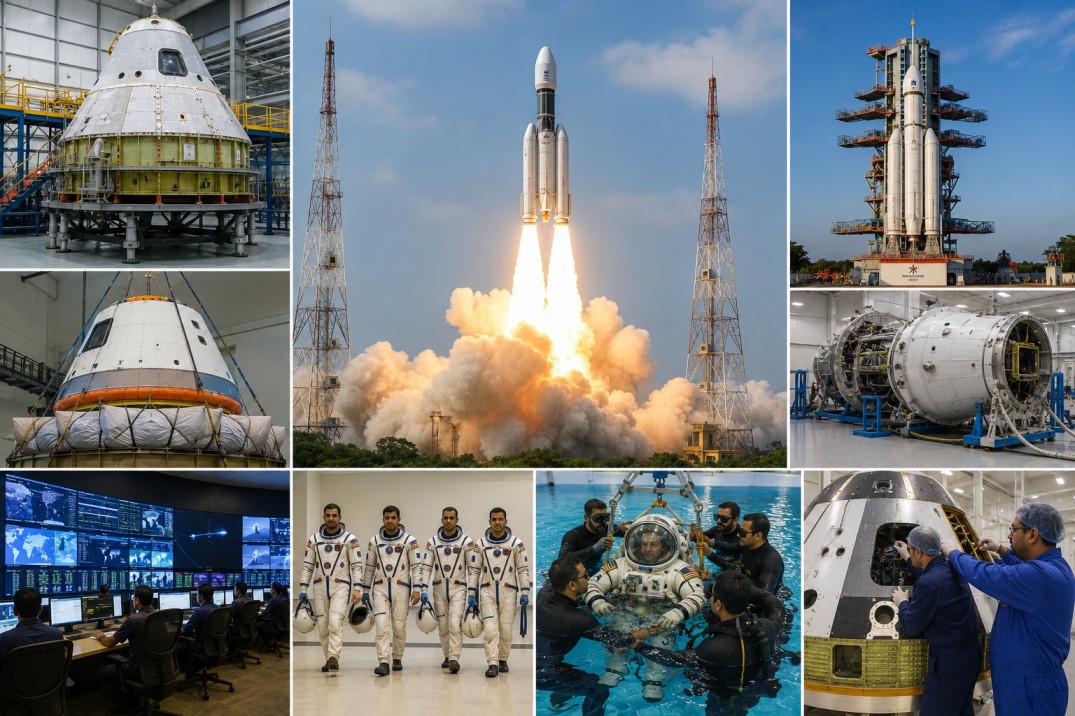
ISRO has completed important testing of the propulsion systems and structures associated with the HLVM3. The propulsion systems for both the Crew Module and Service Module have also undergone development and qualification tests.
These systems are critical because the spacecraft needs controlled propulsion during different stages of the mission. The launch vehicle must provide the required power to reach orbit, while the spacecraft needs reliable systems for movement and operations in space.
Structural testing is equally important because the spacecraft and launch vehicle must withstand strong forces and vibrations during liftoff and the journey into space.
Life Support and Crew Safety Systems
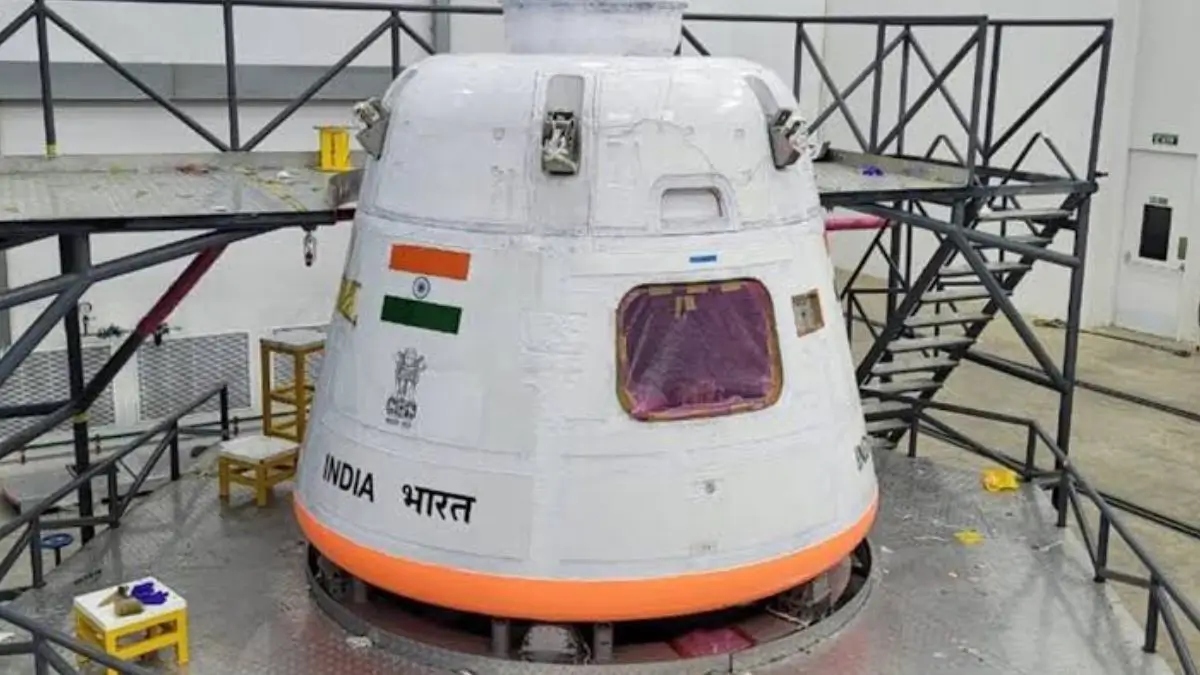
Astronaut safety is one of the most important parts of Gaganyaan. ISRO has developed and tested the Environmental Control and Life Support System, which is designed to provide suitable conditions for astronauts inside the Crew Module.
The system is expected to help control important factors such as air quality, temperature and pressure inside the spacecraft. These functions become especially important when astronauts spend time in the sealed environment of a spacecraft.
The Thermal Protection System has also been developed and tested. It will help protect the Crew Module from the intense heat experienced during atmospheric re-entry.
Another important system is the Crew Module Up-righting System, which is designed to help orient the crew module correctly after landing in the event of an unexpected landing position.
Crew Escape System Gets Extensive Testing
The Crew Escape System is designed to protect astronauts if a serious emergency occurs during launch. It can separate the crew module from the launch vehicle and move astronauts away from a dangerous situation.
The system includes five different types of motors. ISRO has carried out static tests and structural qualification work on these motors as part of the human-rating process.
Testing these systems on the ground before crewed missions is a major part of preparing for human spaceflight. Each component needs to perform reliably under demanding conditions.
Test Missions Build Confidence
ISRO has already conducted several precursor missions to validate important Gaganyaan technologies.
The TV-D1 test vehicle mission played a key role in testing the Crew Escape System. ISRO has also conducted two Integrated Air Drop Tests, known as IADT-01 and IADT-02, to check the performance of the spacecraft’s deceleration and recovery systems.
Such tests help engineers understand how the Crew Module behaves during different stages of flight and landing. The information gathered from these missions is being used to improve the systems before future flights.
Ground Facilities Are Being Prepared
Gaganyaan requires more than a rocket and spacecraft. India is also developing a large ground infrastructure network to support astronaut training, mission control and spacecraft preparation.
The programme includes the Gaganyaan Control Centre, where mission operations will be monitored. A dedicated Crew Training Facility is also being developed to prepare astronauts for the physical and technical demands of spaceflight.
The Orbital Module Preparation Facility will support spacecraft preparation, while upgrades to the Second Launch Pad at Sriharikota are being carried out to support Gaganyaan missions.
Vyommitra to Fly Before Astronauts
India plans to conduct another important step before sending astronauts into space. The first uncrewed experimental Gaganyaan flight carrying Vyommitra, ISRO’s humanoid robot, is scheduled for the fourth quarter of 2026.
Vyommitra will help researchers understand how the spacecraft environment and systems perform during an actual flight without putting human crew members at risk.
The uncrewed mission will provide valuable information about spacecraft performance, environmental conditions and other systems before human astronauts eventually fly.
India’s Long-Term Human Spaceflight Plans
Gaganyaan is also being developed as part of India’s wider human spaceflight ambitions. The programme is expected to provide experience that can support future missions beyond the first crewed flight.
India has also announced plans for the Bharatiya Antariksh Station, with the first phase targeted for 2035. The planned space station is expected to expand India’s capabilities in long-duration human spaceflight and scientific research in orbit.
With human-rating tests, crew safety systems, precursor missions and ground infrastructure progressing together, Gaganyaan is moving through one of the most important phases of its development.