
Global Baby Bust 2100: World Faces Historic Fertility Decline

Global Baby Bust 2100 a groundbreaking new study published in The Lancet has raised global concern by predicting that 97% of the world’s countries will experience below-replacement fertility rates by the end of this century. Conducted by researchers from the Institute for Health Metrics and Evaluation (IHME), the study warns that the world is entering a phase of “demographic division,” which could profoundly reshape economies, societies, and global power structures.
Thank you for reading this post, don't forget to subscribe!The findings paint a complex picture of a planet where many nations are ageing rapidly, while others continue to see population surges a contrast that could define global politics and economics throughout the 21st century.
Global Baby Bust 2100: Sharp Decline in Fertility Rates Worldwide
The new IHME analysis reveals that the total fertility rate (TFR) the average number of children born per woman must stay at 2.1 to maintain stable population levels. However, current data shows an alarming downward trend.
By 2050, around 155 of 204 countries (roughly 76%) are expected to fall below the replacement threshold. By 2100, this figure will rise to 198 nations, representing 97% of the world’s population.
Globally, the fertility rate has plummeted by half over the past seven decades from 5.0 in 1950 to 2.2 in 2021. Countries such as South Korea and Serbia have among the lowest fertility rates, each reporting fewer than 1.1 births per woman, far below the replacement level.
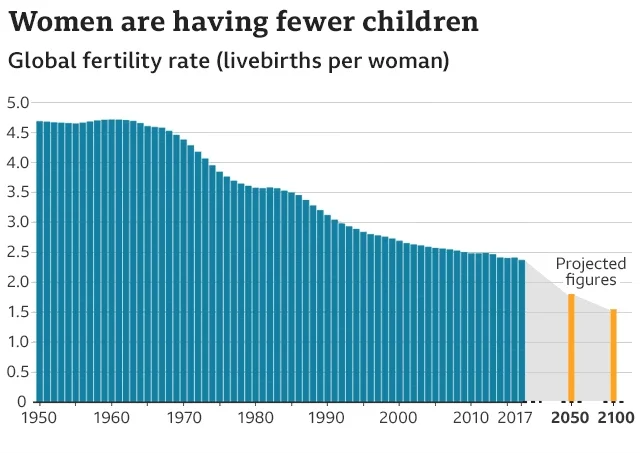
Researchers warn that such drastic declines will lead to shrinking populations in several countries, causing long-term social and economic challenges that could transform the way nations function.
Global Baby Bust 2100: Regional Variations and Population Imbalance
While fertility rates continue to fall in developed regions like Europe, East Asia, and North America, parts of sub-Saharan Africa are witnessing the opposite trend. Nations such as Chad record fertility rates as high as seven births per woman, more than double the global average.
This uneven demographic pattern is creating a dual challenge for policymakers ageing populations in wealthier nations contrasted with youth booms in developing ones.
In high-income regions, declining fertility is leading to rapid population ageing, smaller workforces, and rising dependency ratios, where fewer working-age individuals support a growing elderly population. Meanwhile, countries with young populations face high unemployment rates, education gaps, and resource shortages.
Experts describe this as a “demographically divided world”, where some nations struggle with population decline and economic stagnation, while others grapple with the social pressures of explosive growth.
Global Baby Bust 2100: Economic and Social Consequences
The projected global fertility collapse will have far-reaching implications for labor markets, pension systems, and healthcare infrastructure. In developed countries, the “baby bust” could result in shrinking workforces, which may hinder economic productivity and innovation.
Economists warn that nations like Japan, South Korea, Italy, and Germany may face significant challenges in sustaining their economies as birth rates continue to decline. The imbalance between retirees and working-age citizens will likely strain public finances, forcing governments to raise taxes or reduce benefits.
In contrast, low-income countries particularly in Africa and parts of South Asia may struggle to provide education, jobs, and healthcare for their rapidly growing youth populations. This could lead to increased migration pressures, urban crowding, and political instability in regions where governments are already stretched thin.
Professor Stein Emil Vollset, lead author of the IHME study, emphasized that demographic shifts will redefine the global landscape:
“Some nations will be facing the challenge of supporting the youngest, fastest-growing populations in resource-limited settings, while others will be navigating the complexities of aging societies with shrinking labor forces.”
These contrasting realities could shape the geopolitical balance, with developed nations competing for skilled migrants from younger, developing countries.
Global Baby Bust 2100: Demographic Transition and Global Power Shift
As fertility rates continue to decline in most parts of the world, the demographic transition could significantly alter global power dynamics. By 2100, regions such as Africa are expected to host a much larger share of the global population compared to Europe or East Asia.
For example, Nigeria is projected to become one of the world’s most populous nations, potentially surpassing countries like China, which is already experiencing population decline.
This shift could influence everything from global trade and diplomacy to climate negotiations and migration policies. Economies with stable or growing populations may gain geopolitical advantages, while countries with ageing populations could face declining influence on the world stage.
Global Baby Bust 2100: Key Facts and Insights
- By 2100, 97% of countries will have fertility rates below replacement level.
- Global fertility has dropped from 5.0 (1950) to 2.2 (2021).
- South Korea and Serbia report the lowest fertility rates, below 1.1 per woman.
- Chad has one of the highest fertility rates globally at 7 births per woman.
- Population ageing is fastest in East Asia and Europe, while Africa remains the youngest continent demographically.
These figures underline the growing population imbalance that will define global challenges in the coming decades.
Global Baby Bust 2100: Policy Challenges and the Road Ahead
Researchers and policymakers agree that urgent measures are needed to address the economic and social consequences of the fertility decline. Governments are being urged to design family-friendly policies, including affordable childcare, extended parental leave, flexible work options, and financial incentives for parents.
At the same time, experts recommend adopting ethical and well-regulated immigration policies to counter workforce shortages and maintain demographic balance.
Countries like France, Sweden, and Denmark have already implemented successful pro-natal policies that provide robust family support systems, leading to relatively stable fertility rates compared to their neighbors.
However, experts caution that policy solutions must also consider cultural attitudes, gender equality, and economic pressures that influence decisions about family size.
The study also highlights that as fertility rates fall and life expectancy rises, societies must rethink education, healthcare, and retirement models to remain sustainable.
Declining fertility, if not managed wisely, could redefine the global economy, altering power structures, trade relations, and migration flows. On the other hand, it also offers opportunities for innovation in automation, healthcare, and sustainable development.
As the Global Baby Bust 2100 unfolds, it challenges humanity to adapt to a rapidly changing demographic reality. The future will depend on how nations balance ageing and youth, stability and growth, and technology with tradition shaping the course of the next century.