
Gnani Artha AI

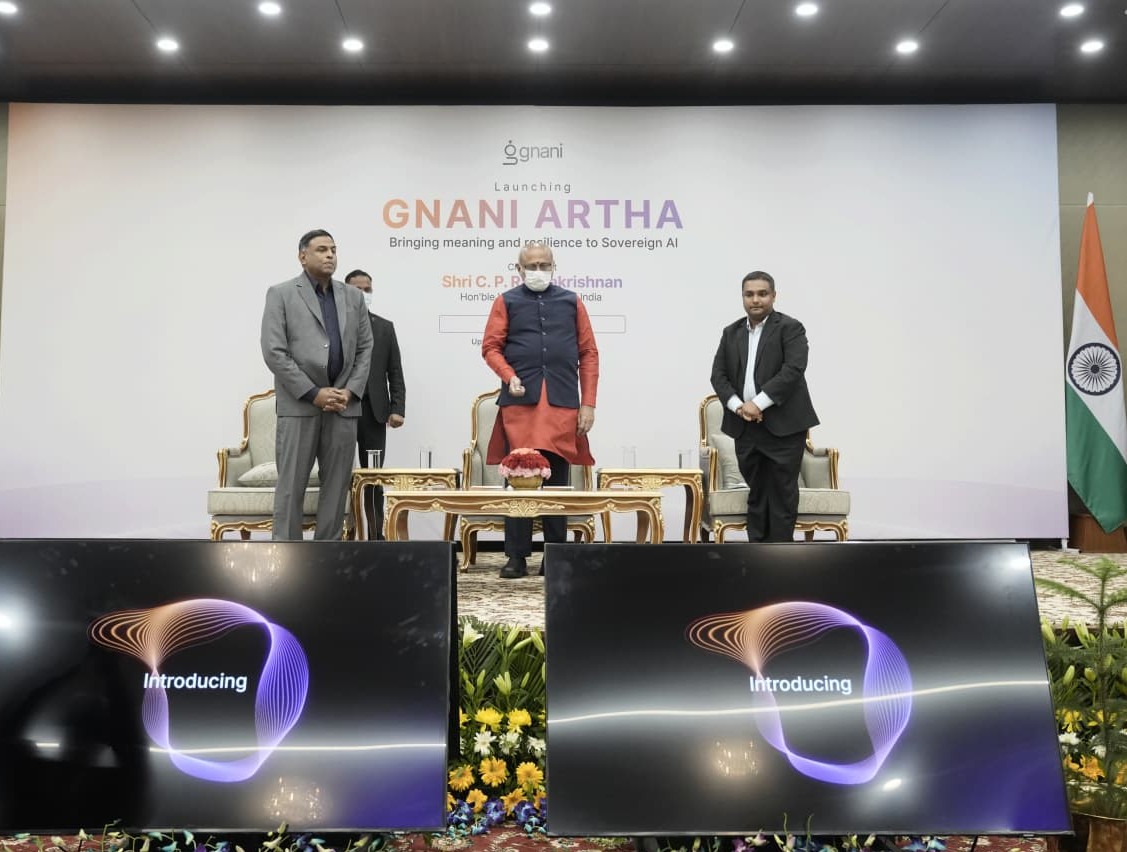
Gnani Artha AI is a new indigenous sovereign Artificial Intelligence (AI) stack launched in India to support secure and locally controlled AI deployment. Vice President of India C. P. Radhakrishnan launched the technology at Uprashtrapati Bhavan in New Delhi on 28 August 2026. Developed by Bengaluru-based voice and conversational AI company GNANI AI, the platform is designed to help Indian public institutions and businesses manage AI systems while keeping greater control over their data and technology infrastructure.
What is Gnani Artha AI?
Gnani Artha is designed as a sovereign AI stack, meaning it focuses on keeping data, computing systems and AI deployment under the control of Indian organisations. This approach has become increasingly important as governments and businesses around the world are looking for secure AI systems that can handle sensitive information.

The platform combines two major technologies: Evon v3.3 and Plexus. Evon v3.3 works as the foundation language model, while Plexus provides an enterprise platform for managing and deploying AI agents.
The development comes at a time when AI adoption is expanding rapidly in India. Government services, banking, healthcare, education, customer support and other industries are increasingly exploring AI-powered tools. Locally developed AI systems can help organisations address issues related to data control, language support and secure deployment.
Evon v3.3 Brings a Large AI Model
Evon v3.3 is an open-weights language model containing 30 billion parameters. It is based on a Mixture-of-Experts (MoE) architecture. Instead of activating the entire model for every task, the system activates selected parts of the model when processing each token.
According to the information released about the platform, around 3.5 billion parameters are activated per token. This approach is designed to make large AI models more efficient while maintaining their ability to handle complex language tasks.
The model has also been developed with a strong focus on Indian languages. It supports 11 Indian languages, which is important for a country where people communicate in many different languages and scripts.
Focus on Indian Languages
One of the notable features of Gnani Artha AI is its focus on Indian-language computing. AI systems often perform differently across languages because training data and digital resources are not equally available for every language.
Evon v3.3 uses a tokenizer designed for Indian scripts. The company says that its tokenizer uses around 20% fewer tokens per Indian-language word than the GPT-5 family and less than half the tokens required by some other major AI models, including DeepSeek, Llama and Qwen.
Lower token usage can be useful because tokens are an important part of the way language models process text. More efficient tokenisation can potentially reduce computing requirements and improve the processing of Indian-language content.
Open-Weights Model and Hugging Face Access
Evon v3.3 is an open-weights model, allowing its model weights to be made available to users under specified conditions. GNANI AI has made the model weights available on request through Hugging Face under the Apache 2.0 licence.
Open-weight AI models are becoming an important part of the global AI ecosystem. They can give organisations and developers greater flexibility in testing, adapting and deploying AI systems instead of depending entirely on closed commercial models.
For India, this also connects with the broader effort to build domestic AI capabilities and encourage local development of AI applications.
Plexus Supports Enterprise AI
The second major component of Gnani Artha AI is Plexus, an enterprise-grade agentic AI orchestration platform.
AI agents are systems that can perform a series of tasks based on a goal rather than simply responding to one question. Plexus is designed to help organisations deploy such AI agents across internal workflows.
This can have applications in areas such as customer service, document processing, business operations and other organisational tasks. The platform is intended for organisations that need controlled AI deployment within their existing systems.
Security and control are especially important for enterprises handling confidential business information. A sovereign AI approach can help organisations maintain stronger control over where data is stored and how AI systems access and process it.
Data Sovereignty Becomes More Important
The launch of Gnani Artha AI comes as data sovereignty has become a major issue in the development of modern digital infrastructure. Data sovereignty refers to the principle that data should remain subject to the laws and controls of the country or jurisdiction where it is stored and processed.
For public institutions, financial organisations and other sensitive sectors, control over data can be important for privacy, security and regulatory compliance.
A sovereign AI stack can potentially provide greater control over the complete AI environment, including models, data, infrastructure and deployment. This is different from relying completely on AI services operated outside the country.
Connection with IndiaAI Mission
The development of Gnani Artha AI also fits into India’s wider push to build domestic artificial intelligence capabilities. The IndiaAI Mission is a major government initiative aimed at strengthening India’s AI ecosystem through areas such as computing infrastructure, innovation, skills and responsible AI development.
India is also increasing its focus on indigenous technology in areas such as semiconductors, digital public infrastructure, cloud computing and advanced computing. AI has become another important part of this technology strategy.
The availability of AI models that can understand Indian languages is particularly relevant to India’s digital growth because large sections of the population use languages other than English for everyday communication.
Why Sovereign AI Matters for India
The growing use of AI creates opportunities as well as new challenges. Organisations need AI systems that can provide useful results while protecting sensitive information and meeting local requirements.
Gnani Artha AI addresses this requirement through its combination of a language model and an enterprise AI platform. Its focus on Indian languages, open weights and controlled deployment makes it part of the growing movement toward locally developed AI technologies.
The launch also highlights the increasing role of Indian technology companies in the country’s AI ecosystem. Bengaluru, Hyderabad, Mumbai, Delhi and other technology centres are seeing growing activity in AI research, software development and enterprise applications.
AI Adoption Across Indian Industries
AI is already being explored across several sectors in India. Banks use AI for fraud detection and customer services, businesses use it for automation, and government organisations are exploring AI for citizen services and administrative work.
Indian-language AI could further expand these applications by allowing people to interact with digital services in languages they are more comfortable using.
For businesses, enterprise AI platforms can also reduce the need to build every AI workflow from the beginning. Tools such as Plexus are designed to provide a structured environment for deploying AI agents and connecting them with organisational processes.
A New Step in India’s AI Ecosystem
The launch of Gnani Artha AI adds another development to India’s rapidly expanding AI landscape. With Evon v3.3 providing the language-model foundation and Plexus supporting enterprise AI agents, the stack combines language processing with practical organisational deployment.
Its emphasis on Indian languages and data sovereignty reflects two important needs in India’s digital future: making AI more accessible to diverse users and ensuring that organisations can maintain control over sensitive data.
As AI systems become more deeply integrated into public services and businesses, technologies that combine local language capability, secure deployment and domestic control are likely to receive increasing attention.