Megaloblatta longipennis World’s Largest Cockroach Explained

Megaloblatta longipennis, known as the world’s largest winged cockroach, continues to capture global scientific interest because of its extraordinary size, unique structure and deep evolutionary ties to tropical rainforests. Found mainly in the dense and humid forests of Peru, Ecuador and Panama, this rare species has been studied since the late 19th century. Its striking appearance and survival abilities make it one of the most remarkable insects ever documented in entomology.
Thank you for reading this post, don't forget to subscribe!Researchers have long been fascinated by how such a large cockroach evolved in ecosystems where most species remain small and inconspicuous. The discovery of multiple specimens across South and Central America has helped scientists understand the species’ biology, movement patterns and remarkable physical features that separate it from ordinary household cockroaches.
Megaloblatta longipennis: Extraordinary Size and Structure
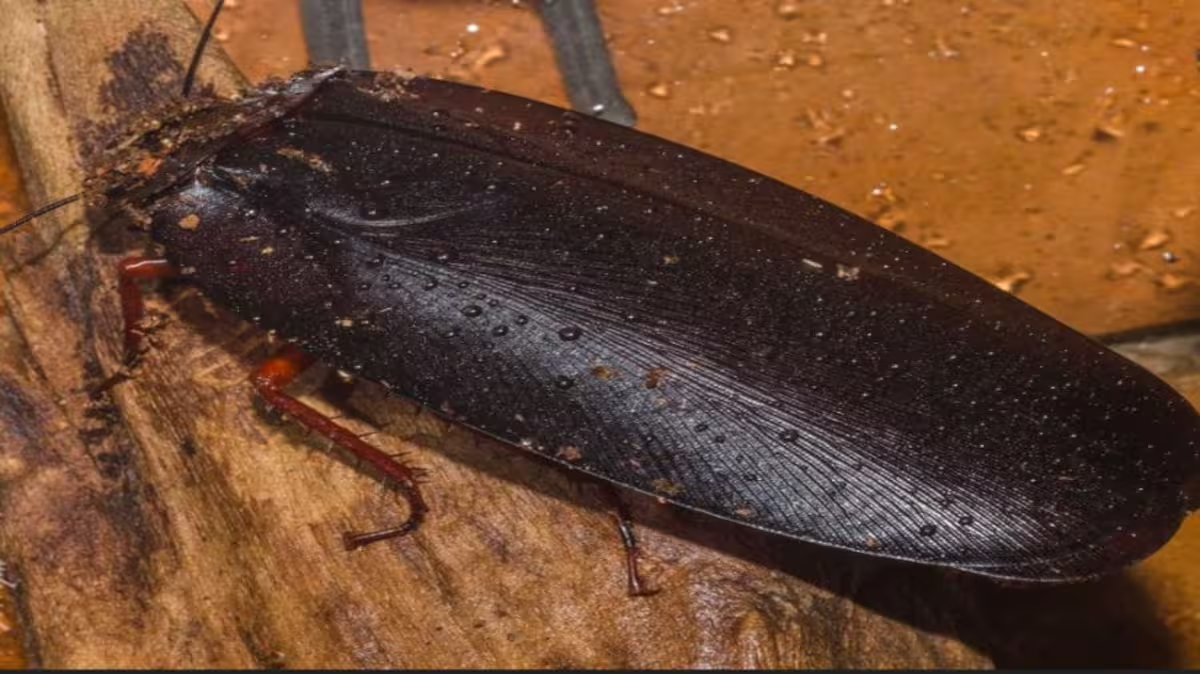
One of the reasons Megaloblatta longipennis receives so much attention is its unmatched size. According to global documented records, one preserved female specimen measured 97 mm in length and 45 mm in width, making it one of the largest cockroaches ever identified. Some individuals are capable of reaching wingspans of up to 20 cm, which allows them to perform short gliding movements between vegetation.
Physically, the species possesses an elongated, flattened body ideally suited for squeezing into tree bark layers, thick leaf litter and narrow spaces in humid forests. A wide, shield-like pronotum covers the head, offering protection from predators. Their legs are strong and spined, helping them to climb rough tree trunks and move swiftly on various surfaces.
The wings are among the most notable features. The top pair is firm and hardened, while the lower wings remain thin and flexible for functional gliding. Their ability to glide, although limited, serves as an effective escape tool when disturbed.
Megaloblatta longipennis: Classification and Taxonomic Identity
The species belongs to a rich and diverse insect lineage. Like all cockroaches, Megaloblatta longipennis is part of:
- Kingdom: Animalia
- Phylum: Arthropoda
- Class: Insecta
- Order: Blattodea
Within Blattodea, the species falls under the superfamily Blaberoidea, known for containing many unique and ecologically important cockroach types. It is placed in the family Ectobiidae and specifically in the subfamily Nyctiborinae. Members of this family often possess flexible egg cases and certain species are known to feed on decaying wood.
The genus Megaloblatta was first described in 1887 by German entomologist Heinrich Dohrn, a researcher who made significant contributions to early cockroach taxonomy. His work built the foundation for modern understanding of cockroach diversity across tropical ecosystems.
Megaloblatta longipennis: Early Discoveries and Scientific Studies
Research on this species spans more than a century. In the late 1800s and early 1900s, collectors and naturalists exploring Central and South American rainforests frequently mistook early specimens for related genera. As more samples were acquired, clearer distinctions were drawn based on body size, wing shape and structural details.
A major study in 1982 revealed one of the species’ most surprising traits. Scientists observed that the young developmental stage, known as nymphs, can produce loud defensive noises. These sounds come from rubbing special abdominal structures, a behavior believed to deter predators or signal distress.
Over the decades, distribution maps, behavioral observations and ecological studies helped define the species more accurately. Researchers learned that Megaloblatta longipennis thrives in areas with high humidity, thick vegetation layers and stable temperature patterns conditions common in tropical rainforests.
Megaloblatta longipennis: Habitat, Movements and Daily Behavior
The species lives primarily in lowland tropical forests, where dense plant cover provides protection and food sources. The ability to flatten its body helps it navigate beneath bark layers or between moist leaves. Being nocturnal, it stays hidden during the day and becomes active at night, reducing the risk of predation.
Gliding is an essential part of its movement. Although not a strong flyer, the insect uses its extended wings to glide short distances to escape threats or move between plants. This adaptation also helps conserve energy in humid environments where oxygen levels and temperatures can vary.
Rainforest conditions rich moisture, decaying plant matter and abundant microorganisms support the species’ diet and reproductive cycles. Size variations across regions suggest that areas with denser vegetation and richer soil produce larger individuals, possibly because of better nutrient availability.
Megaloblatta longipennis: Differences Between Males and Females

One of the most interesting characteristics of Megaloblatta longipennis is sexual dimorphism, meaning males and females differ in appearance. Males typically have:
- Longer wings
- Better gliding ability
- More slender bodies
These adaptations allow males to occupy higher canopy zones, where gliding between branches becomes more useful.
Females, on the other hand, possess:
- Broader bodies
- Wider abdomens
- Shorter wings
Their larger abdominal structures help carry developing egg cases. Female size and shape reflect their reproductive needs and contribute to their slower, more grounded movement within the forest layers.
Megaloblatta longipennis: A Remarkable Species of the Rainforest World
The continuing study of Megaloblatta longipennis helps scientists understand how insects adapt to large body sizes, survive in humid forest systems and evolve specialized traits. From its tremendous wingspan to its defensive sound-producing ability, the species remains one of the most fascinating examples of insect diversity in the tropical biome.
Its long history in scientific research and its rare physical characteristics ensure that Megaloblatta longipennis will continue to be a species of interest for entomologists, wildlife researchers and biodiversity experts worldwide.