NASA Explores Nuclear Option to Deflect Asteroid 2024 YR4

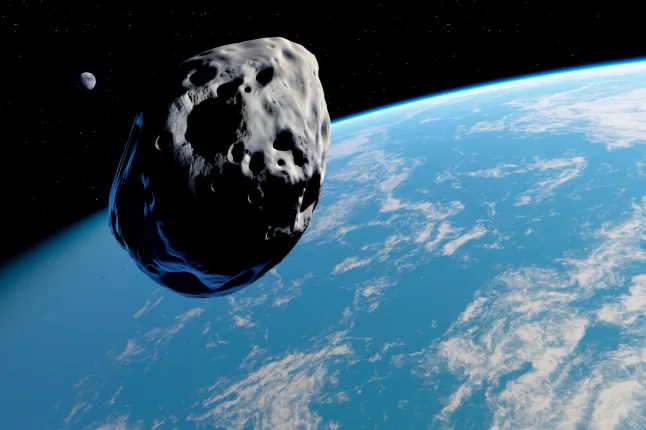
NASA Explores Nuclear Option as it intensifies studies on potential asteroid deflection strategies to prevent a possible lunar impact by asteroid 2024 YR4, a 60-metre-wide space object expected to pass near the Moon in 2032. Although scientists have confirmed that the asteroid poses no direct threat to Earth, its possible collision with the Moon has raised concerns about secondary space hazards especially those that could endanger satellites and future lunar missions.
Thank you for reading this post, don't forget to subscribe!The U.S. space agency has now launched an in-depth analysis of nuclear disruption techniques, marking a significant step forward in planetary defence planning. This research could set the foundation for how humanity responds to potentially dangerous asteroids in the future.
NASA Explores Nuclear Option: Renewed Focus on Planetary Defence
Asteroid 2024 YR4, discovered in December 2024, has become a key focus of NASA’s planetary defence programme. The object follows an orbit that occasionally intersects the Earth–Moon system, and recent observations have identified a 3.8% chance of impacting the lunar surface. While that probability might seem small, the potential consequences of a lunar strike have prompted NASA to take precautionary measures.
The agency, in coordination with international research institutions, is currently studying mission windows from late 2029 to late 2031 to prepare a response plan. Scientists emphasize that even a modest impact could create massive debris plumes, increasing micrometeoroid activity that could threaten Earth’s satellites, lunar bases, and human spaceflight missions.
Planetary defence experts note that the lessons learned from this scenario could help improve humanity’s preparedness for future asteroid encounters that might pose a more serious risk to Earth.
NASA Explores Nuclear Option: Kinetic vs Nuclear Deflection Approaches
Traditional asteroid-deflection missions rely on kinetic impactors, spacecraft designed to collide with asteroids to slightly alter their orbits through momentum transfer. While effective for smaller objects, this approach is insufficient for asteroid 2024 YR4, whose mass and velocity make it difficult to deflect with current spacecraft technology.
Recent analyses by researchers at NASA’s Jet Propulsion Laboratory (JPL) and data published on arXiv indicate that redirecting 2024 YR4 would require far more energy than any existing non-nuclear propulsion system can deliver.
As a result, scientists are exploring the nuclear deflection method, which provides a scalable and powerful impulse capable of significantly altering an asteroid’s path. Unlike kinetic impactors that rely on a direct hit, a nuclear detonation can impart energy remotely, reducing the risk of mission failure due to inaccurate targeting.
NASA Explores Nuclear Option: Physics of Nuclear Standoff Detonation
The proposed nuclear standoff detonation model involves detonating a nuclear device above the asteroid’s surface, rather than directly upon impact. This method ensures that the radiation and heat from the explosion vaporise a thin layer of the asteroid’s surface material, creating a burst of reactive thrust that changes its velocity.
By carefully controlling the detonation distance and energy yield, scientists can ensure the asteroid’s path is altered without shattering it into multiple fragments a major concern in direct-impact methods.
This approach eliminates the need for physical anchoring or surface contact, making it an ideal rapid-response solution when deflection timelines are limited. Researchers describe it as the most efficient last-resort option when conventional means of asteroid redirection cannot meet the required timeframes.
NASA Explores Nuclear Option: Exam-Oriented Key Facts
For readers and students interested in scientific data, here are the exam-oriented highlights from NASA’s current analysis of asteroid 2024 YR4:
- Asteroid Size: Approximately 60 ± 7 metres in diameter.
- Technique Used: Nuclear standoff detonation, not a direct impact.
- Mission Timeline: Potential launch windows between 2029 and 2031.
- Lunar Impact Risk: Estimated 3.8% probability of collision with the Moon by 2032.
- Potential Consequence: Temporary increase in micrometeoroid flux around the Moon, possibly up to 1,000 times normal levels.
- Energy Requirement: Beyond the capacity of current kinetic impactor technology.
These data points highlight both the scientific precision and engineering challenges involved in executing such a mission.
NASA Explores Nuclear Option: Policy and Engineering Challenges Ahead
While the concept of using nuclear energy in space sounds bold, it presents complex policy and legal challenges. International treaties most notably the Outer Space Treaty of 1967 and the Partial Test Ban Treaty restrict the use of nuclear weapons in orbit or on celestial bodies.

To execute such a mission, NASA would require global collaboration and United Nations approval, ensuring full compliance with international space law. The agency has clarified that nuclear intervention would remain a last-resort option, only employed if a verified and unavoidable threat to human assets or planetary safety exists.
From an engineering perspective, the mission would demand advanced propulsion systems, radiation-hardened spacecraft, and precision detonation technology. Current research in nuclear thermal propulsion and deep-space navigation may contribute to the feasibility of such missions in the near future.
If authorized, the mission could mark the first-ever demonstration of nuclear technology for planetary defence, setting a precedent for future global cooperation in asteroid threat mitigation.
NASA Explores Nuclear Option: A Turning Point in Space Safety
The case of asteroid 2024 YR4 represents not just a technological challenge but a policy and ethical test for humanity’s role in defending its celestial neighborhood. By evaluating nuclear disruption methods, NASA and its international partners are exploring every possible measure to ensure the safety of the Earth–Moon system.
While the asteroid poses no direct risk to life on Earth, its potential lunar impact serves as a real-world rehearsal for a future scenario in which a similar object could target our planet. Scientists believe that preparing for such events now could make the difference between catastrophe and control in decades to come.
The NASA Explores Nuclear Option initiative marks a critical step in advancing both planetary defence science and international space governance ushering in an era where humanity not only explores space but actively safeguards it.