




NASA PUNCH Mission Solar Wind Dynamics

The NASA PUNCH Mission Solar Wind Dynamics initiative, launched in 2025, marks a major milestone in humanity’s understanding of the Sun and its influence on space weather. Designed to study the solar wind and the Sun’s outer atmosphere, this mission is transforming how scientists visualize and interpret solar activity. As Earth experiences the current solar maximum a phase of heightened solar activity NASA’s PUNCH mission is providing crucial data to predict and mitigate the impact of solar phenomena on satellites, power systems, and communication networks.
Thank you for reading this post, don't forget to subscribe!NASA PUNCH Mission Solar Wind Dynamics: Overview of the Mission
PUNCH stands for Polarimeter to Unify the Corona and Heliosphere, reflecting its objective to study the Sun’s corona (the outermost layer of the solar atmosphere) and the heliosphere (the vast region of space influenced by solar wind). The mission’s four small satellites, known as “smallsats,” work together to create a complete view of how solar material flows outward from the Sun into interplanetary space.
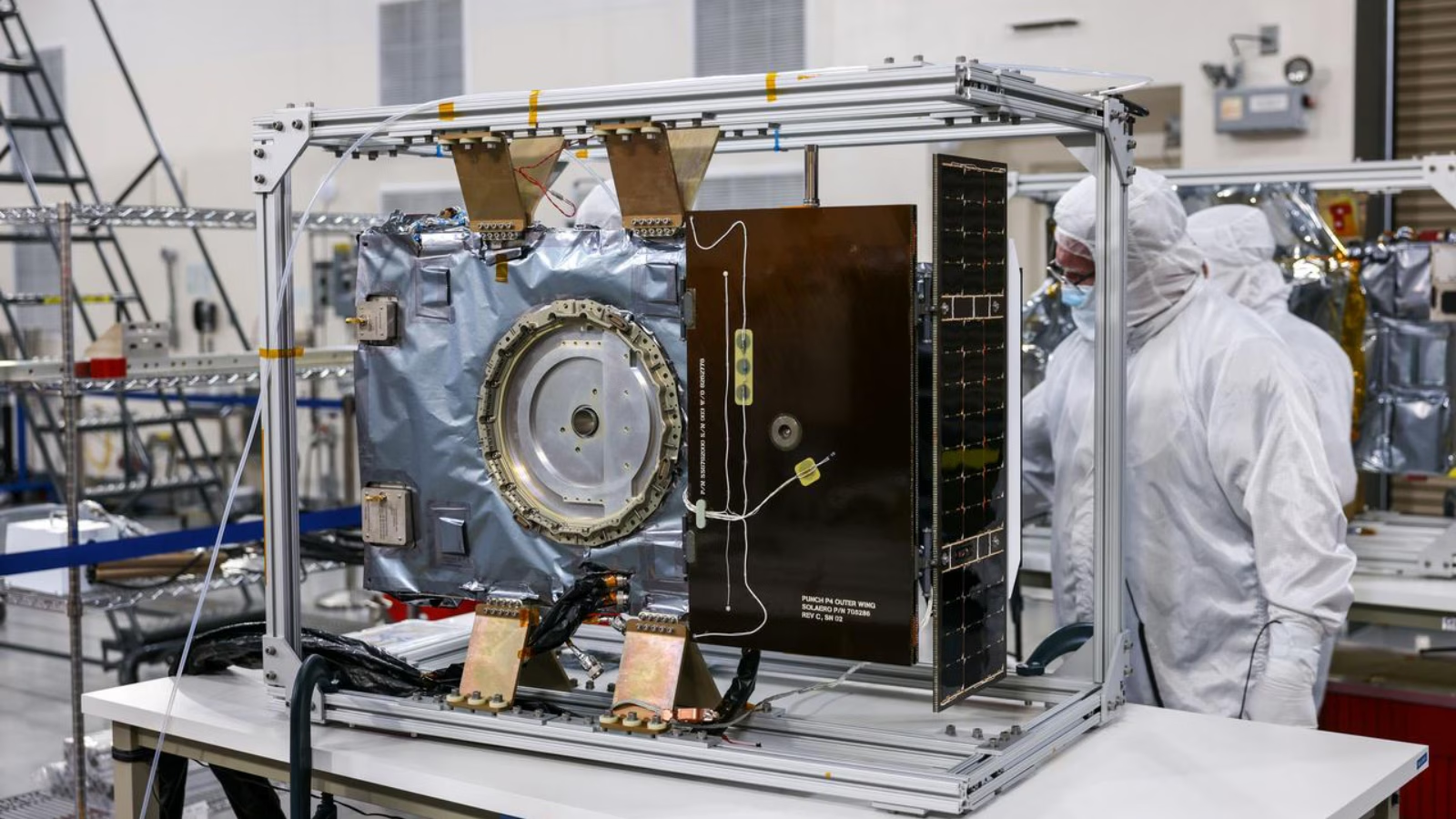
The NASA PUNCH Mission Solar Wind Dynamics focuses on understanding the transition zone where the solar corona becomes solar wind. Using advanced imaging polarimetry, PUNCH captures high-resolution, 3D visuals of solar plasma streams that were previously invisible to traditional telescopes. These observations allow researchers to analyze how solar wind structures evolve as they move away from the Sun and interact with the surrounding interstellar medium.
Scientific Importance of NASA PUNCH Mission Solar Wind Dynamics
Solar wind consists of charged particles mainly electrons and protons constantly ejected from the Sun’s surface. Though invisible to the naked eye, this continuous flow of particles influences Earth’s magnetosphere, space weather, and even climate patterns over long timescales.
Before PUNCH, scientists relied on indirect measurements or spacecraft data from limited vantage points. Now, with the NASA PUNCH Mission Solar Wind Dynamics, researchers can directly visualize these plasma streams in real-time. This ability helps track the formation and propagation of coronal mass ejections (CMEs) massive bursts of solar material that can trigger geomagnetic storms on Earth.
By improving our understanding of the solar wind’s behavior, NASA aims to enhance space weather forecasting models, reducing risks to astronauts, spacecraft, and sensitive technological systems.
NASA PUNCH Mission Solar Wind Dynamics During Solar Maximum
The timing of the PUNCH mission’s launch coincides with the solar maximum, a period of increased sunspot numbers and solar eruptions that occur roughly every 11 years. During this cycle, the Sun becomes more active, releasing intense solar flares and coronal mass ejections that emit radiation and charged particles into space.
The NASA PUNCH Mission Solar Wind Dynamics enables scientists to continuously monitor these events and study how they develop in the corona before spreading across the heliosphere. By visualizing these high-energy emissions, researchers can identify early warning signs of space weather disturbances that might affect Earth.
These observations are critical for mitigating potential damage to global communication systems, power grids, navigation satellites, and even commercial aviation routes that cross polar regions.
Applications of NASA PUNCH Mission Solar Wind Dynamics in Space Weather Forecasting
Space weather forecasting plays a vital role in modern technology-dependent societies. Solar storms can disrupt GPS navigation, cause radio blackouts, and even interfere with power transmission networks. The NASA PUNCH Mission Solar Wind Dynamics provides real-time data that helps space agencies and scientists predict these disruptive events more accurately.
By mapping the flow of solar wind particles and understanding their interactions with Earth’s magnetic field, researchers can issue early warnings to operators of satellites, spacecraft, and terrestrial infrastructure. This early warning system allows engineers to temporarily shut down vulnerable systems or place satellites into protective “safe modes” during major solar events.
Furthermore, the insights from PUNCH are valuable for space exploration missions. Future human missions to the Moon and Mars depend heavily on accurate space weather predictions to protect astronauts from harmful solar radiation. The data gathered by PUNCH contributes directly to improving radiation shielding and mission planning for deep-space exploration.
Technological Innovations in NASA PUNCH Mission Solar Wind Dynamics
The NASA PUNCH Mission Solar Wind Dynamics employs cutting-edge imaging technology capable of detecting faint sunlight scattered by electrons in the solar wind. These polarimetric techniques allow for 3D reconstruction of plasma structures extending millions of kilometers from the Sun.
Each of the four small satellites carries specialized instruments designed for continuous, overlapping coverage of the Sun’s outer atmosphere and the inner heliosphere. Together, they form a panoramic mosaic of solar activity, providing scientists with an unprecedented, full-sky view of the Sun’s influence throughout the solar system.
The smallsat architecture of PUNCH also demonstrates a cost-effective approach to space research, combining compact satellite design with high scientific output. This modular system allows for flexibility and scalability in future missions.
Collaborations and Public Engagement Through NASA PUNCH Mission Solar Wind Dynamics
Beyond scientific research, NASA has placed significant emphasis on public engagement and international collaboration for the PUNCH mission. The mission’s results are shared through global scientific conferences, public lectures, and educational outreach programs.

For example, a recent public event in Thiruvananthapuram, India, highlighted the significance of PUNCH’s early findings in visualizing solar wind streams. Collaborations between NASA, academic institutions, and research organizations across the world ensure that data from PUNCH benefits not just the U.S. but the global scientific community.
Through open data access and outreach, the NASA PUNCH Mission Solar Wind Dynamics continues to inspire young scientists and engineers, encouraging future innovations in solar physics and space exploration.
Future Outlook of NASA PUNCH Mission Solar Wind Dynamics
As the mission progresses, scientists expect PUNCH to redefine our understanding of the Sun Earth connection. By integrating PUNCH’s imaging data with other missions like the Parker Solar Probe and the Solar Orbiter, NASA aims to create a comprehensive model of how solar activity shapes the interplanetary environment.
In the coming years, findings from the NASA PUNCH Mission Solar Wind Dynamics will enhance our ability to predict space weather events, safeguard global technology systems, and deepen humanity’s knowledge of the Sun the source of all life and energy in our solar system.